Tsai Yueh-hsun and Black & White:Making Hollywood-Style Blockbusters
Kuo Da-wei / photos courtesy of Prajna Works / tr. by Chris Nelson
March 2012


Amid the upsurge of Taiwanese film that started in 2010, Tsai Yueh-hsun’s NT$350-million motion picture Black & White Episode I: The Dawn of Assault is second only to Seediq Bale in terms of budget, and is the highest-budget debut work in Taiwanese directing history.
Big budgets, big scenes, big action, elaborate imagery and texture, with no letups, this action thriller was shot by Tsai with Hollywood-grade excitement and suspense, setting a new benchmark for Taiwanese commercial film.
Tsai Yueh-hsun was born and raised in a movie-making family: his father was seasoned Taiwanese film director Tsai Yang-ming. Despite this advantage, the younger Tsai still started at the ground level in filmmaking, undergoing numerous failures and ruts in his career. Now, having made his mark in the TV industry, he has once again returned to filmdom. But when he decided to spend a huge sum of money on his first film, people asked, “Are you nuts?”
The answer is in the movie. Tsai Yueh-hsun seems to be echoing the words of the character Wu Yingxiong, played by Mark Chao: “You know, it takes guts to follow the right path!”
This statement comes from deep inside him: he wanted to prove that his 26 years of conviction and determination in this industry were indeed the right path.
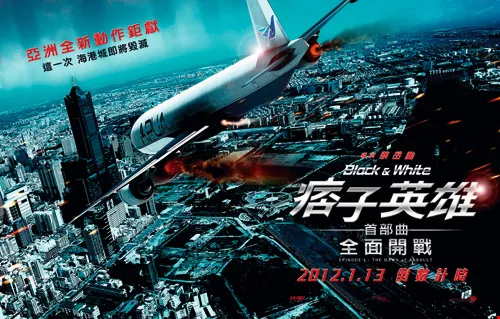
The scene in the movie Black & White in which an airplane collides with a skyscraper is a pioneering work in Taiwanese film production, giving viewers the chance to witness the directing prowess of Tsai Yueh-hsun.
Black & White started out in 2009 as a smash-hit TV drama, and the amount of effort Tsai and his crew made to graduate from television to film is inestimable.
Tsai’s dream of making a Black & White movie is not accidental. When he started shooting the TV series, he planned at the outset to create a two-season TV drama plus one movie. By the end of the first season, he had broadly expanded the characterization and plotlines, and he knew, based on the intense audience reaction, that the opportunity had come to make the movie.
Tsai knew he wanted to shoot a genuine Taiwanese police action movie: “We can shoot an action movie with more than just kung fu and depictions of police character,” says Tsai.
General manager Eric Shih of Warner Brothers Taiwan, who released Orz Boyz and Monga, supported Tsai by suggesting, “When going from TV to film, the first thing to do is to pledge to the viewers: ‘This will be a real movie.’”
This statement was like a shot in the arm, provoking Tsai to think seriously about how to present the scenes needed for a movie, and truly awe the audience.
In March 2010, Tsai announced that he would shoot it as a prequel, because by doing so he could shed the continuity constraints of the TV drama and think up the plot more freely.
“The appetite of Taiwanese viewers has been shaped by Hollywood movies, so we have to incorporate their techniques and rhythms into our social culture and character. In other words, we have to look to the Chinese world for material and the West for technique. The amount we spend has to be large for viewers to see the effects they expect,” says Tsai, who decided to go big.
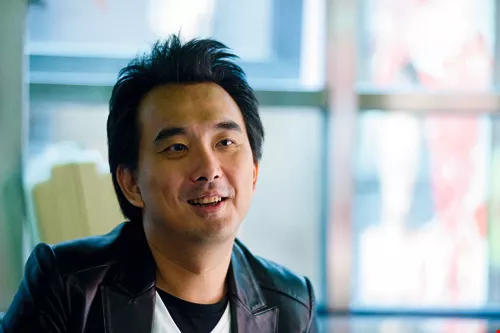
Tsai and his wife Yu Hsiao-hui cooperate closely in home life and at work. Tsai’s vision for his future is to become a producer, helping foster talented new Taiwanese directors.
To shoot a world-class action flick, Tsai specially invited Cyril Raffaelli, martial arts instructor for French director Luc Besson’s Taxi 2, to come to Taiwan and provide intensive fitness and stunt training to actor Mark Chao.
When Tsai confirmed the movie title as Black & White Episode I: The Dawn of Assault, and officially made public that the lead roles would be played by Mark Chao and mainland Chinese star Huang Bo, he even voiced an astonishing statement: “For one key scene involving fights and explosions on a high-altitude plane flight, we have changed our plans to shoot in Canada. Instead we will spend NT$15 million to import real airplane parts from the US to Taiwan, and another NT$5 million to assemble the set, and film in Taiwan’s first-ever studio, in Kaohsiung, built exclusively for shooting airplane scenes.”
Before the 2012 Chinese New Year holiday, Black & White was test screened in Taipei and Kaohsiung to ecstatic audiences. Tsai managed to shoot convincing scenes of a helicopter strafing the ground with rockets, the main character jumping from a building dozens of stories tall to chase the bad guys, and a fight that transitions from the inside to the outside of an airplane, all of which rivaled the thrilling scenes of Hollywood movies.
For instance, regarding a scene in which a bad guy who had brought a deadly weapon onto a plane is preparing to bail out, Tsai reveals that before filming the scene, everyone thought he was crazy. “Just shoot it overseas,” they said. “Why import an entire airplane? And what’ll you do with it anyway when you’re done?”
“For Taiwan’s movie industry to upgrade, we need professional equipment which can be reused, and can even attract overseas moviemakers to Taiwan,” says Tsai.
Another example is the opening scene, featuring a nuclear explosion in a desert, which is reminiscent of the desert scene in Transformers: Revenge of the Fallen. This scene wasn’t filmed overseas either, but in a vacant landfill by the sea near Kaohsiung’s Nanxing Project. The crew brought in eight truckloads of grit used for landfills, 64 wind machines were switched on, and Tsai filmed a sandstorm worthy of a Hollywood movie.
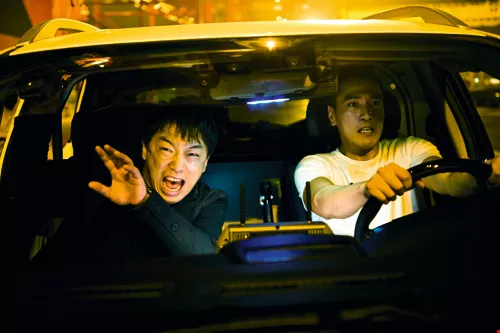
In the movie, mainland Chinese actor Huang Bo (left) and Taiwanese actor Mark Chao play the funny man and straight man respectively, working together seamlessly.
Shooting scenes requires money. For instance, it took NT$20 million to shoot the scene inside the plane. But when he started filming, he had just NT$110 million available, not even a third of the needed amount. How were such large sums financed?
Tsai did have access to a NT$24-million strategic subsidy from the Government Information Office. But Double Edge Entertainment, which had agreed to invest, suddenly pulled out, leading to a major deficit in funds and keeping Tsai awake nights.
Says Yu Hsiao-hui, the movie’s producer and Tsai’s wife, “Later, a buddy of his who he’d known for over 20 years made a special trip back from America to work as the movie’s account director, in charge of soliciting companies for funds. When they had budget problems, he convinced institutions like Chinatrust and the Ministry of Economic Affairs’ Small and Medium Enterprise Administration not to pull out, but instead to increase their investments.”
The movie’s largest stakeholder was Pac-Link Capital, part of the Yulon Group, which invested over NT$100 million. Through product placement, Yulon’s brand Luxgen accompanies the main character in car chases; this is equivalent to a free ad for the brand. This necessary business technique also increased companies’ willingness to invest.
The more outside support they got, the more exacting their internal operations became. When Tsai was shooting TV dramas he was known for being fussy; when graduating to film he became “super-fussy.”
To film the scene where Mark Chao grapples with enemies while hanging outside the airplane, he and director of photography Mark Lee spent three days beforehand discussing the camera positioning.
Once when a crew member was harassed to the verge of breakdown by Tsai’s “super-fussiness,” he complained, “What more do you want? Nobody’s slept for days.”
Black & White is a statement from Tsai’s heart: “The ‘black’ and ‘white’ parts are opposite extremes of personality, and people have a certain amount of each. Inside everyone there’s a courageous Wu Yingxiong; we just need to see when he comes out and how far he goes.”
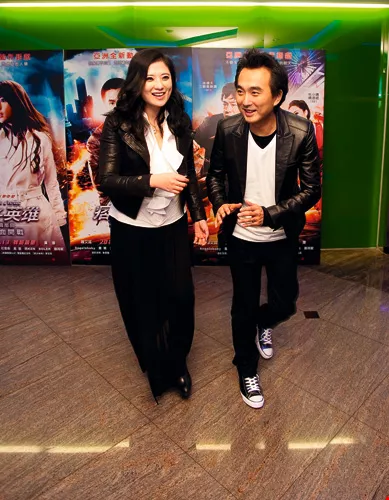
Tsai and his wife Yu Hsiao-hui cooperate closely in home life and at work. Tsai’s vision for his future is to become a producer, helping foster talented new Taiwanese directors.
Born in 1968, Tsai grew up following his father to different film locations. Filmmaking has been his aspiration and his mission. When he was 18 he entered the filmmaking world, undertaking on-the-job training as his father’s log keeper.
Once an actor, Tsai Yang-ming later became a director. But he found directing to be taxing work, and it was difficult to make films that stood out from the crowd. Hoping to create a better future for his son, he cast Tsai Yueh-hsun in the lead role of his 1992 movie Joe-Goody, hoping this would launch young Tsai to stardom; however, the film didn’t do as well as hoped.
Thereafter, Tsai Yueh-hsun’s life and work became trapped in a rut until 1996, when on the recommendation of variety-show host Chang Hsiao-yen, he directed the series Music Love Stories. Through this experience he learned how to control plot, rhythm, camerawork, and the actors, establishing the foundation of his subsequent work shooting so-called “pop-idol dramas.”
In 2001, Tsai saw a great transition in his life. The TV drama he directed was DaAi TV’s Where There Is Love, and afterwards he took on the pop-idol drama Meteor Garden. The former series, which was more cultural in nature, clinched the Best Series award at the Golden Bell Awards, while for the more commercial latter series he won Best Director. Tsai chose to follow the latter route, determined to be a commercial film director who embraced the audience.
During the following few years, Tsai’s works, though not many, were all heavyweights, including Friends, Mars, The Hospital and 2009’s Black & White. He became one of the few brand-name directors of Taiwanese TV with guaranteed viewership.
Back then, Tsai was often asked if he’d ever make another movie. He would reply, “You’ll need to wait a bit until I hone my way of communicating with the audience, and find suitable commercial material.”
This “wait a bit” soon became 10 years. Things change after a decade: Tsai changed in some ways but has also remained the same. Yu Hsiao-hui remembers it all well: “Before, he was like a child with a bad temper. Shooting The Hospital was especially difficult, and he felt that a lot of people were in opposition to him. Knowing the hard work he did, why didn’t everyone understand? He was angry every day at work,” she says.
Perhaps the anger reached its peak. When Tsai turned 40, he suddenly came around: “Every scene contains the spirit of the director. Whatever spirit the director has when shooting a film, the audience will feel it. To bring happiness to the audience, the director needs to film with a joyful spirit,” he says.
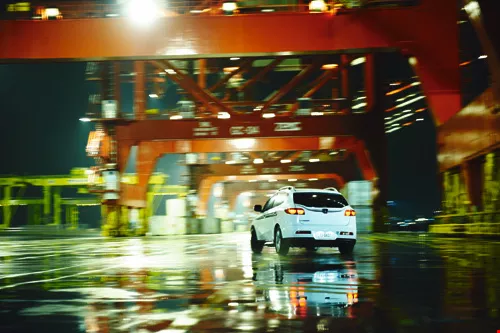
The thrilling scenes in Black & White, including car chases, have attained the standard of international action film.
Looking at today’s Taiwanese filmdom, partners like Tsai and his wife Yu Hsiao-hui are few. They do all promotions and publicity work as a couple. But how do they separate their private and work lives?
Yu admits, “It’s really hard. Sometimes when we have disagreements at work, I get confused: our feelings for each other are so deep, so why do we have to fight so often about work? And then when we go home we just pretend nothing happened.”
As to who blinks first, she says with little hesitation, “Of course it’s me. How could ‘Wu Yingxiong’ blink first? We’re different from how we appear: I look strong, but he’s really the stronger one, and we need to respect him.”
Though he doesn’t blink easily, he is a good father. Says Yu Hsiao-hui, when not filming, Tsai dotes on the children and enjoys organizing the house. He loves cooking, preparing everything from simple mapo doufu to banquet-grade abalone chicken soup; he checks recipes, learning and refining his technique.
Married over decade, Yu Hsiao-hui says frankly, “He gives less time to his family and more to the audience. The kids and I know he’s busy, and we adjust our time to be with him.”
Because of his upbringing, filming is in Tsai’s blood. “In the early years, a Taiwanese director was like an emperor. Once on the set, everything needed to be done right, and the director just sat in the director’s chair giving orders. This is not the case at all now; directors of our generation like Niu Chen-zer or Giddens Ko not only need to know their work, they also need to know how to deal with people,” says Tsai.
As a scion of a Taiwanese directing family, Tsai has been greatly influenced by his father.
“Everyone was impressed by my father’s Gangland Odyssey in which Alex Man won the Golden Horse Award for Best Actor, but in fact, before that, he filmed Taiwan’s first social commentary film The First Error Step, shooting scenes at Huaxi Street, getting local gangsters to help out. So when he was filming indoors, the gangsters were fighting for turf outside. Even then he was a director who dared to film materials that the audiences loved to watch,” says Tsai.
“Lots of people say I’m fussy, but my father’s even more so, reluctant to shoot if the weather and lighting aren’t just right. For Big Land, Flying Eagles, he needed to shoot a scene of people flying out of the desert. It was just around Chinese New Year and it was raining, so he sent some crew members to Baishawan to bring back some sand, and cooked it dry in a big metal wok, since wet sand won’t blow away. Each time director Li Hsing saw my dad, he’d say, ‘You’ve forgotten how scary you were before,’” says Tsai, smiling heartily, his expression exuding admiration.
Yu Hsiao-hui has considered making her father-in-law’s long and winding life into a movie.
When Tsai Yang-ming was born, his family left him for dead, thinking he was stillborn. Luckily a relative discovered that he was still alive, and his life was spared. Once when he was falsely accused of stealing money as a child, he jumped into a well to kill himself, but was rescued. Like a blade of grass, he lived a tough and lowly life. After growing up he made a vow at the temple in Beigang that he’d one day be a movie star. Everyone laughed at him, but it turned out that he really became a star.
Yu Hsiao-hui says that the aim of this film would not be to praise her father-in-law, but to record the history of Taiwanese film through his life, and to record an era of Taiwan and the “vitality and fighting spirit of the little guy.”
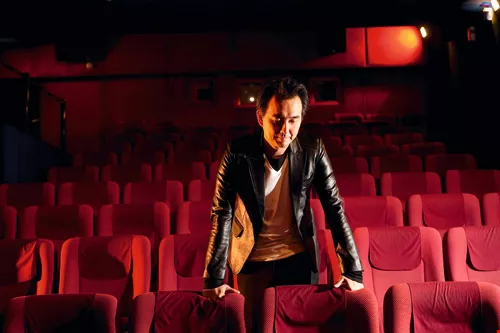
Tsai, who built his career filming TV drama series, has recently crossed over into filmmaking, pursuing his ambition to bring Taiwanese film into the international arena.
Tsai Yueh-hsun has attained his dream of directing, but this is not his ultimate goal. One day he hopes to become a producer.
Says Tsai, “Working as a director, I’ve gone through many clashes and have fumbled about a lot. Now that I’ve gained some resources, I hope to help more young directors flesh out two-dimensional scripts into three-dimensional forms suitable for shooting, and assist them in mapping out comprehensive filmmaking environments and finding the right marketing channels, so they can do it on their own.”
Having experienced first hand the changes in Taiwanese film over the last 30 years, what does Tsai think about the future of Taiwanese film?
“Taiwanese film must become strong and independent. Self sufficiency is important: we should develop robust business mechanisms and market structures to boost the audience’s confidence and interest in Taiwanese movies, so that the film industry will thrive,” says Tsai.
“Taiwanese movies must also go beyond Taiwan, getting in line with other Mandarin-language films. Taiwan and mainland China share similar language and culture, and the mainland Chinese market is so big. If it’s possible to combine the finances, manpower and resources on both sides of the strait, and carefully select subject matter to make ‘borderless’ Mandarin movies, then Mandarin film will be more competitive and influential in Asia and even the world,” he says.
The subject matter of Black & White is chock full of the commercial elements that Asian viewers love. Featuring a mainland Chinese star, Huang Bo, plus Hong Kong star Alex To and the Hong Kong-based model/actress Angelababy who’s big in Japan were all conscious efforts on the part of Tsai to promote this Taiwanese movie to mainland China and elsewhere in Asia.
“Before filming any scene, you have to first think of the audience and the market. This is something I learned when filming Meteor Garden: it deals with subject matter that’s loved by women, and the addition of beautiful people makes it a common language for Asia, selling well everywhere. You Are the Apple of My Eye sells well in Greater China, and this is because the plot is able to resonate widely,” he says.
Says Tsai, “When I saw that the renowned US special-effects company Rhythm & Hues Studios chose Taiwan over Korea, setting up a visual effects center in Kaohsiung, I really needed to express my thanks to director Ang Lee for persuading the company to do so, thereby helping strengthen the competitiveness of Taiwanese film.”
Tsai, a great admirer of Steven Spielberg, hopes that Taiwan will become an important base for Hollywood filmmaking: “Whether I’m a director or a producer, I’m looking forward to seeing such cool things happen.”
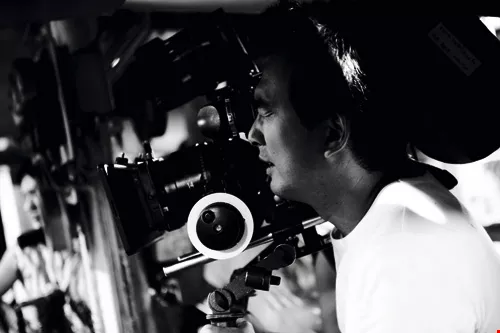
When filming, Tsai is meticulous about every detail, demanding perfection. This earned him his reputation for fussiness.
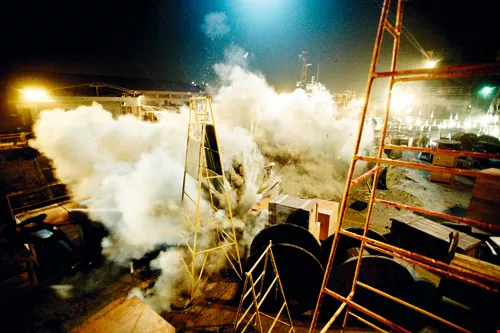
Black & White contains enough explosions and action scenes to require a total budget of NT$350 million.

@List.jpg?w=522&h=410&mode=crop&format=webp&quality=80)


