From Mid-Life Crisis to Critical Acclaim: Kuo Wei-kuo
Teng Sue-feng / photos courtesy of Kuo Wei-kuo / tr. by Phil Newell
June 2008


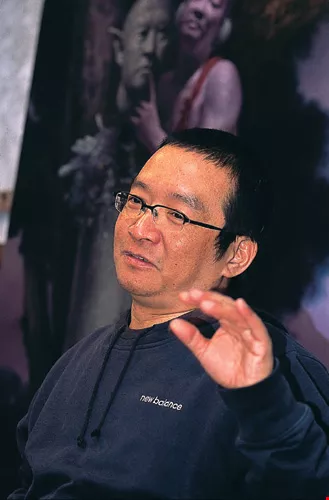
By the end of 2007, after the sales by Christie's of Hong Kong and Zhong Cheng Auctions in Taipei, Kuo Wei-kuo had become the most sought-after personality in the ethnic Chinese art world.
Angel in Butterfly Dress, one of the works in Kuo's series of self-portraits, which shows a winged, half-naked middle-aged man sitting on a tiled rooftop, looking amused as he gazes directly at the viewer, sold for NT$2.53 million. An older work, Taiwan Island, produced 14 years ago, rewrote the record books for contemporary Taiwanese art, changing hands for an astounding NT$18.13 million.
Kuo Wei-kuo, whose personal and painting pathways have been filled with trials, has not had his head turned by the stunning prices his art has been getting. In fact, he reminds himself, "When things start churning, beware of seasickness!"
"I am a sick man. I am a spiteful man. I believe my liver is diseased. However, I know nothing at all about my disease, and do not know for certain what ails me.... I am 40 years old now, and you know 40 years is a whole lifetime; you know it is extreme old age. To live past 40 is bad manners, is vulgar, immoral."
At the time of Kuo Wei-kuo's 2002 exhibition of self-portraits, called "Commotion and Desire," artist Lai Chiu-tsen quoted this passage from Dostoevsky's Notes from the Underground (1864) as his interpretation of the psychological world depicted in Kuo's paintings. Notes from the Underground describes the feelings of terror, contradiction, anxiety, and dissatisfaction of a low-ranking, lonely tax collector, at once self-important yet lacking in self-esteem, as he reaches 40 years of age.
Artist as poser
The self-portraits in the "Commotion and Desire" series express a joyous mood resulting from Kuo's rediscovery of a long-neglected creative potential, a rediscovery made possible by Kuo's finding the courage to reveal his true self.
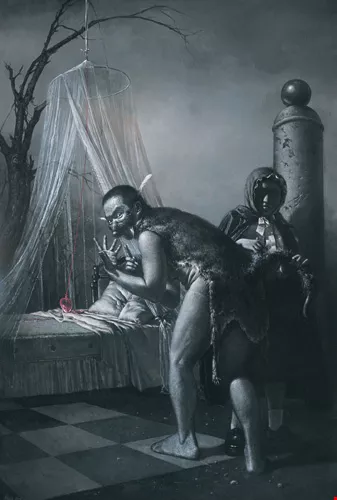
In these works, the painter-as-model is inserted into surrealist fantasized settings, showing vastly different facial expressions and bodily postures, the eyes ranging from somber to sarcastic. In one the figure is seated, almost completely nude, on a wooden horse, in another hidden in a riot of vines. Yet another consists of a torn "photograph" of the painter's face leaning against a withered tree. Through "embedding" himself in each painting, Kuo opens the door to the greater theme of "self-discovery."
Take for example Where is My Home? Depicting a short fat man wearing bikini briefs, a pack strapped to his back, holding an open black umbrella and walking toward a wooden carousel horse symbolizing childhood joys, the work is rich in a mood of nostalgia for childhood days. In Red Ribbon, a man with somber eyes and monstrous bat-like ears stares straight out at the viewer as he drifts amidst dreamlike red ribbons floating past. The artist-as-tortured-beast symbolizes Kuo's own repressed emotions.
Or take a look at the 2.8-meter-wide painting Secrets of the Rear Garden. Kuo has ensconced himself in a giant sliced-open fish. Off to one side, in a bathtub with bestial feet, is an enormous bright red heart. A wall forming the backdrop, crumbling in places, is in one spot pierced by tangled tree roots, and in another partly hidden behind soft red silk suspended from bone and meat floating in air. The absurd, obscure setting expresses the early loss of Kuo's father, and his feelings about being raised single-handedly by his strict, tough mother. (Kuo uses the fish as a metaphor for the maternal womb.)
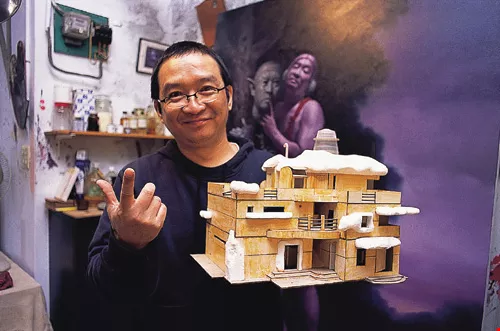
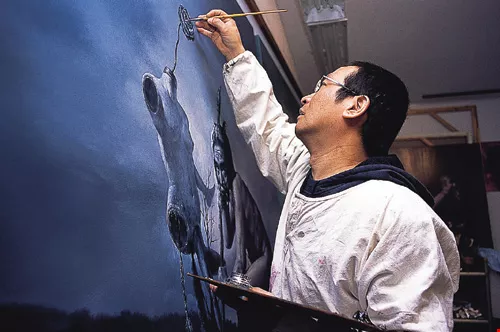
The production process for each painting starts with Kuo photographing himself, with his chosen posture and facial expression, in his studio. Then, after printing out the photo, he meticulously paints it onto the canvas. Finally he begins slowly adding background, attire, and props until the work is complete. On average it takes three months to do a large-size composition.
The "three me's" that are part of each painting-the photo, the subject on the canvas, and the artist himself-give Kuo a feeling like that of meeting a once-intimate friend after having lost touch for many years: familiarity, but also distance and strangeness.
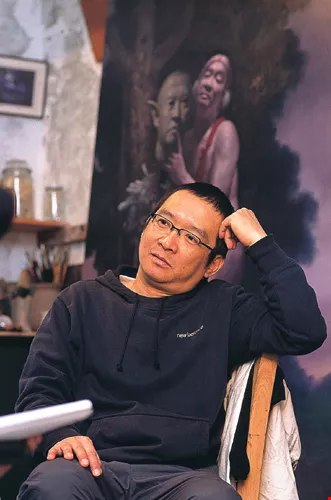
"Imagination has no boundaries. Sometimes I imagine that my soul has left my body, and it feels like I am actually in the painting, looking out." In his studio in the rooftop apartment in Taipei's Neihu District that is also his home, Kuo, gazing at three half-finished works hanging on the wall, is reluctant to analyze his own creations, because he really doesn't want his deepest inner secrets to be leaked out for all to see. But at the same time he uses symbols in the paintings that tear off his soft facade and reveal his subconscious self. And it brings him confidence and liberation to see this inner self in his works.
AWOL from art
Kuo, born in 1960, studied in the art department at Fu-Hsin Trade and Arts School. Feeling himself drawn deeper into the palace of visual culture, he decided that he would make fine arts departments his first choice on the university entrance exam. But the first time he took the exam, he scored only 99 out of 600. On his second try, he finally tested into Chinese Culture University. He worked with dedication to make the most of this hard-won academic opportunity, and, in the liberal and open-minded environment that then characterized the Department of Fine Arts at CCU, he developed an outstanding and very personal realist technique.
After graduating in 1984, for a short time he ran a gallery, but it was not a financial success. After getting married, to make ends meet he started up a company specializing in building exteriors. As the business grew, he ended up with a staff of five and monthly revenues in excess of NT$1 million. But during this period of being entirely "absent without leave" from art, he could never fully ignore the aspiring soul within him.
In the summer of 1992, two of his older schoolmates from CCU, the painters Wu Tien-chang and Lu Hsien-ming, came to see him, and gave him a good talking to: "Are you going to paint, or what? If you don't paint, then the history of Taiwanese art will be missing your page. Otherwise you might as well focus entirely on making money, so at least you can collect our paintings!"
Just a few days later, Kuo suddenly closed his company, and took up his brush once again. But the results proved nearly unbearable. Kuo considered his 1996 one-man exhibition, called "Scenery of Desire in the Dark," held at the Taipei Museum of Fine Arts, "an enormous failure."
In the mid-1990s, official agencies-including the national government's Council for Cultural Affairs and museums at the county and municipal levels-were strongly pushing artists to participate in the Venice Biennale and other global art showcases. Numerous local events held under the banner of "exporting art" became the screening process by which Taiwanese artists became supported and renowned, or were left by the wayside. In this process, artists working in the fields of installation art, video, mixed media, and new concept art suddenly became the center of attention.
A lot of Kuo's friends tried to persuade him: "Give up painting! The way to go now is installation art; traditional painting has been relegated to the attic!" Losing confidence in himself, Kuo began to "installation-ify" his two-dimensional paintings, surrounding works with comics, film, betel-nut stands, and other elements of contemporary mass culture, as well as using media like flashing lights or glitter.
Sadly, as Kuo says today, "The works in the 1996 show with the greatest visual impact were in fact just sound and fury, signifying nothing. They did nothing to express my genuine inner world, and merely revealed my own emptiness and inadequacy. I couldn't see myself anywhere in a single one of those works."
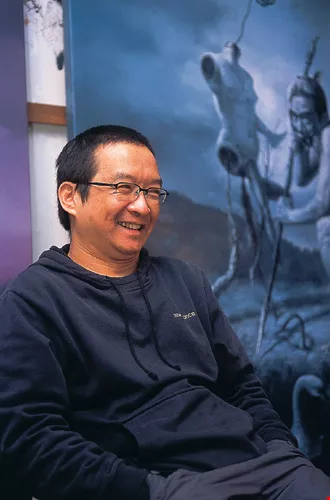
At the low point of his life, the 48-year-old Kuo Wei-kuo courageously faced up to his true psychological state and, through the "Commotion and Desire" series of self-portraits, rediscovered the joys of creating.
Diagnosis and therapy
This sense of anxiety left Kuo, then nearing 40, beset by personal demons. For more than a year, he could not take up his brush and was unable to create anything. At that time, with a five-year-old daughter to look after, Kuo's wife started up a day-care center. Kuo worked as kiddie chauffeur, picking the children up and taking them home again. Two years later, after their daughter entered primary school, they closed the center.
"Degraded, completely lost, in turmoil," is how Kuo describes himself then: "1997 was my darkest year." Then one day he picked up a discarded bathroom mirror from the roadside and installed it in his studio. Like a magic mirror in a fairy tale, it reflected back to him his deepest inner self, and he painted his first self-portrait, with glasses and a flat-top haircut, set against a backdrop of colorful cloudy skies.
Deciding to accept himself and his art on their own terms, he turned to the realist drafting skills which were once a great source of pride in order to prove that he could still paint. Through meticulous observation of the subject, he began to listen once again to his deepest inner voice, and the creative attitude and concepts of his past were recalled one by one from his dusty memory.
He recalled to mind his third year in university, when each evening after classes he would go to the hospital to look after his father, who was suffering from esophageal cancer. "Human existence is solitary. No matter how close to you family members or partners may be, they cannot go with you when you die, and in the end we all pass away alone."
Around that time, purely by chance, Kuo came across a catalogue of works by the Dublin-born British painter Francis Bacon (1909-1992). The distorted, exaggerated depictions of bodies and faces carried a powerful message of sickness, self-destructiveness, and schizophrenia. Stunningly powerful, they inspired Kuo to the realization that "there is also a kind of beauty in tragedy."
Like his own stricken father, Kuo was suffering from an illness. Unable to find or define himself, he knew he had symptoms, but was unable to locate the cause. But today, by depicting on canvas all the symptoms of his life experience, the paintings of the "Commotion and Desire" series are his form of self-diagnosis and therapy. They are the "charts" of his illness, his "medical records." Finally, he had recovered the confidence to create.
The man in the mirror
At that point there was a dramatic transformation in Kuo's style. By way of contrast, look first at the earlier (1993) series "Luminescence and Tension." In these cold, bizarre paintings, there often appear wriggling organic tubes, sharp metallic saw teeth, and hard geometric frames and structures. Offering opposition and inharmonious visual tension against the surroundings of boundless chaotic spaces, they were considered to be "social paintings" replete with a sense of conflict.
The "Commotion and Desire" series, on the other hand, mixes classical realism with surrealist painting techniques. It voluminously displays metaphorical symbols belonging to the artist's personal memories, such as spring water that represents spiritual purity, cloudy skies representing homesickness, silk material representing the softness of his own personality, and man-beasts representing wild lusts. These depict a conscious realm of narcissism, self-absorption, and self-pity.
"Character is decisive. The more other people told me that traditional painting had no future, the more I refused to go along with the current," says Kuo. In 1998, Kuo and two other CCU graduates, Yang Mao-lin and Wu Tien-chang, formed the Handtoo Art Group, in order to defend two-dimensional art. Through their actions and their creative works, they stood stoutly against the cresting wave of three-dimensional new media.
The middle-aged, 165-centimeter-tall Kuo Wei-kuo does not cut a very handsome figure. But he boldly chose to feature his own short, overweight body in his 1999 exhibition "Commotion and Desire," with the intention of "reversing the verdict" on his previous failure.
Then in 2001, following in the footsteps of Yang Mao-lin and Lu Hsien-ming, he signed a contract to be represented by the Lin and Keng Gallery.
"If at that time I was overly concerned with critics, or worried that my mother would ask, 'What the heck is this, anyway?' when she saw a work, I probably never would have emerged," relates Kuo. Recently some relatives, seeing the prices for his paintings skyrocket, spoke to his mom about it, and now when she comes up to pay her respects at the family's ancestral altar next to the studio, she seems proud of him, which is really a relief for Kuo.
Out from the shade
However, the "Commotion and Desire" series has also, as far as artist Lai Chiu-tsen is concerned, exposed Kuo's limitations. Lai acknowledges that Kuo's self-awakening opened up the door to a new creative phase, and that Kuo has worked hard developing this inspiration over time. But given the ball and chain that the series has become, each canvas confronts the viewer with the same somber colors, similar compositions, and repeated themes and props. Like Dostoevsky's underground author protecting his nest, though he has a sure refuge to stay out of the storm, he is confined to the little structure he has built for himself, and is too timid to go beyond its confines.
Kuo is conscious of this stagnation. He says, "In my mind I have already recognized that the day will come when I say goodbye to the 'Commotion and Desire' series, and begin exploring another creative direction." Kuo is not yet certain about what this new direction will be, but one thing is for sure: It will be different from the moods of darkness, freakishness, and solitude of "Commotion and Desire." For several years now Kuo has wandered through the willow forest of Commotion and Desire, and is satisfied. After leaving the "willow shade" behind, he is prepared to make a new start into the sunlight.
Kuo Wei-kuo, whose mid-life passage has been both sobering and inspiring, has had the courage to depict through paintings his pain and his pleasures. Fortunately, from this process of self-awakening, he has found a creative place where he really belongs.