

Taiwanese o-pei-la (a play on the word "opera" in Taiwanese) is a jambalaya of pop-cultural conventions and ancient and modern elements, all blended together into the populist flavors of this homegrown theatrical genre.
Its origins can be traced back to the end of the Meiji era (1816-1912), when Taiwanese theater was subjected to "Japanization." Even the puppets in puppet theater were obliged to be outfitted with Japanese attire, and Taiwanese Opera (koa-a-hi--or gezaixi in Mandarin) was subject to restrictions on the use of themes of filial piety and loyalty that could stir up folk sentiment. In order to keep operating, some theaters began to step outside of the rules, to develop theater that combined the styles of Eastern and Western dramas and musicals. Insiders termed this new theatrical genre "o-pei-la."
What is interesting is that this new genre, originally devised as a way to smuggle in performances that could stymie the colonial government's surveillance, eventually developed not only in theaters but also in open-air venues, and can still be found in force at local temple festivals.
O-pei-la has the primary mandate of entertaining its audience. In doing so, it has used all sorts of tricks. Paying customers in theaters, their fees securing sufficient sites, funds, and talent, could witness grandiose sets such as flaming mountains, realistic rain scenes, flying superheroes, and more. Outdoor performances, staged on a more modest scale, nonetheless also displayed impulses towards innovation and currency.
The playwright Shih Ju-fang says, "Taiwanese Opera has never been comparable to traditional Chinese opera in terms of its long tradition and standardized forms. There is an expansive acceptance of the eclecticism in o-pei-la that contrasts with the nitpickiness of more traditional forms." Thus, as long as it is o-pei-la that is being staged, the audience tends to relax, knowing it they might see a performer wearing a denim cap, wielding a samurai sword, singing beiguan melodies. Or, they might witness a performer wearing traditional garb suddenly pull out a cellphone to issue orders rather than utilizing signaling firecrackers. Audiences have learned to enjoy the fruits of such fervid imaginings.
Such observations better prepare one, when enjoying the plots concocted by the recently formed Golden Bough Theatre, to really enter into the world of o-pei-la. It is a theatrical world that fuses trends of the times and ever-changing pop culture in its continuous quest for newness. Since this type of theater is not restricted by any particular historical period and is able to freely improvise, it is able to better reflect everyday voices and social realities. In comparison with the more refined Taiwanese Opera, o-pei-la enjoys more experimental freedom.
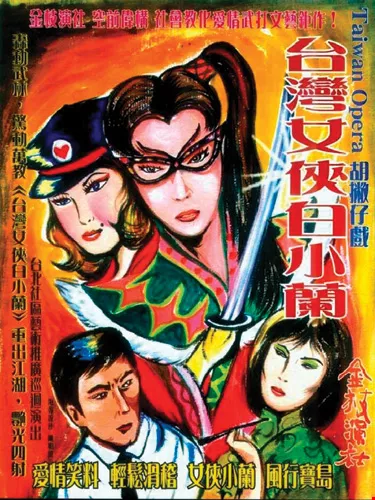
The Golden Bough Theatre, founded in 1993, has performed such modern plays as Rite of Passage, Stop the World, Heart of Spring Flowers, and Wading through the Tsuoshui River. The Female Robin Hood--Pai Hsiao Lan, which premiered a decade ago, was staged in the style of outdoor temple dramas put on by local youth in traditional agrarian times, in this case outfitted with a modern stage set up atop a small truck. The audience, which sat freely all around the stage close to the performers, was able to experience the highs and lows of the performance, and was rocked with laughter by the performers' antics. Some in the audience even began conversing with the performers to marvelous improvisational effect, highlighting the power of outdoor theater.
On the day of the premiere, it rained so hard that the stage was moved underneath an overpass. The audience, undeterred by the rain, joined the umbrella-toting performers in a soulful rendition of "One Small Umbrella." At that moment, director Wang Rong-yu peered out into a darkened corner and seemed to see himself again, as the angry young boy that he once was.
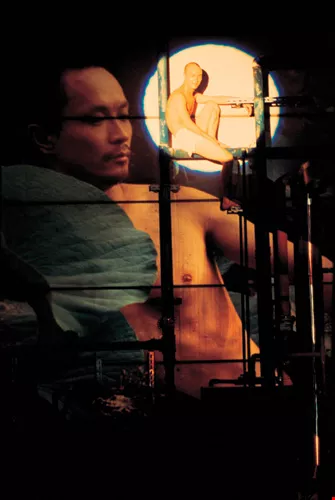
In 1998, Golden Bough Theatre premiered Tiantai Frog, creating on stage the upper floors of a Taipei skyscraper.
Choosing his destiny
Wang Rong-yu was born in 1960 into a family of the theater in Taichung. His grandfather, Hsieh Lien-chih, headed the Tsailien Theater during the period of Japanese rule. His mother, Hsieh Yueh-hsia, adopted from another branch of the family at the age of four, achieved fame at the age of 13, playing young male leads and the even more popular roles of raspy-voiced male leads. Though resplendent on stage, his mother did not enjoy a happy marriage offstage. Wang's first memory of his father is calling out to him through prison bars.
Recruited thrice by Taipei's Hsin Ta-chun Theater Group, Wang's mother left her three children in Taichung and went to Taipei. She came to dominate the Kuting Theater, giving 32 performances a month. When Wang was eight, his father suddenly returned home from prison one day and, hiring a taxi, took the children to Taipei in search of their mother.
"That night, my mother was performing in a hayfield that had just been cleared through burning. She was playing the role of Hsueh Ting-shan. My parents started to argue quite violently backstage, even coming to blows. Enraged and still in costume, my mother suddenly came before me and started berating me. With a younger sister on either arm, I walked out into the darkness, thinking only of getting far away from that place." From that moment, Wang bitterly hated Taiwanese Opera. No matter how famous his mother became, Wang would always list her as "housewife" on school forms.
In 1983, after failing to finish at Chung Shan Medical and Dental College, Wang joined the firm First International Computer. For five years, he was a team leader and software engineer at that company. Even after reaching a management position, he felt that something was missing in his life. He began to take up courses in cinematography and ballroom dancing in his spare time. One day, he noticed a tiny advertisement seeking participants for the Lanling Theatre Workshop. He won a spot in the workshop, which admitted only 40 out of hundreds of applicants. In that same year, Wang also joined U-Theatre.
Wang is bemused when he thinks about how he still ended up in theater after such a lengthy detour. "I've chosen my destiny," he says. Having grown up in a theatrical family, his "recessive genes" in the performing arts were finally being activated.
In 1990, Wang quit his job to participate in a three-year project with U-Theatre, entitled "Retrospect." He began engaging in folk ethnography, studying religious rites at the temples, the dramatic performances of temple troupes, as well as Aboriginal sacrificial rites. That same year, while watching the late Chen Ming-tsai's The Taiwanese Opera of the Seven-Colored Brook, Wang was shocked to realize that this was none other than the type of theater that his mother had performed. Could it be that that, too, was art?
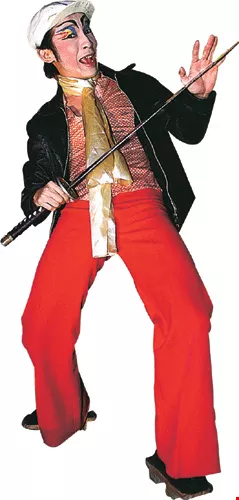
The Golden Bough Theatre brought Taiwanese o-pei-la to the modern stage for the first time, bringing new power to traditional outdoor drama. Pictured is a scene from The Female Robin Hood--Pai Hsiao Lan, performed at Tungshih Township in Chiayi.
People's theater
"After The Taiwanese Opera of the Seven-Colored Brook, I began to reassess my mother's theatrical career and began to swap tips on performing techniques with her. It was as if we were going through the first warm phase in our familial relationship," says Wang. However, his contrarian tendencies were not entirely quelled, and he decided to form his own theater troupe. "My mother always talked about how hard it was to make a living in the theater. I just couldn't believe that forming a troupe and performing was that difficult!" he says. The Golden Bough Theatre thus came into being.
Wang's original plan was simple. He would take the savings he had accumulated in his computer job and try his hand at forming a theater group, with the aim of bringing something enjoyable to the public for a few years. What he didn't know was that once his theatrical genes had been activated, he could never turn back.
Wang's first o-pei-la, The Female Robin Hood--Pai Hsiao Lan, included a koa-a-hi chorus and a "bitter" (kudan) character, a koa-a-hi veteran with over 50 years of experience. That character not only portrayed his mother's life, but also the lives of a generation of koa-a-hi performers. Lin Ho-yi, chair of National Taiwan University's Department of Drama and Theatre, says of the play: "The bubbling energy of the play makes one hope for the prospect of a 'people's theater,' the arrival of an authentic theatrical movement."
Pai Hsiao Lan was performed over 100 times all around Taiwan, and was the first modern play requested at temple festivals as entertainment for the deities. The play competed with the usual risque organ-accompanied routines and puppet theater at the communal festivals of the city-god temple in Yuanlin. After the September 21 earthquake in 1999, Wang was invited by the Council for Cultural Affairs to participate in a project that sought "healing through the arts," halting his own scheduled performances for four months and going to assist in relief efforts. He toured and performed the play at Kuohsing, Chungliao, Chushan, and Luku in Nantou County; Shihkang and Tali in Taichung County; and a variety of Aboriginal settlements. When recalling the performances at Chungliao Township, Wang's wife and Golden Bough playwright Yu Hui-fen can scarcely fight back her emotions.
At the time the troupe was performing in the community center at Chungliao. The play sets a plot of gallantry within a koa-a-hi setting. It should have been a play in which the interaction between players and audience would be strong, but the audience that night seemed scarcely moved at all.
"After going through such a huge disaster, the people there were unable to express happiness or any strong emotions," Yu says. Initially, rain had been falling off and on, but towards the end of the performance, it suddenly began pouring. Unable to bear the sight of the performers on stage getting soaked, the villagers began to call out, "Let's just stop the performance!" However, the performers insisted on continuing. After the final curtain, the villagers rushed forward with towels for the performers to dry off with. They also made tea and cooked up glass noodles to treat the performers. All their emotions, pent up for so long, were suddenly released.
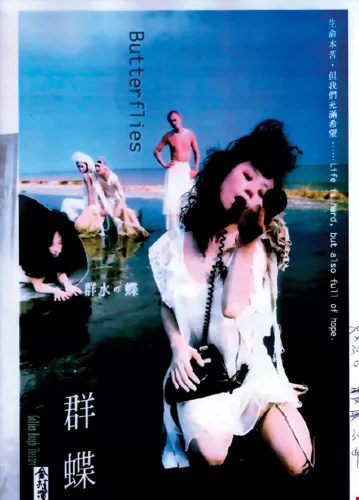
1999's Butterflies stirred up Taipei with its violent aesthetic. The play was recognized as an outstanding work of the Taipei independent stage, and stands as one of Wang Rong-yu's representative works.
Theater meets life
Seeking out the urban fringes to discover alternative performance spaces has always been one of the Golden Bough Theatre's creative goals.
In 1996, the troupe used a small truck as the stage for Pai Hsiao Lan, drifting from night market to night market. In 1997, Troy, Troy... Taiwan premiered in the disused Huashan rice wine distillery in Taipei, stirring up renewed interest in urban wastelands, which led to the formation of the Huashan Art District. In 1998, Tiantai Frog depicted life in the workaday world, with characters smoking cigarettes and breathlessly negotiating with relationships in the high-rise office spaces of Taipei. It was a play that successfully knit together whims and fancies and portrayed them on stage. In 2002, the performance of The Saga of Kuanyin Mountain resurrected interest in the historic sites on the old Shell Oil facilities in Tanshui, giving audiences an experience of wooded, open-air performance space. Viewers could sit under the night sky and delight in the fusion of fantasy and reality. In 2005, Troy, Troy... Taiwan opened at the Huwei Fortress in Tanshui, a Grade II historical landmark.
Many of the troupe's plays have plots that call for outdoor performances. According to Wang: "Our pursuit of this idea reflects the spirit of my mother's experiences in folk theater. Life and the theater should always be in contact with each other." However, reshaping a historic site to fit the needs of the stage was no easy task. For example, in the case of the Huwei Fortress, in order to protect the site and not disturb any undiscovered artifacts, not a single nail or stake was used in the construction of the stage. Instead, a sturdy stage was placed on an elevated platform over the uneven terrain.
As opposed to the meticulous designs of the modern theater, outdoor staging exposes one to myriad uncontrollable variables. For example, how should one control for the lighting? How should sound effects be done? In the spacious environs of this historic site, the performers needed to come ready with an array of physical skills to be able to pull off the performance. There were no formal entrance and exit points for the actors to shuttle back and forth through. To preserve the flow and rhythm of the play, the actors needed to overcome all of these challenges.
"All we can do is experiment, hypothesize, give things a try, and learn from our mistakes. We're always looking for performance spaces with potential, to create a dialogue between the play and a space that is not simply a backdrop for the play. Instead, the performance space can create the mood of the performance and contain dramatic potential," says Wang. He adds wryly: "I think this shows the Golden Bough Theatre's unique spirit, and is perhaps why outsiders often think of us as being a restless creative force."
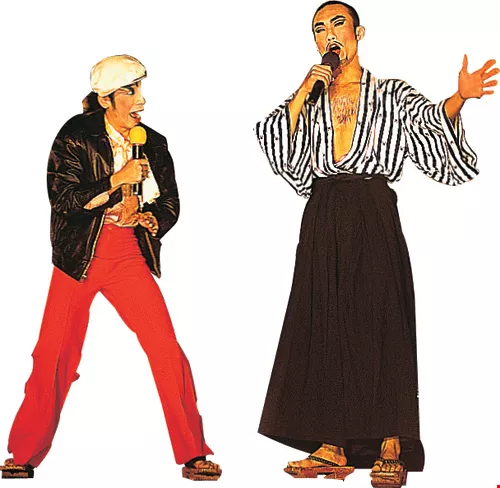
The Golden Bough Theatre insists on staging its plays outdoors. Audience members gather around a stage that has been set up on a truck, mingling freely with the actors and even speaking directly with them. All this creates an ideal climate for improvisation.
Nation in crisis
What exactly is the relationship between a historic fortress in Taiwan and Greek mythology of 3,000 years ago? Wang opens up Edith Hamilton's Mythology, which describes an ancient city on the eastern edge of Asia Minor, unparalleled at the time in its wealth and power, and throughout history in its fame: Troy.
"Whenever I read about Troy, tears come to my eyes. But what resounds in my mind is not Troy. Indeed, if you change some of the words around, this could easily be a description of Taiwan. Taiwan is a young island, yet has passed through so many trials. In each era, there have been stories that match those that happened in Troy, just slightly different in form. Even today, we are under threat and awaiting deliverance." Wang has found a way to reflect on his own cultural plight through the lens of a Western classic.
In order to make the play ring true, Wang has staged the epic in Taiwanese. He says, "I've poured folk sentiment into this mythic epic. As Cassandra says, 'If the roots of one's homeland are uprooted, one is like a withered leaf that cannot sprout new life.' I hope that through this play I can bring my mother tongue back into daily life. I don't want it to become something that has to be preserved and studied as a dead language someday."
Taking its basis in an imagined myth of an ancient Taiwanese kingdom, the play reinterprets the decade-long war between Troy and Greece. It describes battles, the people, freedom, idealism, and other great issues, achieving a kind of spiritual aesthetic that seeks to preserve home and hearth, unbending in the face of adversity.
The Golden Bough Theatre's insistence on retaining the native language is not only manifest in the script, but also in the way that elements of popular songs have been woven into the play. According to Yu, "The lyrics themselves are a dramatic piece through which a pure and beautiful past can be portrayed, and familiar melodies allow our audience to feel a sense of beauty."
Another example is She Is So Lovely, first performed in 2001, a hilarious story of the trials of love that creates a wonderfully nostalgic mood. The play deftly weaves in songs that were popular in Taiwan from the 1930s to the 1970s. This kind of pop cultural collage fuses these utterly familiar songs into the eclectic aesthetic of o-pei-la.
She Is So Lovely uses a light-hearted, humorous approach to tell a different kind of love story: "If no one loves you, then of course it's your fault. If too many people love you, then it must be their fault!" The play swept through university campuses in Taiwan, and in 2003 the troupe was invited to Beijing to perform there. Local online fans received it enthusiastically as in the following account: "The play brings marvelously unexpected details out of well-worn themes and figures, using startling dramatic techniques and exaggerated body language to shed pretense and speak to the common man."
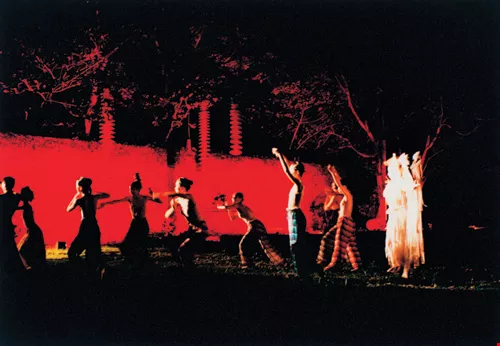
The Saga of Kuanyin Mountain, coming out in 2002, resurrected interest in the historic sites on the old Shell Oil facilities in Tanshui, giving audiences an experience of wooded, open-air performance space. Viewers could sit under the night sky and delight in the fusion of fantasy and reality.
Letting the gods decide
The playwright Shih Juo-fang feels that while o-pei-la is intentionally provocative in its costume, sets, and emphasis on sensory stimulation, what's most important is the dramatic talent of the players. Actors need to have enough talent and skill to begin with, to be able to leap out of theatrical conventions and perform in the dynamic, spontaneous style of o-pei-la.
To achieve this onstage balance of exaggerated mischief and spontaneous feeling, the Golden Bough Theatre's training includes such courses as traditional dramatic techniques that work on posture, vocals, meditation, and taiji daoyin practise, as well as modern theatrical training in body language. What is most distinctive is the troupe's training, however, is its annual participation in the Paishatun Matsu pilgrimage.
The Paishatun Matsu pilgrimage travels from Tunghsiao Township in Miaoli County to Peikang Township in Yunlin County, and is the longest such pilgrimage in Taiwan. The pilgrimage is unique in the way that it proceeds according to the wishes of the gods. The date and length of the pilgrimage is determined by throwing divinatory blocks, and the route of the temple troupes as well as the location of the stops along the pilgrimage route are all determined according to the directions derived from the movements of the divine carriages that express the will of the gods.
Wang, who has participated in the pilgrimage for 14 years now, says that this way of heeding the gods in all things resembles the spontaneity of o-pei-la.
"It's precisely because there is no set structure that we are able to encompass so much territory and spontaneously improvise." To Wang, o-pei-la is not just a theatrical style, but inherits the vivifying spirit of folk theater, in turn fusing that spirit with the creative experiments of modern theater. The Golden Bough Theatre's plays thus have a grassroots quality that reflects the life of the Taiwanese people and folk aesthetics, a creative quality that differs from that of Western theater.
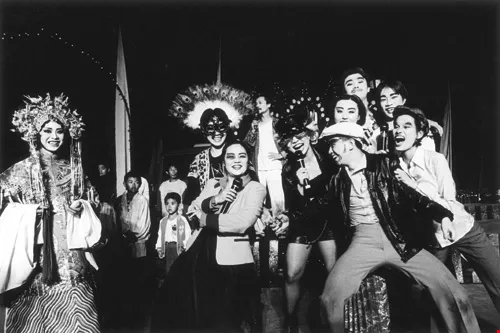
The Golden Bough Theatre brought Taiwanese o-pei-la to the modern stage for the first time, bringing new power to traditional outdoor drama. Pictured is a scene from The Female Robin Hood--Pai Hsiao Lan, performed at Tungshih Township in Chiayi.
Forever fresh
In Taiwan, there has always been a lack of theatergoers. Even though the Golden Bough Theatre has been praised for its unique performance style, it is nonetheless not an easy task to maintain its financial viability. Of the 12 current members of the troupe, only a third draw full-time salaries, the rest being paid a fee per performance. The theater has established a "chairs club" to try and build up a core audience for performances.
This scheme derives from traditional practices in the theater world especially popular after the war, and is a predecessor to the theater subscriptions of today. Members who contribute the modest fee can travel around with the troupe, with the theater providing seats for them at each performance. These theater fans develop strong ties of friendship with the actors and support their performances. This institution is thus a unique feature of Taiwanese theater.
From his beginning forays to his marvelous artistic achievements, theater has become an integral part of Wang's life, one that he compares to the philosophy behind taiji practice.
"Among the 'pushing hands' techniques of taiji there is a move called 'no resistance and no exertion.' This is what it's like in life. You can't be too recklessly insistent, but you also can't be too timid." Wang emphasizes that taiji is is learned by doing, not by studying theory. Theater is like that as well, something that one must throw one's whole heart and being into. "Spending enough time in the theater is the way to come into one's own," he says.
Currently, Wang's ambitions are not restricted to theater. He wants to remind people of the beauty of the world through his performances. At the end of his Butterflies, all of the performers step out onto the stage, gazing at a pregnant woman, who lies in sweet slumber. The commentary: "Life is hard, but also full of hope."
The Golden Bough Theater is suffused with hopefulness and fresh techniques. What will they come up with next? Stay tuned!
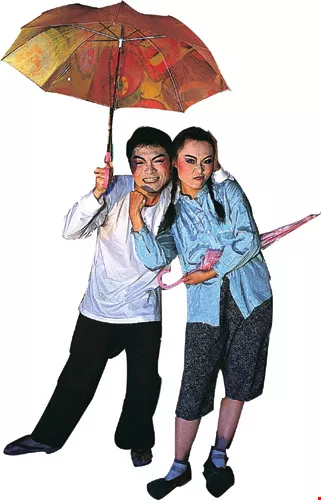
The Golden Bough Theatre brought Taiwanese o-pei-la to the modern stage for the first time, bringing new power to traditional outdoor drama. Pictured is a scene from The Female Robin Hood--Pai Hsiao Lan, performed at Tungshih Township in Chiayi.
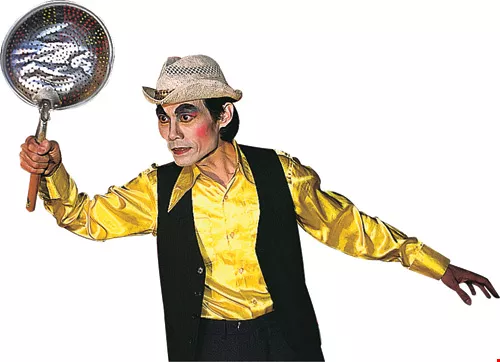
The Golden Bough Theatre brought Taiwanese o-pei-la to the modern stage for the first time, bringing new power to traditional outdoor drama. Pictured is a scene from The Female Robin Hood--Pai Hsiao Lan, performed at Tungshih Township in Chiayi.
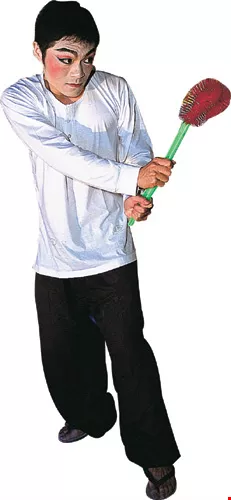
The Golden Bough Theatre brought Taiwanese o-pei-la to the modern stage for the first time, bringing new power to traditional outdoor drama. Pictured is a scene from The Female Robin Hood--Pai Hsiao Lan, performed at Tungshih Township in Chiayi.
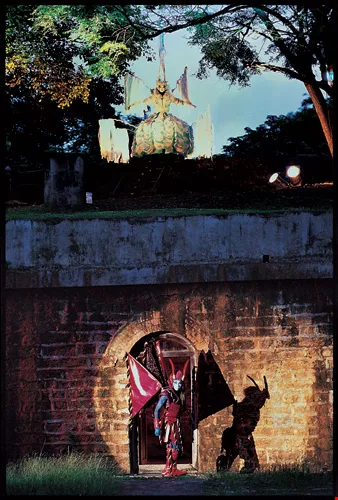
In 2005, the complete Troy, Troy... Taiwan was performed at the Huwei Fortress in Tanshui, a Grade II historical landmark. The play took up an imagined myth of an ancient Taiwanese kingdom, creating a new and authentically Taiwanese aesthetic.
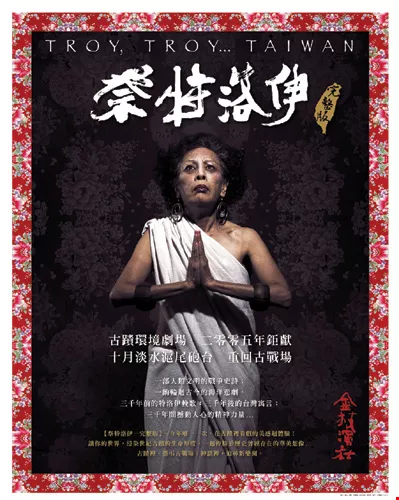
Wang's mother Hsieh Yueh-hsia was a koa-a-hi performer, famous for her performances of raspy-voiced characters. Her performances came to indirectly influence Wang's creative work.
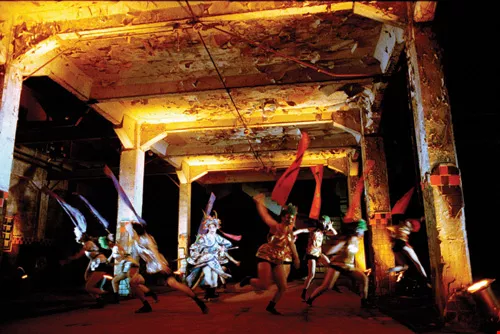
In 1997, Troy, Troy... Taiwan premiered in the disused Huashan rice wine distillery in Taipei, stirring up renewed interest in urban wastelands, which led to the formation of the Huashan Art District.
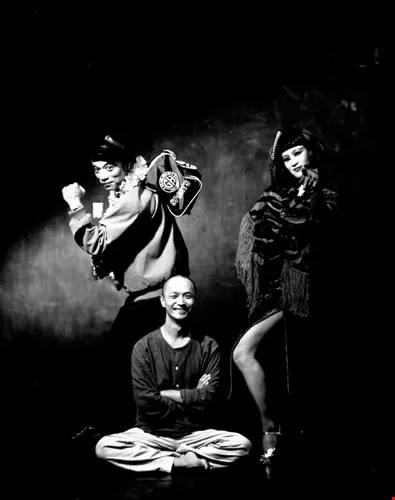
Artistic director Wang Rong-yu (seated, middle) was born into a family of the stage. He bemusedly calls the lengthy detour that eventually brought him back to theater a process of "choosing my destiny."
The Golden Bough Theatre brought Taiwanese o-pei-la to the modern stage for the first time, bringing new power to traditional outdoor drama. Pictured is a scene from The Female Robin Hood--Pai Hsiao Lan, performed at Tungshih Township in Chiayi.

@List.jpg?w=522&h=410&mode=crop&format=webp&quality=80)


