“Auntie Yang” and childhood television
As a researcher, Ko is meticulous in checking his evidence. Once he sets aside his “researcher’s lens,” though, he is still like the child watching opera in front of the television that he once was.
He grew up in an old apartment building in Sanchong, now part of New Taipei City, with a temple just downstairs. In his childhood memories, Taiwanese opera was a fixture of temple festivals and of evenings watching television series with his mother and maternal grandmother.
When they watched Zhu Hongwu, in which the emperor orders peanuts to retreat underground, his mother pointed to the screen and told him this was the legend of the “emperor’s word,” commands that must be carried out. In Sun Bin Descends the Mountain, the villainous Pang Juan made him seethe, and as a boy, he both hated and feared Chen Ya-lan, who played the role. He can still sing the theme songs from Di Qing and Zhu Hongwu today.
Recalling his meeting with Yang during filming of the documentary Emperor on Stage, he says: “The moment Yang appeared in the studio, the background music for the TV productions Yang Li-hua Taiwanese Opera started playing in my head! Really!” He saw her exacting attention to professional details such as lighting and camera work, but also a kindly elder who cared deeply about Taiwanese opera and could not turn her back on its fans. “If only Grandma could have seen this,” he said in our interview, remembering the grandmother who first introduced him to the art.
Recently, after posting an article about Yang online, he unexpectedly received a message from his maternal uncle, who is battling cancer: “You’ve done a great job,” it said. Although his uncle has never really understood Ko’s work, the article brought back memories of Taiwanese opera to him. Ko realized that when people see or hear about Yang, they are doing more than seeing a star: They are revisiting their own stories and memories.

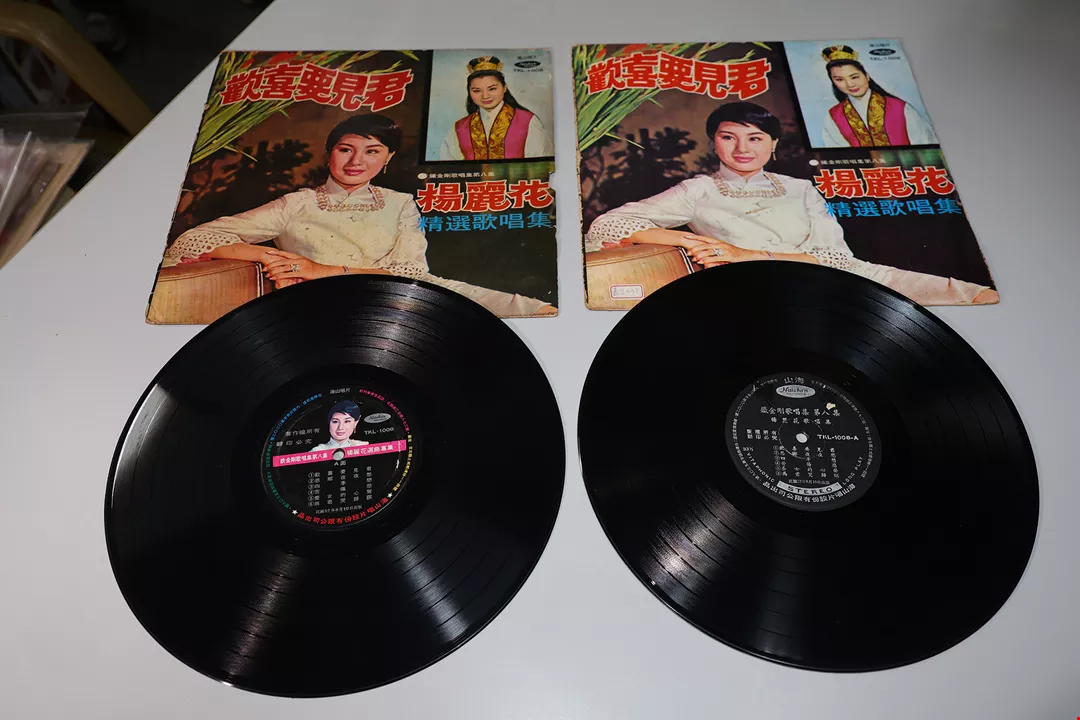
Ko’s passion as a researcher and fan extends to rare early photographs, books, magazines, newspapers, and other Yang Li-hua memorabilia. The third photograph from the right in the bottom row shows Xiao Liyun, an early stage partner who played young female roles.

Ko found that Yang Li-hua plays the male villain Zhou Asi on the Sister Lintou record but the female victim Li Zhaoniang in the film—an intriguing change from her usual role of dashing male leads. (courtesy of Ko Jung-san)

The film poster shown here bears a label at the lower right reading “In Taiwanese Hokkien.” Under the language policies of the time, Taiwanese Hokkien films had to be released with Mandarin dubbing; in general, only a limited number of screenings used the original Taiwanese Hokkien soundtrack, prompting cinemas to specify the language.


.jpg?w=1080&mode=crop&format=webp&quality=80)