Crisis or Opportunity?--Taiwan's NPOs Go Commercial
Chang Chiung-fang / photos Jimmy Lin / tr. by Scott Williams
September 2005


Recent newspaper revelations that the Red Cross Society of the Republic of China had paid its secretary-general Hao Lung-bin, three department heads and four key employees annual salaries of nearly NT$10 million sent shockwaves through Taiwan. Hao ultimately was forced to make a statement clarifying his own position-that he was "only a volunteer and did not receive a salary."
Non-profit organizations (NPO) like the Red Cross, which take the lead on a host of public welfare issues, feel almost tainted the moment money is mentioned. But are they truly sullied by money? No matter how noble the mission, how lofty the ideals, it takes people and money to realize them. Taiwan's NPOs are undergoing a transformation, but are they being improved or ruined? What are they struggling with, and what breakthroughs are they achieving along the way? These are issues about which the public ought to be concerned.
"Taiwan lacks public spirit," says Chiang Min-hsiu, director of the Center for the Third Sector at National Chengchi University. "And it has not established a social contract." According to Chiang, NPOs have two absolutely critical needs: people and money. But Taiwan's NPOs lack both. He notes that in terms of man-hours, Taiwanese spend less than one-tenth as much time volunteering than their Western counterparts, and that the practice of donating to NPOs has not yet become widespread.
According to the Directorate-General of Budget, Accounting and Statistics (DGBAS), some 2.14 million Taiwanese volunteered in 1999, a participation rate of 13.31%. This falls far short of the participation rates in Japan (25.3%), Germany (34%) and the United States (55.5%).

After opening up the car wash center, the Sunshine Foundation steps into the gas station business, providing work opportunities to the facially disfigured.
The work of a few?
So, how many Taiwanese actually devotes themselves to NPOs? No one really knows. However, given how much overlap there is among NPO boards, and how frequently NPOs find themselves short-handed, few people seem to be making a career of NPO work.
According to Professor Lin Wan-i of National Taiwan University's Department of Social Work, there just aren't many people interested in working for NPOs who are enthusiastic about and experienced with social movements. Consequently, organizations do a lot of "poaching," and one person may end up being a social worker for several groups. The upshot of this is that in Taiwan NPO work is the work of a very small number of people. How are NPOs to recruit staffers? It's a difficult problem.
People generally assume that NPO salaries are less than those at for-profit enterprises, an assumption that grows out of the image of NPOs as charitable groups. They think that NPO work is "volunteer work," and must involve some kind of sacrifice.
In the wake of the 1999 Chichi Earthquake, a number of NPOs participating in the relief efforts, including the Garden of Hope Foundation, were accused of "making improper use of the public's donations." People wondered whether the salaries of Garden of Hope social workers in the disaster area were being paid with earthquake relief donations. "NPOs are just people serving other people," objects Garden of Hope CEO Chi Hui-jung. "If they don't get paid, how can they serve?"
Some people say that it is only right that a person's pay should reflect the work they contribute. Others wonder whether it is appropriate for NPO staffers to receive high salaries. "Society's goodwill is not something to be wasted," says NTU's Lin. He believes that because NPOs are collectives rather than individual enterprises, the people working for them should not be paid "absurdly high" salaries.
Garden of Hope's Chi makes a similar argument. She says that the rewards for working at an NPO are not high salaries, bonuses, and promotions, but helping clients through tough times and the relationships between coworkers. But how can NPOs retain good people for a long time if they invariably pay them poorly and ask them to make sacrifices? How can NPOs focus so strongly on universal human rights, then turn around and exploit their own workers?
Chi cites the Garden of Hope as an example, saying that in order to attract staffers, the foundation offers university graduates a starting salary of NT$28,000 a month, which is slightly higher than a typical position in the for-profit sector. Even so, it has trouble finding "life counselors" for its halfway house. These counselors, who play the role of guardians to their charges, are on duty 24 hours a day, and must live in close quarters with abused children. The children's behavior can be very erratic, making the work extremely stressful.
The Creation Social Welfare Foundation (CSFW) faces a similar problem: the organization has been understaffed since it was first established. CFSW chairman Cao Ching says that CFSW offers salaries and benefits that are comparable to those in the public sector, but hiring staff has proved difficult because many people are uncomfortable with the thought of caring for people in vegetative states and associating with vagrants. He estimates that the foundation, which currently employs about 280 persons, would require need an additional 80 people to be adequately staffed.
A few years ago, the National Youth Commission began a grassroots program on Taiwan's campuses to address the recruiting difficulties faced by NPOs. The program aims to acquaint students with NPOs and get them involved before they graduate. To that end, it screens documentary films about NPOs on campuses, brings NPO representatives to give talks in person, and has even created NPO-related general-education classes which students can take as electives.
Lin Chen-chang, director of the National Youth Commission's 3rd Department, says that the objective of the grassroots initiative is to encourage young people to consider careers in the Third Sector as an alternative to government or private-sector employment.
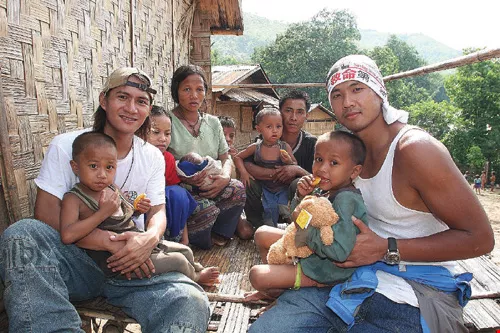
Celebrity spokespeople are everywhere now, and even non-profit organizations are getting into the act. The photo depicts Chen Chien-chou and Wang Hung-en (Biung) who became "famine ambassadors" at the invitation of World Vision Taiwan stepping onto the frontline work of saving lives in Laos. 1,500 tons of charity rice grain where distributed.
Too few people, too little money
The problem of NPO funding also remains unresolved.
Chiang's view is that Taiwanese people are accustomed to giving money to temples, a practice which grows out of the ancient idea of doing good deeds to bring good fortune to oneself. Charitable gifts therefore tend to flow their way, with the result that they are well funded. In contrast, non-religious groups have to rely on marketing and sales techniques to raise public awareness of their existence and keep themselves afloat.
"NPOs need to get much better at fundraising," says Andy Kao, assistant executive director of the Himalaya Foundation. Kao notes that of the NT$40 billion that the DGBAS estimates Taiwanese give to charitable causes every year, only about NT$10 billion went to NPOs. To him, this disparity indicates that NPOs have a lot of room for improvement in their fundraising.
Some groups use all kinds of methods to raise money. The CSWF has adopted perhaps the most innovative approach, encouraging the public to donate their shopping receipts. (Under the government's receipt lottery program, instituted to encourage the public to patronize shops that pay taxes, some percentage of these donated receipts are redeemable for cash.) Although the CSWF didn't invent the method, the group has made very aggressive use of it. In 1993, the CSWF's first year of collecting receipts, the group collected about 100,000 receipts, and this figure has risen steadily since. Last year, the CSWF collected over 70 million receipts, and it now expects to exceed this year's target of 90 million. Although the government has made the receipts less valuable than they used to be by gradually reducing the chance of winning prize money, they remain an important source of the CSWF's funding.
The Garden of Hope, meanwhile, raises funds through the sale of Garden of Hope dolls. In addition to raising money, the NT$1,000 dolls serve an educational purpose and have been very well received. To date, the foundation has sold more than 4,000 of them.
The dolls have evolved since their introduction, and the foundation is now selling its third-generation doll, called "The Inner Child." These have a built-in recorder on which doll owners can record their inmost thoughts as they are growing up, then relive those experiences at a later date.
World Vision Taiwan's "30-Hour Famine," an annual 30-hour fast to raise hunger awareness, has also been phenomenally successful. Drawing on marketing techniques, every year WVT invites celebrity hosts to participate. This year's hosts were Chang Hui-mei (A-Mei), Chen Chien-chou and Wang Hung-en (Biung), the first of whom traveled to Sudan and the latter two of whom went to Laos as "famine ambassadors." The images they brought back to show event participants were both shocking and persuasive.
The event, which has been growing steadily over the years, urges people to personally experience hunger and to take responsibility for the lives of others by participating in a "famine camp" at which they fast and make a monetary donation. With more than 10,000 participants, this year's 30-Hour Famine, which ended in the middle of August, required planning and organizational skills on a par with those of an international corporation.
As Su Kuo-chen, the first president of the Children Are Us Foundation, explains, with the number of NPOs growing, the competition among them for resources has become a zero-sum game. Because the size of the pie is fixed, when the top-tier foundations take a bigger slice, the second-tier foundations are left with a smaller one.
In their quest for funds, NPOs have had to change their ways. They no longer avoid the spotlight while quietly doing good deeds. Instead, public relations staffers are now playing an important role in their media relations and fundraising. In order to get more media exposure, which aids name-recognition and fundraising, NPOs are becoming actively involved with any and every heart-wrenching human interest story reported in the media. Child abuse, rare diseases, deadly accidents... the NPOs are there, sometimes even sacrificing the victims' right to privacy in order to better satisfy the media's curiosity.
Then there are advocacy groups. Unlike large NPOs that provide services directly to the disadvantaged, advocacy groups tend to be small and serve people only indirectly. In consequence, they are less visible and less sympathetic, which means they have far greater difficulty raising money. In July, for example, the much beloved and respected Consumers' Foundation announced that it was unable to pay its staffers' salaries and that after 25 years of serving the public, it might be forced to shut its doors.
"Advocacy NPOs are of great benefit to society and their influence runs very deep," says NCU's Chiang Min-hsiu. "Everyone benefits from their services, but few people support them in tangible ways, either because they lack a sympathetic victim, or because people feel it's not their responsibility."

More and more non-profit organizations have "corporatized," bringing both crisis and opportunity. The picture depicts the Sunshine Gas Station.
Social enterprises
Many NPOs are now seeking to make themselves independent of government handouts and charitable contributions, which rise and fall with the economy. In this quest for self-sufficiency, many are developing their own money-making ventures-the so-called "social enterprises."
In 1993, the Sunshine Social Welfare Foundation, which assists burn victims and others who have suffered facial injuries, established Taiwan's first NPO-run business-the Sunshine Car Wash. The car wash provides work opportunities to the mentally handicapped and people with facial disfigurements.
The Sunshine Car Wash has been an industry leader in many ways-in addition to handling more cars and employing more people than any other car wash on the island, it was also Taiwan's first legally incorporated car wash. Unfortunately, its net earnings account for only 4% of the foundation's income, the bulk of which still comes from donations (67%) and government subsidies (28%).
Many other foundations have followed in Sunshine's footsteps: the Eden Social Welfare Foundation now operates a massage center staffed by visually impaired persons; the Syin-Lu Social Welfare Foundation runs a laundromat staffed by mentally handicapped individuals; the Children Are Us Foundation has a restaurant and a bakery; the Yu Cheng Social Welfare Foundation runs a recycling center; the Wilderness Society sells cards, T-shirts and bookmarks, as well as offering talks and guide services; and the Garden of Hope has established a business department and become a Tai-Salt convenience store franchisee.
"Taiwan's NPOs are becoming more dynamic and are taking steps to save themselves," says the Himalaya Foundation's Andy Kao. NPOs' for-profit enterprises resemble those of normal businesses in their emphasis on efficiency and good management. But there is one important difference: NPO profits don't end up in the pockets of a proprietor or shareholders. Instead they remain within an organization that applies them to the development or running of programs for the public good.
"It's not just Taiwan," says Kao. "In recent years, even NPOs in developed nations, which have never suffered from a lack of donations, have begun to focus on social enterprises." According to Kao, at February's Asian NPO conference, representatives from the nations in attendance confirmed that social enterprises were being used throughout the region to ensure the long-term viability of NPOs.
"The trend towards commercializing social welfare organizations is becoming very apparent," says Ku Chung-hwa, a professor of sociology at National Chengchi University. According to Ku, NPOs are being permitted to operate for-profit enterprises in order to garner the resources they need to keep themselves afloat. Ku sees this as a win-win situation wherein organizations providing social services provide job opportunities to the disadvantaged and also protect the interests of the community. "In recent years, the scholarly community has also come to support NPOs' use of for-profit enterprises. The commercialization of NPOs now seems to have been inevitable."

The Children Are Us restaurant is a "sheltered" employment field for the mentally disabled. It also provides an opportunity for the general society to come into contact with and get to know them.
Mission drift
For some, the commercialization of NPO is a trend, but others see it creating the risk of "mission drift."
"NPOs cannot be guided by thoughts of profitability," says NTU's Lin Wan-i. His concern is evident as he explains that the commercialization of NPOs will make them more and more like profit-making entities. "NPOs were originally a type of organization that didn't believe in 'profit.' But with more and more of them becoming involved in 'business,' and dealing with all kinds of clients in the running of these businesses, they are becoming more and more compromised, and less and less socially critical, creative and public-spirited."
NCCU's Chiang has a different view. He argues that by engaging in commerce, NPOs will raise the question of competitive cooperation because as "foundations," NPOs enjoy tax breaks that give them an unfair competitive advantage over small and medium enterprises. NPOs' for-profit activities have not yet turned them into monopolists nor threatened the markets in which they participate, and these for-profit ventures do pay taxes. But Chiang feels they must be careful not to lose sight of their original objectives.
Returning to the idea that NPOs are "people serving people," World Vision Taiwan seeks to remind its staffers of the importance of every call offering donations or support with a display on its office wall showing the number of incoming calls and the number of people currently on hold. The Creation Social Welfare Foundation, meanwhile, mails a monthly newsletter to 530,000 donors. "The only way we're going to become large and keep our operations going over the long-term is with the help of many, many small contributions," says CSWF chairman Cao Ching.
One would think that small donations would neither be stable nor amount to much, but they are a valuable expression of the public's goodwill and its sense that "we are all one family."
"NPOs are society's conscience," says NTU's Lin. "They also get things started at the grassroots level. The better established these kinds of grassroots organizations are, the more stable society becomes." Lin also warns that society suffers when those who were originally its guardians become so busy with commercial endeavors that donors become reluctant to support them.
Can the Third Sector become a viable option for youth seeking employment? Does the commercialization of NPOs represent a crisis or a turning point? We'll soon begin to find out.

The Creation Social Welfare Foundation's gets mountains of receipt donations. Volunteers must check all of them before the deadline for claiming awards is up, otherwise people's charity will be for naught.

Other than the words "Love Welfare Store" on the entrance, the Garden of Hope Foundation's Taian franchise store is no different from any other store.