Navigating a Sea of Wonders--The Children's Art Museum in Taipei
Tsai Wen-ting / photos Chuang Kung-ju / tr. by Geof Aberhart
June 2004


Last January, Taiwan's first art mu-seum devoted to children's works opened its doors. This museum gives the children of the island a place to exhibit their masterpieces, and aims to water the seeds of their creativity. At the same time, adult visitors will discover that children can be artists of unbounded creativity, and that their work, the work of free spirits, can even make pieces by grown adults look uninspired.
The moment you walk into the Children's Art Museum-which is in the business district of the Taipei suburb Tienmu-you're greeted by a table arrayed with crayons and paper on your right. Children, parents, teachers... all visitors can enter the museum for free, with one proviso: they have to use those crayons and paper to draw a "ticket."
The instructions are listed on a sheet of paper: everyone must draw a picture that includes a house, trees, flowers, grass, people, butterflies, mountains, and a bicycle. Once the whole group has finished their picture, the guide will lay them all out side by side. The more keen-eyed amongst the group will give an embarrassed chuckle as the rest of the group spot the same thing they've seen; with a shake of their heads, everyone starts to wonder aloud, "How come everybody's pictures look so similar? They all have a cluster of three blades of grass, a five-petaled flower with two leaves.... Even the houses look the same; they all have sloping roofs, two large square windows, each divided into four square panes, and a door in the middle!" And this does include everyone-even the adults' pictures look like that. Once they've seen this, the adults come to realize their own artistic deficiencies, and head into the museum with a new attitude, ready to learn just like their children, eyes and minds newly re-opened.
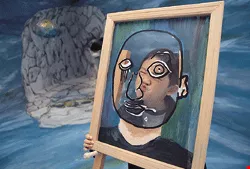
What do you see? Look at this at the right angle and what once looked like a scene of icebergs and jellyfish turns into a bizarre face!
Your ticket, a picture
This unconventional ticketing technique is the brainchild of the museum's curator Lin Chien-ling. "All of those pictures look like that," explains Lin, "because that's the 'model' that's drilled into people in art classes."
In Taiwan, most art classes concentrate on realism, focusing on replicating details. This essentially closes people's eyes, so they lose the childlike sense of wonder and imagination. While we draw, we look, but don't see; we think, but without setting our mind free. Lin has devoted herself to running children's art classes for the past 12 years, and has strong opinions on the part parents play in the reinforcement of this standardized art education. "The problem with Taiwan's art education doesn't really have anything to do with the creativity of the children; it's about the attitude of the adults," says Lin, who obviously feels very strongly about the subject.
Very few other countries have anything like the number of art courses that we in Taiwan do, but our aesthetic sensitivities and ability to appreciate art haven't developed in line with the quantity of "learning." At the most basic level, the fact that we keep sticking to our erroneous art education methods seems to be to blame. These methods seem generally to stifle and smother children's creative urges rather than encourage them.
"Don't be too happy if your child brings home pieces from art class, no matter how vibrant and creative they may seem. Thanks to the pressure to be 'good,' those pictures could be more curse than blessing." This is Lin's message to parents, pointing out to them that they can help shatter the current tendency to place technical mastery on a pedestal.
As every art teacher knows, all you need to do is show children what to do and they'll be able to copy you quickly and well. But this mechanical method of teaching belittles the creative mind and observational skills. Lin, concerned about the toll this is taking, says, "That technique might seem like a magical pill, getting the quickest results, but it's more like a lethal poison." Through the birth of the Children's Art Museum, Lin hopes to shed some light on children's art and get adults to learn to value it, while also trying to revive their creativity and imagination.
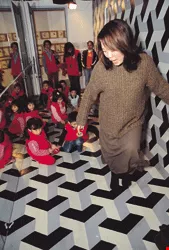
Slipping off their shoes and walking into the Magical Learning Room, the kids gasp in amazement: "Why does the floor look all pointy, but when I feel it, it's flat?"
Education over collection
"The collection isn't our main focus; education is the heart and soul of the museum," says Lin. In this one sentence, she has hit on the greatest defining characteristic of the museum-education is the crux of all of the museum's planning, development, and operation.
Places like this, which aim to educate visitors about creating art rather than simply appreciating it, are a rarity in the world of art museums. But this is exactly the aim of the Children's Art Museum in Taipei.
Since its opening, the gallery has been running an educational exhibition of self-portraits by famous artists. Visitors can see the caterpillarish eyebrows of Mexican artist Frida Kahlo, the amazing coiled moustache of Spain's Salvador Dali, and the strawlike hair of Dutch painter Vincent Van Gogh, learning first hand how artists can convey their feelings and innermost selves through self-portraits.
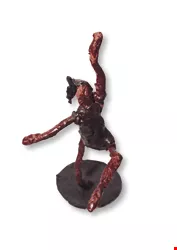
Lin Chien-ling, the lone hand running the Children's Art Museum in Taipei. She hopes that adults and children alike can look with innocent eyes and discover the wondrous world of art.
Finding the magic line
Late this past spring, the walls of the Camel Exhibition Area were covered in works by children aged between four and 15 years old for the Portrait Education Exhibition. The subjects in the pictures were many and varied, with no two alike. Even the works of those children too young to even be able to draw a straight line still managed to capture vividly the essence of their subjects.
The tour guides teach the children that before you paint a portrait, you must first find that person's "magic line," just as when looking at a tree one first takes in the trunk, and then works one's way out to the branches and twigs.
Then the tour guide takes hold of a clear plastic sheet, places it on top of the children's artworks, and illustrates for the kids the baseline of every portrait's subject-their "magic line," which happens to follow the line of the spine. For example,a person standing can look like a "1," the magic line of someone hunched over is a kind of boomerang shape, while a seated subject is like the letter "L." Once an artist has got hold of the basic structure of the pose, they can then start to fill in the details. And with this skill, you can happily take on the myriad of poses your subject may take.
While the guide explains this idea, the children just jump up and try and strike the most awkward, difficult poses for their activity partners, to see if they can find their magic line.
Then further on, in the multipurpose Art Tunnel Area, a variety of portraits by artists of different eras are on display, along with pictures showing the average heights of people of different ages and genders, and pictures of the world's tallest man and woman. This helps the children realize that the bodies of people of different ages actually have very different proportions.
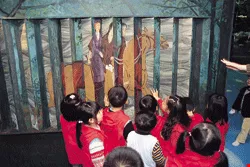
As you move from left to right, this mural gradually changes before your very eyes from a picture of a European belle into a Tang dynasty Chinese beauty. At this museum, the pictures are definitely more than meets the eye!
Breaking with uniformity
After heading through the educational displays in the Camel Exhibition Area and Art Tunnel Area, the children are led through into an area dedicated solely to exhibiting children's works, the Oasis Exhibition Area. Here what they find on display is portraits done on plaster, a very delicate and deliberate art form.
Looking closer, these plaster portraits vary immensely, with the children having discarded all considerations of scale or resemblance and simply crafted their pictures with complete freedom. The most important aspect of doing this work is the children's experience with charcoal as a medium for art. By toying around with the different effects it can create, they come to understand that between black and white lies shade upon shade of gray.
It is Lin Chien-ling's hope that what the children take away from all this is a feeling for art, rather than any specific methods. After all, the true wonder of art is the way it can put across the deepest feelings and emotions of the artist, rather than how precisely the artist can imitate the form of objects.
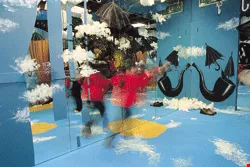
Clouds in the sky, clouds on the ground, even clouds floating in the mirrors! Immersing themselves in a Surrealist landscape, the children get a feel for the ever-changing face of modern art.
Exploring art
As well as helping people appreciate the works of foreign masters and children, the gallery is moving into the new millennium and increasing its focus on interaction with the children. They are doing this through the Magical Learning Room, which lets children become "art explorers," experiencing the many and varied faces of art in a classroom devoted to imagination.
Slipping off their shoes and stepping into the magic classroom, the children gasp in amazement: "How come the floor looks all pointy, but when I walk on it, it's flat?"
As part of the Magical Learning Room's current theme, Surrealist optical illusions, the room is divided into seven sections, each putting the eye's ability to tell reality from fantasy to the test.
In the first section, through the use of lines and shading, the floor looks as though it is covered in thousands of spikes. The children head on into the room, to a mass of painted holes, looking for the one genuine hole-the entrance to the second section.
In that second section is a replica of a family of polar bears in an expanse of snow. On closer inspection, the children discover that up on the white cliff face hides something that looks like an elephant, or a huge bird of some sort. And from a distance, standing in a certain spot, one of the rocks sticking out, a shark in the water, and a stalactite hanging down seem to combine to make a face. Through this experience, the children come to understand what is meant by the phrase "not being able to see the forest for the trees."
In the final section is a fascinating skyscape, covered with black umbrellas, like an expanse of black clouds hanging overhead, and inside the umbrellas are drops of rain. This installation is a composite of various representative works by Surrealist artist Rene Magritte.
One door leads to another, and the children experience the whole thing first hand, as they search through each section of the Magical Learning Room on a journey they never want to end.
Global perspective
In total, the gallery takes up some 1300 square meters, and is divided into four galleries, the Magical Learning Room, and other audiovisual and administrative areas. The whole museum can contain 200 pictures and paintings and 50 sculptures and other 3D works.
Many of the main pieces on display come from the 15 branches of the art school wing of the museum, the Soho Art Education Center. The Magical Learning Room and the Tunnel are the creation of some 80 teachers from those 15 schools, each contributing their own special skills to the project.
These schools provide a support base for the museum, helping to recover personnel and other costs. The museum provides the ideological foundation for the classes, the education being based on the ideas espoused by the gallery and put into practice in the classes. Lin has been running these two organizations for years now in her effort to try and free people's artistry from the shackles it has been placed in, and to let children be able to sample the emotional qualities inherent in real art.
However, even she is ready to acknowledge that if most of the works on display are coming from just one kind of class, the range will be limited. So, the Children's Art Museum also emphasizes exchanges with foreign galleries, with their inaugural exhibition coming from the permanent collection of the Children's Museum of the Arts in New York, with 58 works from 29 different countries on display.
These 58 pieces come from a collection established in 1996, when the Children's Museum of the Arts selected 100 works from a total of over 5000 submissions for their permanent collection. Interestingly, four of those 100 pieces actually come from Lin's children's studio in America; this helped establish the relationship between Lin and the New York gallery.
As well as this kind of exchange, the Children's Art Museum in Taipei has also started accepting applications for exhibitions by painters and other artists. Last year, Wu Yi-fan, an artist studying in France, and Li Chao-tsang, studying in Japan, teamed up to create a piece of installation art entitled The Perception Game, which attracted a substantial number of visitors.
Heading through the curtained corridors of The Perception Game, some of the children say it's like a maze, some say it's like a sea full of waves, and some say it's like a secret cave. Wu Yi-fan says that through the use of diffusive, highly elastic curtains, they've produced an effect like the trip out from the womb, and he hopes that while the children are crawling through, they will rediscover the softness and safety they felt from their mothers.
Every Sunday, the Children's Art Museum also holds classes in their Hands-on Learning Room, letting the kids loose to create their own masterpieces after having seen, thought about, and discovered real art, and having played around in the context of art.
The buds of art
Along with working for art education, Lin Chien-ling feels that when many children's works are put on display together in a gallery it will give the exhibition a value different to just a single child's piece here and there.
"This place is a kind of declaration, an oath even, that we shall help children explain themselves through art. Looking each child's pictures placed side by side, we can trace their development as they grow. Also, here it becomes obvious to parents that a child's creativity is something that can't be hurried or forced."
If, say, their four-year-old child is still just scrawling and scribbling, parents need to accept that this is where the child is. They shouldn't try and measure their child by their own standards, or by concepts of "good" or "bad" work.
"When children say 'I can't draw,' that just means that they've suffered too many roadblocks on their creative journey, that they've been hurt too many times by the opinions of adults," says Lin, obviously distressed by this.
In the development of art to the point it is at today, a lot of traditional artists have stuck to the tried and true, and a lot of avant-garde art seems kind of pointless, and weird for the sake of weirdness. Heading into the Children's Art Museum in Taipei with our children, we can discover anew the imaginative power of children, and realize once more that art truly can be a thing of wonder!
Children's Art Museum in Taipei:
Opening hours: 10:00 a.m. to 5:30 p.m.,
Tuesday to Sunday.
Tel.: (02) 2872-1366
Address: B1, #20, Lane 40, Tienmu W. Rd., Taipei
Website: www.artart.com.tw