Strength in Solidarity: The Relocation of the Rukai of Wutai
Coral Lee / photos Jimmy Lin / tr. by Phil Newell
September 2010


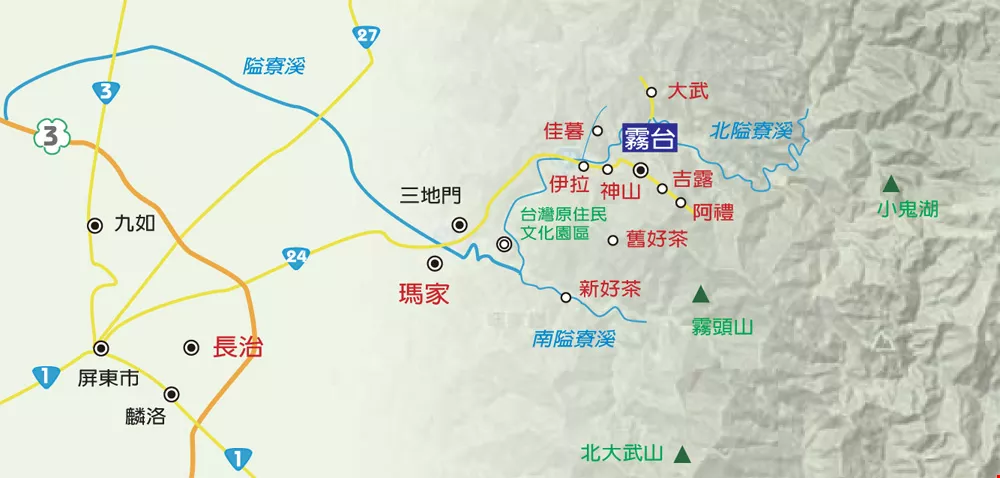
Wutai is a mountain township of craggy peaks swept by clouds and mist. In this ridgeland of 278 square kilometers were scattered eight communities of Rukai indigenous people, making Wutai the center of Rukai life in Pingtung County. This was also one of the locations most severely devastated by Typhoon Morakot on August 8 of 2009. Nearly 300 households have been forced to relocate out of the three most damaged communities: Haocha, Ali, and Jilu. Moreover, the two communities of Jiamu and Yila have been designated "high-risk" locales, and 120 households-75% of their residents-have opted to move to the lowlands.
Faced with what has been called the largest migration in Rukai history, some tribal leaders called for a "Rukai collective village" in the hope that barriers between communities could be overcome and all the displaced Rukai could move to one place. However, for various reasons this never came to pass. At present, four communities have moved to the Changzhi Baihe settlement, a dozen or so kilometers to the southeast of Pingtung City. In addition, the Haocha community has relocated to the Majia Farm in the foothills of Wutai's mountains, while some of the residents of Dawu have moved to Sanhezhong, a community they are building on their own.
Though the "collective village" concept did not succeed, in the course of this migration the Rukai have shown considerable unity and autonomy in negotiating and communicating with the government, aid providers, and contractors. They have not only won more negotiating space for themselves, but their consistently reasoned and measured attitude has, in contrast with the anger and protests elsewhere, been a remarkable page in the story of post-Morakot reconstruction.
However, also attracting attention is the question: Will this relocation hasten the decline of the culture of the Rukai, whose class structure and traditions had remained relatively intact? Or will it be a moment of opportunity to breathe new life into that culture?
On the eve of the first anniversary of Typhoon Morakot, the two most-watched permanent housing locations in Pingtung County-Changzhi Baihe (funded by Tzu Chi) and Majia Farm (built by World Vision Taiwan)-were hopping with activity, as they held, respectively, a ceremony for moving into new homes and a concert in commemoration of the anniversary of the disaster.
As a cool breeze blows over Majia Farm this afternoon, richly attired members of the Rukai and Paiwan indigenous peoples, using prayer, song, and dance, dispel the anguish that has reverberated since last year's disaster. The image of hundreds of Aborigines, who are mostly Christians, joining hands and singing "Together we praise, Hallelujah!" is deeply moving.
Majia Farm, in the foothills of Wutai Township, occupies 90 hectares of flat land on a plateau 200 meters above sea level overlooking the greater Pingtung area. Of this, 29 hectares has been developed for resettlement of disaster victims. It is anticipated that 319 households (from Haocha and from two Paiwan communities) will be settled here as permanent housing is finished in August and September. The Western-style homes give one the feeling of being in the countryside somewhere in Europe or America. There are three models, including a single-family dwelling and a duplex. Each is 105 square meters in size, with 7.2 meters between the structures, creating an open and spacious feeling. Moreover, the owners are able to express their traditional tribal aesthetics or personal preferences, as they can attach stone slabs or other designs of their own making on the outer wall up to the height of one meter off the ground and on the floor of the patio.
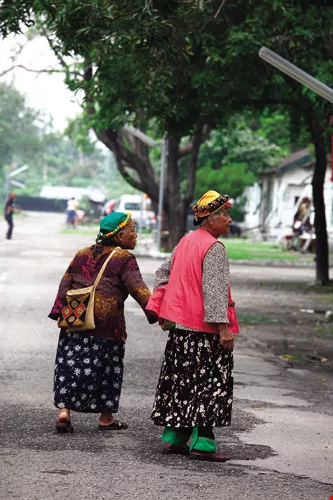
The people of Haocha Aboriginal community, who have been through a lot of ups and downs together, called on the government to amend the rehousing criteria so that all 177 households could move together as one into new permanent housing. The photo shows two old ladies from Haocha who had been temporarily sheltered at an abandoned military base.
"We want to create a hometown with stone slab culture," says Chen Zaihui, the director of the Haocha Relocation and Reconstruction Association. The specifics for the permanent housing in Majia, from the allocations among groups to the width of the roads to the size of the homes, all were won through numerous discussions between the association, the county government and World Vision Taiwan. Although the association cannot be said to be completely satisfied, the Aborigines could feel that the relevant agencies were sincerely trying to meet their needs.
"At the current stage the main problem left to be resolved is the number of households that can move in." As Chen explains, Haocha was instantaneously and completely inundated by the collapse of a barrier lake. Fortunately, the villagers had already evacuated and there were no casualties. But the mud and silt were as deep as a five-story building, and not a brick or roof tile was left. Under the Special Act on Reconstruction Following the Typhoon Morakot Disaster, only 115 of Haocha's households were eligible for permanent housing. What about the other 62 households who remained ineligible for various reasons (for example, the houses they lived in were not legally built structures, or they did not have their legal domicile in Haocha)? In an effort to maintain the integrity of the community, the residents issued a declaration requesting that the government complete 177 new houses in one package, and relocate all 177 households together in a single move. They refused to be relocated separately, in order to avoid a repeat of the tribulations and intra-community squabbles experienced three years ago after Typhoon Sepat, when one-fourth of their village was washed away in a landslide.
Because there are many Aboriginal villages in a situation similar to that of Haocha, with the whole community being forced to relocate but not everyone able to claim ownership of a legal residence in the old hometown, the Post-Morakot Disaster Reconstruction Council of the central government plans to adopt new regulations permitting relocation of complete communities, based on Article 20 of the Special Act which calls for respecting the views of the indigenous peoples themselves. The criteria will include the following: A certain percentage of the whole community agrees to relocate; a consensus is reached through the tribal assembly and a specially designated process; and the original village has been designated a "restricted area"-meaning unsafe for any further habitation. Council Deputy CEO Chern Jenn-chuan states that for the majority of displaced villagers who have "landed outside the safety net" this will hopefully resolve the problem of qualifying for new housing.
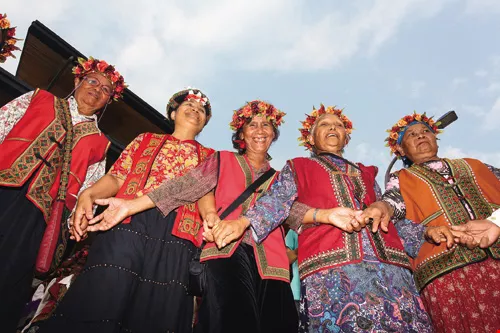
On the eve of the first anniversary of Typhoon Morakot, people dislocated from Haocha Village perform a traditional dance to celebrate the imminent completion of their new homes in Majia Farm.
Panning over about 20 kilometers, we zoom in on another major site of permanent housing for the Rukai: land in Changzhi that belonged to the Broadcasting Corporation of China. It consists of about 30 hectares of level land surrounded by a huge stretch of banana and pineapple plantations. After much effort by the Rukai, recently it was decided to name the settlement Changzhi Baihe, with baihe meaning "lily," a symbol of sacred purity in Rukai culture, while lilies have been added to the imagery at the entrance. Mainly for four Aboriginal communities from Wutai and two from Sandimen Township, it will have a capacity of 500 households, of which work has been completed on 154 homes. The outlines of the community have taken shape, and although there is still much to be done to clean up and plant greenery around roads and public spaces, nonetheless some people have recently moved into new houses.
The home of Xu Xiuxiang, who relocated from Jiamu Village to Changzhi Baihe, is churning with activity in the middle of this otherwise somewhat lifelessly pristine environment. Six or seven women and countless children are in the living room, as it turns out that this is the day that Xu's sisters and those of her husband (an Aborigine of the Amis people) have come from all over to celebrate their move into a new home, as well as hold a thanksgiving mass in the evening. As they roll millet flour into the traditional Rukai food called abai (similar to mashu, with millet on the outside and pork on the inside) for that evening, they laugh and chat, creating a warm family atmosphere. "This is the way we Aborigines are, one big happy family!" Although scattered geographically, this extended clan grabs every opportunity to visit one another's homes.
Xu is asked whether she likes her new home. "It's a lot better than staying at the Pingtung Veterans' Home, which is where we got provisional housing after the disaster. And Tzu Chi [Buddhist Foundation] gave us a sofa and beds, and overseas Chinese from the Philippines gave us a TV and refrigerator, so the only things we're missing are a washing machine and air conditioner. Everyone has been so kind to us!" Xu says that her only son went into a vegetative state after a traffic accident many years ago and died three years later, and her daughter-in-law walked out; her husband made a living in the mountains picking lingzhi (Ganoderma) mushrooms and hunting to support their four grandchildren. Now that they have moved to Changzhi Baihe, it will be a lot easier for the grandchildren to go to school. Although they have to adjust to a new environment, they thank God for giving them this house.
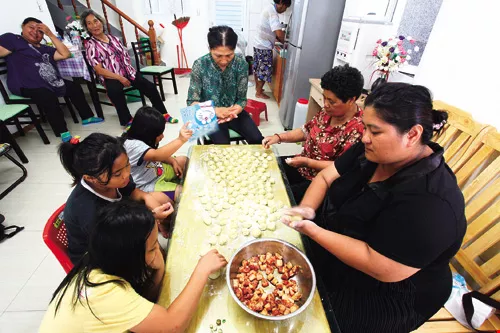
Friends and relatives from all over who have gathered at the home of Jiamu Village resident Xu Xiuxiang-who has just moved into new housing in Changzhi Baihe-prepare abai millet-flour dumplings, an essential dish at Rukai celebrations.
"The Rukai are a people who understand gratitude; when we get a drop of help, we repay with a gushing spring," says Lavuras Abaliwsu, the sixth-generation chief of Ali. Considering the waves of efforts put in by government and NGOs over the past year, including the crash of a helicopter in Yila Village in Wutai Township during rescue operations in which Han Chinese sacrificed their lives in rescuing Aborigines, he has no words to express his gratitude. When the displaced Rukai have all settled down, he will call on his fellow tribesmen to do something concrete to repay society. For example, he might gather together professional rescue personnel from the Rukai tribe to form a volunteer group that could lend a hand if there are fires or other emergencies elsewhere.
So what does he have to say about the controversy over whether the criteria for getting a new home (which have left some displaced persons outside the safety net) are fair? Lavuras argues that it is impossible for the government to take care of all the needs of every individual, but he still reminds everyone that they should feel grateful.
"In the lowlands," he says, "people can work for a lifetime and still not own their own homes. It's already a very lucky thing that people from the indigenous mountain communities now have homes of their own in the lowlands. If people only complain and criticize, outsiders will think that Aborigines are really 'troublemakers.'" This is why he did not approve of the protest held in front of the presidential office on the eve of the first anniversary of Typhoon Morakot by an Aboriginal activist group. "It's not wrong to express dissatisfaction, but you have to use rational methods, like public debate and dialogue."
Based on what this reporter saw on her visit, compared to displaced persons in Kaohsiung and Chiayi counties who have sometimes complained vociferously that the government's reconstruction efforts have been inadequate, the Rukai and Paiwan of Pingtung have been much more measured. In particular, even though construction of permanent housing in Pingtung has been several months behind that in Kaohsiung County, you rarely hear people getting upset about it. Why is this?
Here is how Sun Ta-chuan, a Puyuma Aborigine and currently minister of the Council of Indigenous Peoples of the central government, answers that question: The character of the Rukai and Paiwan peoples is more circumspect and moderate. You also have to consider the staying power of traditional culture, in which the chiefs and elders retain a lot of influence, and the tribe emphasizes the "integrity" of united action and shared hardship, so consensus is easier. Therefore the government has a coherent dialogue partner with clear leaders they can talk to who can effectively speak on everyone's behalf, so communication is smoother, and you don't end up with everybody having their own say. In consequence, the situation with Rukai and Paiwan disaster victims has been correspondingly trouble-free.
In contrast, in places like Namasia and Taoyuan in Kaohsiung County, a lot more people have been affected. Also, the Bunun, who are the main residents in those areas, have a clan-based society, and everybody's voice is given weight, so it is harder to aggregate views. Also, the disaster area is much bigger, and there are many issues, so it is impossible to get every detail right, and naturally there will be more criticism from the disaster victims there.
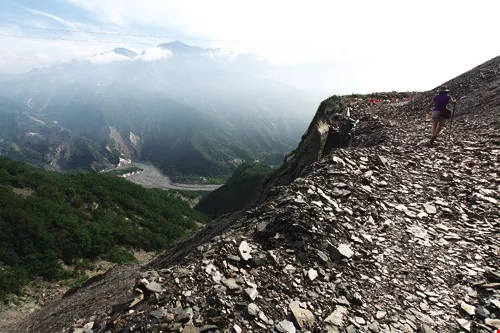
Typhoon Morakot transformed scenic Wutai Township. Of eight Aboriginal communities in the township, most of the people in five of them have decided to move to the lowlands in what has been called the largest relocation in Rukai history. This photo shows a landslide along Provincial Highway 24 between Jilu and Ali.
"The Rukai understand that protesting about everything won't solve problems, and that it is necessary to realistically face up to extreme weather and the dilemmas faced by the tribe," says Sasala Taiban, chairman of the Department of Tourism Management at Tajen University and one of the most outstanding middle-aged people from Haocha Village. In dealing with the various problems of relocating, each community first discussed the matter internally, then harmonized with other communities, and through one meeting after another reached a coordinated and integrated position.
For example, with the earliest question to arise, "Should we relocate out of the mountains?" besides the people of Haocha, which was so devastated that they had no option but to relocate, the people of the other communities all had a choice. Some advocated staying in their hometowns, but others argued that even without a Typhoon Morakot, people had long been leaving the mountains to work elsewhere, and there were no economic opportunities in the mountains that anyone would really regret leaving behind, so why bother to cling to the old places?
Next, those who decided to relocate, whether collectively or individually, had to decide where to go. Originally the county government had planned to put all the Rukai people from Wutai Township in Changzhi, but this plan ran aground on the fact that long before Typhoon Morakot it was already decided to relocate the residents of Haocha to Majia Farm. Although the county government strongly tried to persuade Haocha folks to move to Changzhi, after weighing the options the latter decided, for various reasons including close proximity to the old hometown, to stick with the original plan.
After waiting for the four other communities to make up their minds on whether to move to Changzhi or not, the county government, thinking that the Changzhi site might prove too small at only about 30 hectares, sought to get use of a farm of over 100 hectares northeast of Pingtung City owned by Taiwan Sugar Corporation. However, because TSC was only willing to turn over eight hectares in the first phase, the Wutai Township executive began to worry that the future would be insecure with this plan. Also, many of the Aborigines awaiting relocation thought that the hog-raising operations near the TSC site would pollute the soil and water. So they decided (albeit only in March of this year!) to go back to Changzhi, and the county respected their decision.
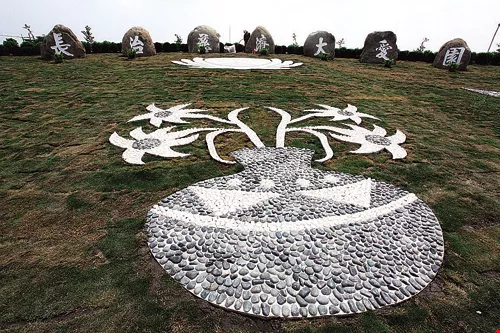
The Changzhi permanent housing site has been formally renamed "The Pingtung Great Love Park Changzhi Baihe Aboriginal Community," with baihe meaning "lily." The images at the entrance mix the logo of the Tzu Chi Buddhist Foundation (at the rear of the grassy area) with the lily, an important symbol to both the Rukai and Paiwan peoples.
Having decided to relocate to Changzhi, some members of the tribe then began to be concerned with the "coherence" problem. Not only did the people of Haocha decide to wait it out in their crude and hot temporary shelters at an abandoned military base so that all 177 households could move together into permanent housing, there were also voices from the Ali community saying, "If we move, then everyone should be able to move together."
Ke Qingxiong, the director of the Ali Reconstruction Association, states that although they will move into new houses, many Rukai people, himself included, are not joyous. Indeed, they feel "uneasy" because, of Ali's 88 households more than 30 have been ruled ineligible for new homes. He says that most Ali people work in the lowlands, and in order to register their kids in school they had to move their legal domicile down, though their identity is still with the old hometown. If they are excluded from the new settlement because of a narrow reading of the law, these 30-plus households will become "driftwood" rooted nowhere.
The Post-Morakot Disaster Reconstruction Council has promised to devise a legal framework permitting "collective relocation of a whole village" to solve this problem, but can they really implement it? What will be the criteria for eligibility for the second review? The people of Ali cannot rid themselves of anxieties over such questions, and they are continuing to work hard toward making these promises a reality.
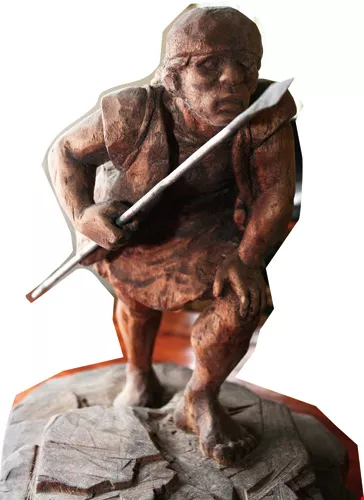
"Without a house, you have no standing in the community," says Sasala Taiban. He says that Rukai society is based on the house as its core unit, and each dwelling has its own moniker. When a child grows up and establishes his own household, not only does the whole village mobilize to help build the structure, the tribal elders will choose a new name for it. The allocation of benefits and honors is also done with the dwelling as the unit. For example, if a hunter brings home a mountain boar, besides the parts that go to the chief, everything else is divided by households (depending upon the degree of relation to the hunter), and when hunters in a family earn glory, it is their house that wears the symbols of the success.
"To the Rukai a house is not just a shell to keep out the elements." In the community, houses also have the function of differentiating social status. What kinds of images can be used to decorate the house of the chief? The nobility? A hunter? There are rigid rules governing all these things, which is why the people of Ali felt it was absurd for traditional and elected community leaders to have been ruled ineligible for permanent housing.
"A lot of people left the village to work hard elsewhere but always thought there would be a day they could go back and have their own house in the community where they could grow old and reconnect spiritually." Sasala Taiban points to himself as an example. He has turned down opportunities to teach anthropology at universities in other counties and remained in Pingtung not only because Tajen University supports research into indigenous peoples, but also so he could stay close to his people.
Now that the dust has settled on the controversies surrounding permanent housing, what is the next step for the people of Ali?
Ali chief Lavuras Abaliwsu proposes the principles, "Don't abandon the hometown, don't let the culture die out, keep the Rukai going on a sustainable basis." He feels that for all the Western Rukai, whether they live in the mountains or lowlands, there is an unbreakable bond with the land handed down by their ancestors in Wutai, forming an organic whole like mother and child tied by an umbilical cord. The hometowns in the mountains are like an ailing mother who should not be neglected, but should be cared for and helped to recuperate. This is why he has defined them as a "recovery and nurturing group." Meanwhile, those who have moved to new communities in the lowlands are like children who need nourishment, whom he calls an "inheritance and offspring group."
When typhoons approach, indigenous peoples' communities in the lowlands can offer temporary shelter to those from the mountains, while in normal times the lowland communities will be the windows for packaging, display, and logistics for mountain products. Meanwhile the people in the mountains will be responsible for protecting the ancestral land and hometowns, making it possible for those from the lowlands to go back to their hometowns for economic activity. In this way those in the lowlands and those in the mountains will be mutually supportive. The "umbilical cord," meanwhile, is Provincial Highway 24 and its branch roads. "We are not asking for the roads to be wide or fast, just basically safe and accessible, that's enough," says Lavuras. To those who ask whether it is worth spending hundreds of millions of NT dollars for the benefit of a few holdout households in the mountains, he responds: "If you look at it as rescuing an ethnic group that is about to disintegrate, you will judge differently!"
As for reconstruction in the mountains, he feels this should include three aspects: environmental recovery, cultural recovery, and revitalization of traditional industries. He intends that the "inheritance and offspring group" in the lowlands will travel back to their hometowns for education in their mother languages and for visits to reconnect with their roots, and a "visitor service center" should be established so that travelers who intend to go into the mountains for eco-tourism can get informed and educated prior to departure.
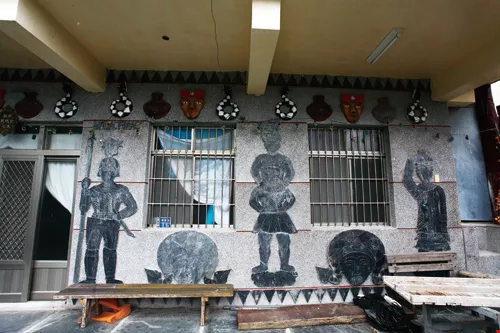
Rukai homes are filled with cultural and social meanings, as people of different ranks have different imagery on their homes. Across the top of this picture you can see images of hundred-pace snakes and heads with red "butterfly knots," which means that this house belongs to the chief, who has an exclusive right to use such symbols.
In contrast to those who urge a return to indigenous hometowns, Sasala Taiban suggests that since most people have already moved to the lowlands, they should focus on succeeding in their new environment and coming up with a new way of life.
"I'm not that worried about the ability of the displaced people to adapt in terms of daily life," he says. There has long been a big difference between modern Rukai and their ancestors, and anyway all ethnic groups have to face new environments and challenges. What's important is that they find a new motive force for cultural development, so that they have a safe environment where they can enjoy the benefits of modern society (like solar power and sewerage systems) while also ensuring the transmission of Rukai culture.
For example, how can a "new hunting culture" be developed that retains the sharing, self-sacrifice, and cooperation of traditional hunting culture? Perhaps this will be through links with the mountain forests. An enterprise fund could be established to be collectively managed and shared by all the people of a tribe (just as funds have been established using revenues from gambling casinos on reservations of Native Americans), which can be applied to the preservation of culture and rituals. Or, in the farmland around the new permanent housing communities, people could collectively farm and then share the harvest among the tribe, which would be another way to pass on their volksgeist.
As Taiban emphasizes, these community enterprises must have a different operating model from the private, competitive one of Han society, because once you move toward personal ownership and pursuit of profit, Rukai culture will disintegrate even faster. "In dealing with the impact from the larger society, we have no choice but to use collective power if we want to resist!"
In addition, Taiban also calls for very careful handling of administrative problems in the new permanent housing sites, because these will greatly affect the integrity of the development of tribal groups. In particular, the Majia Farm is the new home to three mountain communities, of which two-the Haocha community of Rukai people and the Majia community of Paiwan people-have a century-old feud over farming land. If in the future it is decided to make the settlement a single administrative jurisdiction, there will be serious problems, because there can only be one village executive and one representative, so which community would they serve?
"Although there are challenges for the Rukai people moving to Changzhi and Majia, there's no need to be pessimistic," says Sun Ta-chuan. Whether it be linkages between hometowns and new communities, or setting down new roots in lowland settlements, things will be OK so long as everyone is determined, while the government will give support in a variety of ways. Moreover, Taiwanese society is more and more pluralized and tolerant, so it is not likely that the culture of indigenous peoples will be extinguished in the lowlands, and people can still search for new ways of life. From the record of 30 years of urban life of the Amis people of Hualien and Taitung counties, Sun says, they still favor living environments close to water and close to nature, and the social network has not fallen apart. They still have the chief system, hold the harvest festival every year, and so forth. If the Amis can do it, given that the Rukai have very deeply set cultural roots, we can still be upbeat about their future.
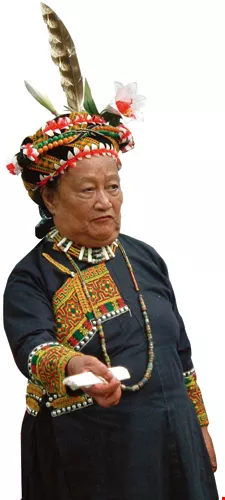
Bao Baoyin, fifth generation chief of Ali.
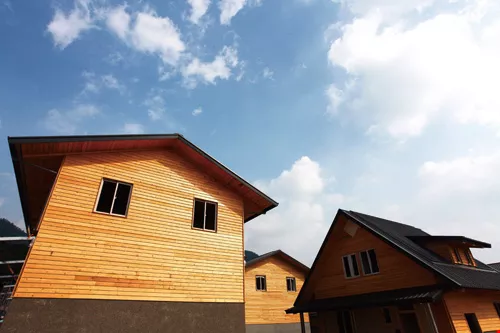
The permanent housing in Majia Farm, funded by World Vision Taiwan and designed by the renowned architect Hsieh Ying-chun, reserves the lower part of the external walls for residents to express their creativity. aThe goal is to build a new Rukai hometown with a touch of traditional "stone slab culture."

@List.jpg?w=522&h=410&mode=crop&format=webp&quality=80)

@List.jpg?w=522&h=410&mode=crop&format=webp&quality=80)


