here River Meets Mountain--Lungching Township
Kate Yang / photos Chuang Kung-ju / tr. by Geof Aberhart
December 2004


The township of Lungching, in Tai- chung County, is a traditional farming village, with over half the population making a living off farming.
Springing from the Central Mountains and running through this township as it snakes toward the sea is the Tatu River. Every township that neighbors the river has its own irrigation system drawing water from the river, and it is the farmers' most important source of water. The eastern side of Lungching sits next to the Tatu Mountains, with rice paddies at their foot, while up further there is a small arts community by the name of "Lihsiangkuo," and still higher up, sweet potatoes flourish in the rich red soil. This mix of mountain and river lifestyles gives Lungching its unique character.
Another point of note is that Lihsiangkuo was the brainchild of local man and Tunghai University architecture graduate Pai Hsi-min, who came up with the idea over 20 years ago, starting Lungching on its way to becoming a pioneer of town planning and social consciousness in Taiwan. That small arts community is still one of the things Lungching is most proud of. It's really no surprise that people say, "If you're going to central Taiwan, you have to visit Lihsiangkuo-it's the highlight of the Tatu Mountains."
Lungching Township sits near the border of Taichung City and Taichung County, stretching out toward Taichung Harbor along Chungkang Road, and out toward the foot of the Tatu Mountains. If you look out from Tunghai University in Taichung, you can see a stand of royal poinciana trees-and it is there you'll find Lungching.
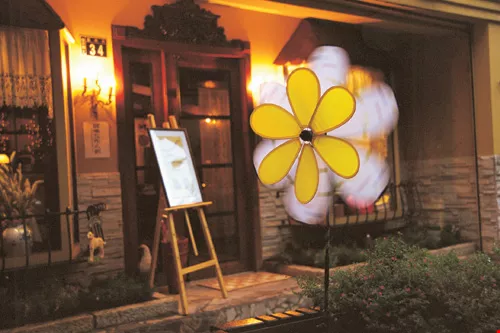
Lihsiangkuo artists' community is the highlight of Lungching Township. The open public spaces on the street corners of Lihsiangkuo give residents a place to chat and relax.
Paradise found
Halfway up the Tatu Mountains, behind Lungching Township, is a small place with a very cultured air and artistic outlook-Lihsiangkuo. Small, sloping streets run between stonecrafted storefronts, with store after store on either side of the road giving the whole place a decidedly post-modern, old-European air. Other buildings, like teahouses, pottery stores, and stores selling traditional Chinese clothing just add to the elegant aura of the place, and when you add in the rows of Indian coral trees, big public areas at street corners, and beautiful little private villas, you've got a spectacular scene. Whenever visitors arrive in Lihsiangkuo, the magic of the scene, combined with the wonderful Taichung weather, immediately enraptures them.
Sitting at a street corner, sipping a wonderfully fragrant coffee, it's hard to imagine that this artistic little place was, at the start of the 80s, home to 2000 run-down and overgrown buildings, with 70% of the houses in this 40-hectare area abandoned.
"Back then, those empty lots were covered in piles of trash, and no-one was willing to come clean the place up. No government officials dared even visit the place, mostly because it wouldn't win them any votes, and it would probably just have annoyed the locals if they did anyway. Gangs of youths would roam the streets at night picking fights, all the houses were locked up tight... the place was like a ghost town," remembers Pai Hsi-min, the man who first came up with the idea for Lihsiangkuo.
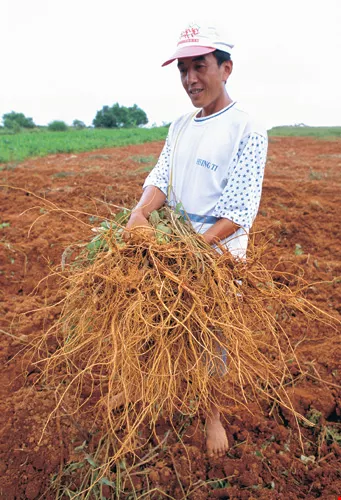
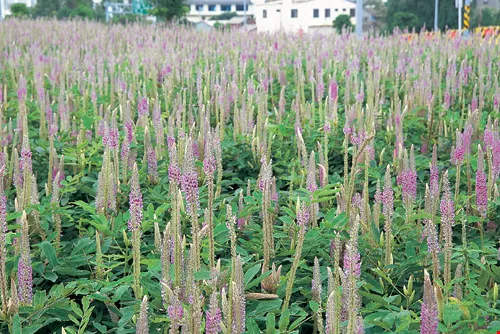
Recently local farmers have taken to farming bristlegrass in the hardy red soil of the tablelands, giving Lungching another local specialty.
Black and white
Pai Hsi-min, a student of Taiwanese master aesthete Pao the Han and graduate of the Architecture Department of Tunghai University, was a young man brimming with ideals and ideas. He had a dream of putting his knowledge and skills to work to bring together traditional industry and modern society and create something entirely new. Pai applied for positions working in places like Sanyi Township in Miaoli, and Chinkuashi and Chiufen in Taipei Country, but hit dead ends each time. Eventually he decided that the best place to try and make his dream reality was his hometown of Lungching, next to his alma mater, despite the fact that the area was hardly a cultural treasure-chest, nor did it have any real sense of community.
At that time, in 1974, the Taiwanese government was preparing to implement the Regional Plan Act, which would impose restrictions on building outside of urban areas. These looming restrictions caused a building boom throughout Taiwan, and the Tatu Mountains area was no exception. It was here that the communities of Yuentung and Kuochi were born, with a combined population of over 2000 households. However, due to the poor quality of the building work and the difficulties supplying the communities with water, eventually houses were being offered at just NT$1 million for three and still attracting no interest, while a three-story house could be rented for just NT$1000 a month. But, aside from retired servicemen, the only people who had it in them to even try living there were a few male students from nearby Tunghai University.
But to Pai Hsi-min, the area wasn't a run-down old eyesore but a real-life game of othello: the run-down buildings were the black pieces, and the new and rented-out ones, the white. Gradually working his way across his "board," Pai breathed new life into the 40-hectare area, while also starting a movement amongst the locals to develop the community, bringing together art, pottery, and carving studios, cafes, and other such enterprises in a "community of artists."
"At the beginning, the people of Taichung just laughed at us, saying those plans were just pie in the sky-who'd want to come all the way out here just to buy a woodblock print? And Taipei people said we were just fishing for fame: how dare we call such a miserable hole as this 'artistic'?!" remembers Pai with a chuckle.
But against all the naysayers' predictions, Pai did turn that "miserable hole" into a massive success. Of all the new buildings in this once decrepit town, one group of villas named Lihsiangkuo made a big name for itself. Thanks to that, over time, the town became home to more and more buildings, eventually reaching over 1000. Of those, 240 were small suites, while the rest was made up of apartment buildings of all sizes, with prices ranging from over NT$2 million to NT$20 million.
Thanks to impetus provided by the Lihsiangkuo villas, real estate prices in the area started to rocket in this township that was once almost begging to be razed, and Pai got substantial praise from then-director of Land Bank, Donald T. Chen.
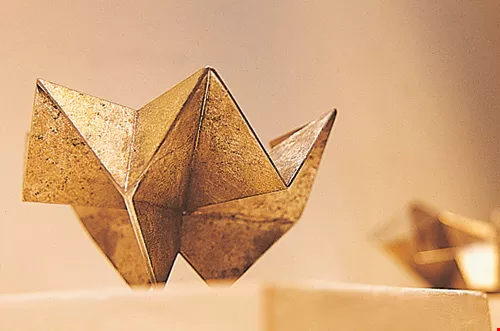
Chinkung Arts is a relatively new studio to the town, starting in the past couple of years.
A new coat of paint
"It wasn't enough to rely just on those 'white pieces' to revive the community," says Pai. "More important than those were the old 'black pieces.' But to get those old buildings that no-one wanted into shape and make them places people would actually want to live in, people had to be willing to spend the money needed to repair the buildings' facades. Once that was done, the interiors would follow suit."
In order to fulfill his othello-like plan of having the "white pieces" influence and "reverse" the "black pieces," Pai enlisted the support of DuPont Taiwan, asking them to donate some of their product to help Lihsiangkuo. After that, he got the community residents to sign on and receive some of that paint, setting a goal of 150 households. The people were asked to repaint their entire places, inside and out, and told that their work would be judged, with the residents of the most impressive home winning an overseas vacation. Marketing agencies throughout Taiwan heralded this as a bold, creative move by Pai.
Pai believed that if he could get the residents to start really thinking about how their homes looked, and get them eager to get their families back into town, it wouldn't matter how the actual renovation turned out-more important than that was the sense of community and of confidence it would bring back to the town.
As far as the business side of the community goes, over the past 20 years there has been a fourfold increase in businesses in Lihsiangkuo, from 80 in 1989 to over 300 today. Proudly, Pai notes that while business areas in Taichung City, like Tzuyou Road, had periods of prosperity, they eventually tailed off, whereas in Lihsiangkuo there's nary a closed shop.
From run-down and virtually abandoned, in 20 years Lihsiangkuo has grown into a thriving community and tourist attraction of over 3000 households and businesses with 10,000 residents. For a community to truly thrive, says Pai, it needs to have its political, economic, educational, cultural, and religious sides in harmony. With Pai's leadership, Lihsiangkuo has gone from a sparsely populated eyesore to an independently thriving township, leading some to jokingly call him the town's "go-to guy."
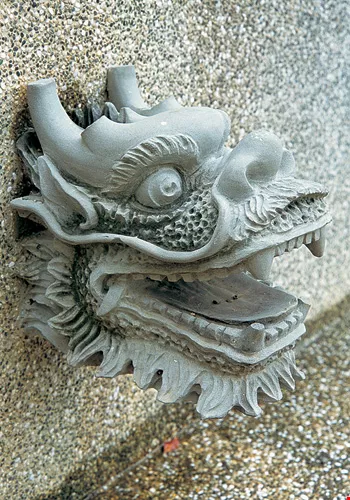
One of the Dragon's Eye Wells (Lungmuching) that give Lungching its name-unfortunately today, the wells are bone dry.
Dream on
Lihsiangkuo may have come a long way from being just a dream, but as far as Pai's concerned, it's still got a way to go, and he's almost afraid his dream will never be fully realized.
"The artistic community I originally envisioned is still a way off, since my ideal was for art studios to prosper here, but at the moment there are more restaurants than studios, which is just kind of superficial and too consumer oriented," laments Pai.
In the early days, the town was actually home to several studios, and the work that came from them developed quite a reputation, bringing in orders from all over for clothing and artworks. Pai figured this would be enough for the town to live off. But now, it's become mostly shops rather than workshops.
The basic cause of this situation is exactly that reputation-as the artists got better known, a lot of them moved out to find larger studios, or out into the forest for some peace. Those that remained were forced to move into smaller places in lanes and alleys because of the rising rent for their old studios, and eventually many just upped sticks and left. As a result, the number of artists resident in the town has dropped from more than ten in the early days to two or three now. As far as Pai is concerned, without the color, variety, and sense of artistic community the artists brought to the place, Lihsiangkuo is like a flower that's lost its roots, fading into a mere shadow of itself.
Despite this, you don't have to look too hard to find places that have retained their old spirit, like the studio Son of Hsiao-yu.
Hsiao-yu and family, who set up shop in the community early on in the piece, moved into one of the lanes fairly early to avoid the increasing rents, and now they display their work in the front of the shop. Hsiao-yu does metalwork and fashion design, with all his pieces having a certain Zen-like simplicity; they have even attracted the interest of Eslite bookstore, who, rumor has it, have invited Hsiao-yu to set up a display in their stores.
The Tatu Mountains are known for the rice paddies that array the foothills, Lihsiangkuo on the hillside, and the sweet potatoes that grow in the red earth of the summit. This photo shows the view from the top of the mountains.
From mountain to river
To people from outside the area, Lihsiangkuo is the big drawcard for Lungching, but for the average local farmer, that community and its streams of visitors-from Taichung and further afield-can't hold a candle to their red soil.
Since the earth of the Tatu Mountains is so iron rich and easily oxidized, it has taken on a reddish hue. The high acidity of this red soil means it's not too good for agriculture, and because the geography of the area makes it difficult to irrigate, the farmers there can only really grow drought-resistant crops like sweet potato. In recent times, though, you can see more and more green bristlegrass being grown around the area. Bristlegrass doesn't take much to farm; when harvesting, all that's kept is the root, which is then washed and chopped for use in stews and soups. When this root hit the market, with its reputation for high nutritional value, it received rave reviews, and farmers took to planting row upon row of it, making bristlegrass Lungching's new cash crop.
Water may be scarce in the tablelands, but the plains at the foot of the mountains sit on a fault line, and as such have plentiful underground water supplies. This attracted a number of Pingpu Aboriginal tribes to the area. Then, during the Qing Dynasty, a large number of single men from Zhangpu, in China's Fujian Province, moved to Taiwan and married Aboriginal women. As local historian Lin Sung-fan points out with the aid of old photos, the Pingpu women were both beautiful and capable, with a reputation for excelling in weaving and working the fields. They would have seemed like the perfect women to the men of the time.
But the Tatu Mountains and their red soil aren't the be-all and end-all of the lives of the residents of Lungching, as Lin notes-at around the turn of the 20th century, before the mouth of the Tatu River had silted up, there was a port there by the name of Tukechueh, which was the only major cargo port in central Taiwan for a time during the Qing dynasty.
Back then the Tatu River was a major crossing point for inward and outward shipping. Incoming goods included rice, sugar, and camphor headed for Wujih, Tali, and Taiping, amongst other places, while the outbound goods were mostly headed for Japan. Lungching was a bustling town, thanks to the constant flow of shipping traffic.
These days, the shipping capacity of Tatu River has dropped off, and the port is no more. Instead the things the river is most known for are the large stretches of watermelon plots and the flocks of wild geese that gather at the river mouth. But the river itself continues to flow, and to this day continues to run through the irrigation channels into the rice paddies of the area, nourishing the earth and bringing life to Lungching.
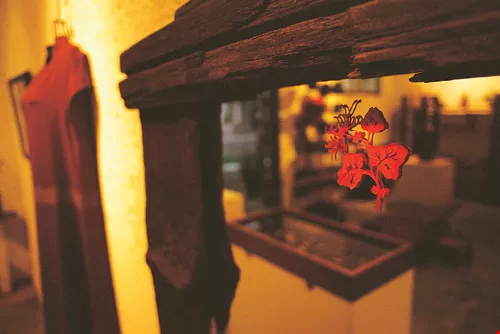
The studio Son of Hsiao-yu was one of the earliest members of the community here, and carries on in one of the town's alleys to this day, displaying the works they're currently selling outside the storefront.
Strategic stronghold
Looking out over the Tatu tablelands toward the sea, the red and white smokestacks of the Taichung Thermal Power Plant, Taiwan's largest, tower proudly over the plains, visible to all travelers driving down the highway miles away from the plant itself. Further down toward the coast, the warm water discharged by the power plant's pipes attracts both shoals of fish and groups of fishermen alike.
In order to power the growing economy of the area, the whole plain is surrounded by pylon after pylon. Although Taipower have agreed to pay annual compensation of NT$1000 per person to the local residents, that money can't make up for the unease and fear caused by the illnesses that the pylons are said to have brought to the area. When talking about this, Lin Sung-fan gets quite emotional: "These pylons are like a hangman's noose around Lungching."
Taichung Port, near the Tatu Mountains, is part of the restricted Taichung Port Special District, and the summit of those mountains is one of the best anti-aircraft defense points in Taiwan; even today you can still see several pillboxes at the summit pointed out over Taichung Port, ready to defend it should the need arise.
Since building in the restricted zone is prohibited, the area is virtually an oasis, which was one of the factors in deciding to establish the Taichung Metropolitan Park in the area. The park, which is 88 hectares in area, is a vast, ecologically rich area, and is dotted with lights in the evenings, making it a must-visit for visitors wanting to take in the best nighttime scenes in the Taichung area.
Meanwhile, off to the eastern side of the Tatu plain is the site of the in-construction Central Taiwan Science-based Industrial Park (CTSIP), which is gaining wide attention, and which started soliciting for occupants in July this year. At the moment, recent arrivals who have moved to the area ready to take up jobs at the science park are having to vie with students of neighboring Tunghai University for apartments, and it's clear to see that in the next few years, as the park continues to grow, there will be an astonishing number of people moving to the area, bringing with them massive leaps in both traffic and business opportunities.
As far as outsiders are concerned, CTSIP looks set to lead Taiwan to a new economic peak, bringing with it skyrocketing property prices in the Tatu Mountain area and a new period of prosperity to Lungching. As for the simple farmers of the area, they enjoy their lives between the mountains and the river, and their peaceful, relaxed community-the last thing they want is for rapid progress to rush in and take it all away from them.
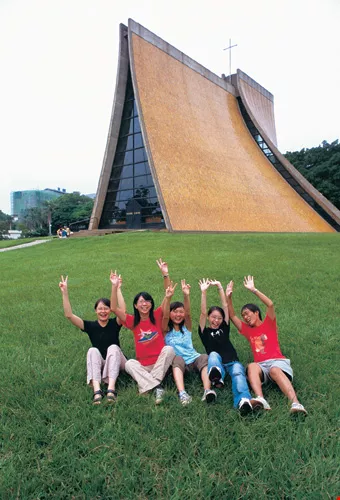
Businesses of all kinds can be found within the township of Lungching, many of which seem to be being kept alive by the students of nearby Tunghai University. This photo shows the Tunghai Chapel, designed by architect I.M. Pei.
About Lungching Township
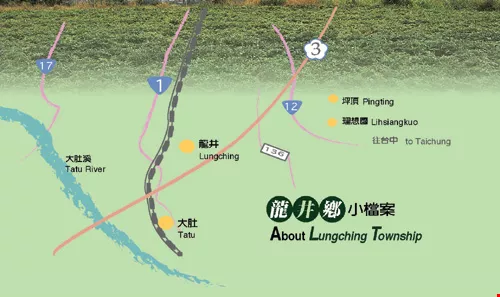
Lungching Township sits in the southwest of Taichung County, with the mouth of the Tatu River to the south, the Taiwan Strait to the west, and the Tatu Mountains and Taichung City to the east. The township has a population of over 60,000, covering an area of 38 square kilometers, and is one of Taichung City's satellite townships.
The area is predominantly plains, with rice paddies occupying a large portion of the land. At the foot of the mountains is the 120-year-old Lin Family Ancestral Home, which was built during the late 19th century, one of many examples of the traditional open courtyard style of building that was brought over from southern China. Midway up the mountains you can find the township and artistic community of Lihsiangkuo, one of the area's major attractions. (compiled by Kate Yang/tr. by Geof Aberhart)
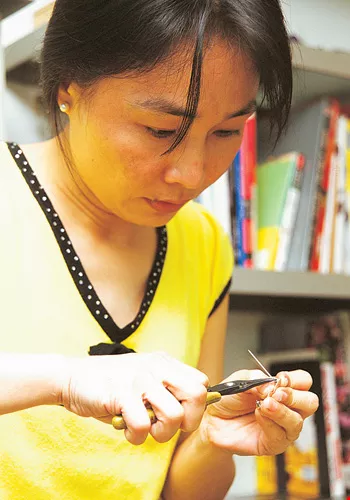
The original concept behind this artists' community is to attract artists to move here and carry on their creative work, which has given the place its own unique character.
The Eye of the Dragon
Don't be fooled, Lungching isn't named for its famous namesake tea; in fact, the name "Lungching" simply comes from the area's two old Dragon's Eye Wells-or Lungmuching-which had a reputation for being able to "spring several meters high, like a fountain of brilliant spring flowers."
The search for the origins of Lungching's name takes us, led by local historian Lin Sung-fan, to Lungmu Alley in Lungchuen Village, which sits at the foot of the Tatu Mountains.
It's three in the afternoon, and villagers are starting to gather at the local temple, the Chingshui Ancestral Hall, where the elderly residents sit telling stories to their grandchildren. About 30 meters in front of this scene stand two huge banyan trees, below which sit two dried up old wells-the Lungmuching.
A local man by the name of Mr. Chen, an assistant at the temple in his 60s, recounts to us the story of these wells: when he was a child, the wells were a rich source of water, and every day the locals would go to the wells and draw water. That is, at least, until some schools were built nearby, sucking most of the water out of the underground supply. The residents then tried digging a second, deeper well to get their water supply back to normal, but then the water company ran a pipeline out to the area, which sucked out the last of the water. Now, looking down the well, one can see clear to the bottom, which is bone dry, leaving nothing more than its name to remind people of what once was.
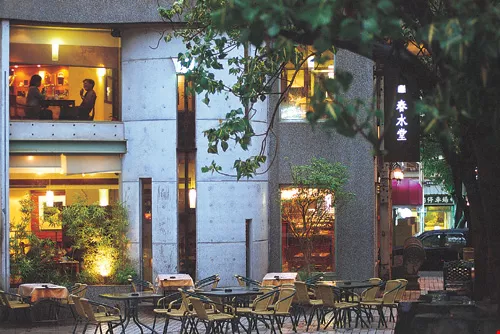
Lihsiangkuo artists' community is the highlight of Lungching Township. The open public spaces on the street corners of Lihsiangkuo give residents a place to chat and relax.
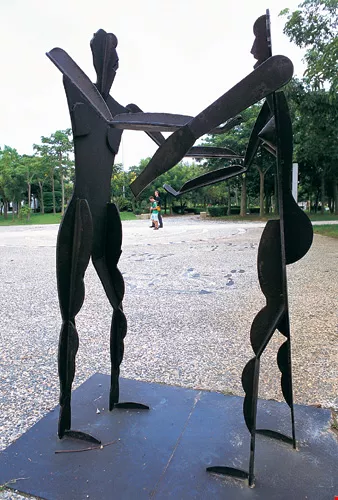
As well as its drought-resistant crops and its stonework, the area next to the Tatu Mountains is also home to the 88-hectare Taichung Metropolitan Park, which is an excellent place for nighttime views of the central Taiwan area. This photo shows one of the sculptures that can be found in the park.
The Tatu Mountains are known for the rice paddies that array the foothills, Lihsiangkuo on the hillside, and the sweet potatoes that grow in the red earth of the summit. This photo shows the view from the top of the mountains.
The Tatu Mountains are known for the rice paddies that array the foothills, Lihsiangkuo on the hillside, and the sweet potatoes that grow in the red earth of the summit. This photo shows the view from the top of the mountains.


@List.jpg?w=522&h=410&mode=crop&format=webp&quality=80)


