Chinese Documentary Goes International:An Interview with CNEX CEO Ben Tsiang
interview by Teng Sue-feng and Wei Hung-chin / photos courtesy of CNEX / tr. by Josh Aguiar
October 2012


Money, dreams and hopes, the next generation’s homeland, crisis and opportunity, youth and citizenship, education.... 100 documentaries shot over the course of 10 years, with each year devoted to a single overarching theme. With this ambitious undertaking the CNEX Foundation hopes to bear witness to the changing face of Chinese society in Taiwan, mainland China, and Hong Kong.
The name CNEX is an amalgamation of two concepts, “See Next” and “Chinese Next.” The organization provides a space for archiving images of the Chinese experience and a window for broadcasting Chinese-language documentaries to the world. CNEX CEO Ben Tsiang is the visionary behind it all, and the man responsible for applying an international production style to Chinese documentaries.
Q: CNEX has been screening submissions for six years now, and in 2010 inaugurated its Chinese Documentary Forum. How do these two methods of sponsoring and producing documentaries differ from one another?
A: CNEX acts as both sponsor and producer for these films. Over the past few years we’ve seen directors really grow and mature to the point that they’re ready to tackle larger challenges, in terms of both subject matter and budget. The problem is that presently our annual budget for each film we select is limited to around US$20,000. If a documentary manages to be selected by one of the film festivals, then we often spend up to US$100,000 to reformat it for the big screen, as well as on promotion.
In recent years we’ve discovered that some of the material is actually quite suitable for international audiences, so we’ve been thinking of ways to get on the international circuit, which involves revamping our selection process.

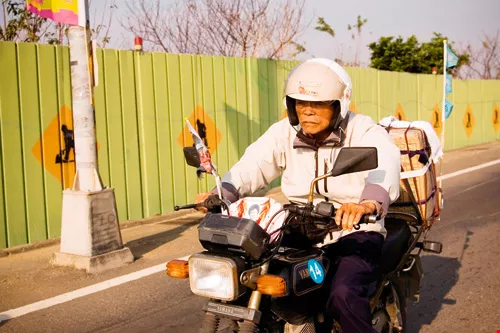
CNEX worked with the Hondao Senior Citizens’ Welfare Foundation to make Go Grandriders, the thrilling tale of a group of seniors, who despite their average age of 81, circumnavigate Taiwan, a journey of 1178 kilometers, on their motorcycles. The film hits theaters on October 12.
In many cases, even documentaries made in the most supportive countries have to tap into overseas funding, for the simple reason that films whose budgets exceed US$300,000 seldom recoup that investment at the domestic box office alone. In Europe and the US, “pitching forums” have been an institution for some time already. Amsterdam is the focal point in Europe, and Toronto is the counterpart in North America. It’s hard for Chinese filmmakers to make inroads at either locale, but there is nonetheless tremendous interest in Chinese stories.
After examining the broader trends I began pondering whether it might be possible to establish a similar platform that would specifically bring together Chinese stories. The success of the first Chinese Documentary Forum in 2010 exceeded all expectation. Eighty films were submitted from Taiwan, Hong Kong, and mainland China, of which 18 were selected. The event was covered by the international media and there was even a contingent of foreign filmmakers on hand to share their expertise. The following year was even bigger, with over 100 films participating in that preliminary round.
There are so many relevant stories within the Chinese world; all that’s needed is a bridge to the outside world. What we’ve done is find a way to link the stories with directors, producers, international cooperation, promotion, and finally audiences in a big value chain.
The smaller-scale screenings we do are like the minor leagues; the Chinese Documentary Forum is the big leagues where we take mature concepts and offer them to the international community, and as such, it gives Chinese filmmakers a tremendous opportunity for growth.

CNEX’s declared mission to bear witness to unfolding Chinese history has achieved a broad resonance, as demonstrated by the success of such films as KJ: Music and Life, 1428, and Hip-Hop Storm, all of which received awards at various domestic and international festivals.
Q: To date, CNEX has helped produce more than 20 Chinese-language documentaries. Are there any cultural differences in terms of the subject matter?
A: Generally speaking, mainland filmmakers tend to focus on social issues; they take the sociological perspective. But in Taiwan, the emphasis is on the individual and matters of the heart—a psychological perspective, if you will.
One of our films the first year was Umbrella, from mainland director Du Haibin. It examines all of the facets of the umbrella industry, from the workers who assemble them to the businessmen who sell them, to students clutching umbrellas as they scour the streets for jobs in the pouring rain. Umbrellas become the prism reflecting a Chinese society in constant flux in the wake of economic reform.
In Taiwan, on the other hand, Hip-Hop Storm casts the spotlight on 34-year-old A-lun, a 17-year hip-hop dance veteran, and the fulfilment of his quest to dance at the Juste Debout competition in Paris. KJ: Music and Life is a portrait of a Hong Kong prodigy at two stages of his life, ages 11 and 17, exploring his ambivalence towards the pressures of performing, and touching in the process upon such complicated themes as parent-child relationships, education for the gifted, social utilitarianism, and the philosophy of childrearing.
The mainland is caught up in a very turbulent transition: a single policy can have far-reaching consequences for individual lives. The most sweeping social change in Taiwan occurred 20 years ago, and the dust has settled. As a result, people pay greater attention to the psychological and spiritual needs of the individual. And in the wake of the return to Chinese rule, Hong Kong constantly battles with issues of identity and place in the world.
Using Sun Yat-sen’s Three Principles of the People as a metaphor, contemporary Taiwan is most concerned with democracy, Hong Kong with social welfare, and mainland China with nationalism. The values are totally different.

CNEX’s declared mission to bear witness to unfolding Chinese history has achieved a broad resonance, as demonstrated by the success of such films as KJ: Music and Life, 1428, and Hip-Hop Storm, all of which received awards at various domestic and international festivals.
Q: CNEX brings Chinese-language documentaries to the international stage. Are there many opportunities? How have they been received?
A: Taking things international is a way to augment a film’s influence. When a film does well at an international festival, it earns a cachet that will improve its reception back in the Chinese community.
Naturally, not all films are treated the same way. We’re very deliberate about the whole process. Some films are ready to be shown to Chinese audiences immediately. With some of the others, the path is more circuitous, requiring exposure overseas before ultimately showing them back home.
There’s one film this year on the verge of completion about sandstorms raging in mainland China. The focal point is on an endangered oasis in Minqin in Gansu Province. The oasis is situated between two encroaching deserts. Should the oasis eventually succumb to desertification it poses a direct threat to Beijing and even to Japan, and the locals are constantly being displaced.
Last year at the pitching forum, Japanese and European attendees were very much taken with the plight of these environmental refugees, especially the Japanese, since they themselves are likely to be affected. As a result, NHK has been collaborating with us on it.
Q: Can you discuss the commercial aspects of documentary film? In Taiwan, for example, the domestic box office has been on fire in recent years. Have documentaries fared similarly well?
A: It’s still essentially impossible to fund these films through sales alone, which means that we’re relying heavily on fundraising and donor support. But there are some positive signs: In the last three Taipei Film Festivals, the top honors have gone to KJ: Music and Life, Hip-Hop Storm, and Hometown Boy. Our documentaries are going head to head with dramatic films and coming out on top. KJ: Music and Life even won prizes for Best Editing and Best Sound Design.
Every year there are documentaries that hit the theaters in Taiwan, such as Go Grandriders, a film made with the assistance of the Hondao Senior Citizens’ Welfare Foundation that will hit theaters in mid-October.
My general sense is that dramatic film is becoming more like documentary in terms of verisimilitude. Documentaries, on the other hand, are becoming more creative and engaging. They’re starting to make use of animation and music. Documentary can be fun—it doesn’t have to be some stuffy anthropological dissertation.
We’re constantly on the lookout for alternative media outlets, like television, which can share production costs and guarantee an audience. But the subject matter and visual aesthetic have to be appropriate to the TV medium for it to work. In the future, we hope that every documentary can have one cut for TV and another for the theaters: a more measured pace for people to digest slowly in the confines of the theater, and a faster pace for television, as well as a shorter duration of approximately 50 minutes.

CNEX’s declared mission to bear witness to unfolding Chinese history has achieved a broad resonance, as demonstrated by the success of such films as KJ: Music and Life, 1428, and Hip-Hop Storm, all of which received awards at various domestic and international festivals.
Q: You’re Internet savvy. What can the Internet do for documentary film?
A: Developing things on the Internet has to proceed in steps. We’re in the process of assembling an Internet broadcasting network comprising six different mainland web channels. It’s got great potential. Documentaries deal with social concerns that are relevant to people’s lives, so it’s not impossible for a new film to get around 5 million hits in a single day. In the past three months, we broadcast some things online and were able to get 2–3 million views on a single website.
But the Internet isn’t profitable right now. All we can do is put stuff out there to establish a presence. If we want to succeed from a business standpoint, we need to continue adding more features and content to attract more hits.
Right now there are so many different outlets, including theaters, television, DVDs, the Internet, even school campuses. Theaters on the mainland don’t show documentaries and the DVD market is completely rife with piracy. Every time a DVD is released in Taiwan, pirated copies begin showing up immediately in mainland China. So the Internet truly has the best potential as far as the mainland is concerned.
If you can get 100,000 people to see a documentary at a theater or some other brick-and-mortar venue, that’s quite a tour de force. But on the Internet it’s no big deal to get 5 million views! Moreover, it helps establish a good reputation for a film and can even attract attention from the traditional media. The Internet really is a resource that documentary film needs to exploit further.

CNEX worked with the Hondao Senior Citizens’ Welfare Foundation to make Go Grandriders, the thrilling tale of a group of seniors, who despite their average age of 81, circumnavigate Taiwan, a journey of 1178 kilometers, on their motorcycles. The film hits theaters on October 12.
Q: What role does Taiwan play in Chinese-language documentary? What does CNEX hope to accomplish in its first 10 years?
A: Well, the mainland has had documentary film festivals, like the one in Guangzhou, but the problem is that they tend to get censored once they get successful enough for the government to take notice. You can’t discuss Tibet, Tian’anmen, the Great Famine; there’s no critical material for international audiences to view.
Recently, the mainland has decided to invest in documentary, even setting up a documentary center in Xi’an where filmmakers can work without having to starve in seclusion in their apartments. The government is also providing financial muscle to attract foreign filmmakers to help tell Chinese stories.
In terms of free speech and cultural expression, Taiwan is foremost amongst all Chinese societies, which makes it an ideal place for documentary workers to meet and interact. Taiwan has a responsibility to have a festival that provides an indispensible annual event for Chinese and foreign documentary workers. We should fight for the honor of being the nexus of all Chinese-language documentary activity.
I run into a lot of overseas Chinese at the film festivals I frequent, and they seem quite taken with the direction we’re taking. Many have expressed the hope that the overseas community can contribute to and support our efforts.
Presently, I’m concerned with the mode of production of documentaries, the operational aspects, namely how we can achieve better distribution in the Chinese community and overseas. I want to consult with directors on how we can prime the material—find how we can better tell Chinese stories—for viewing by the world at large. I hope that in the next few years CNEX’s international collaboration will begin to bear fruit.

CNEX worked with the Hondao Senior Citizens’ Welfare Foundation to make Go Grandriders, the thrilling tale of a group of seniors, who despite their average age of 81, circumnavigate Taiwan, a journey of 1178 kilometers, on their motorcycles. The film hits theaters on October 12.

The 2012 CNEX Documentary Film Festival carries the theme “Youth and Citizenship,” and includes such films as Dialogue between Blue & Green (right), a snapshot of first-time voters in a Taiwanese presidential election, and Bazaar Jumpers (facing page), a look at extreme sport enthusiasts in mainland China. This choice of themes reflects the hope that today’s young people will undertake the responsibilities of both being good citizens and promoting the ideals of citizenship.
CNEX worked with the Hondao Senior Citizens’ Welfare Foundation to make Go Grandriders, the thrilling tale of a group of seniors, who despite their average age of 81, circumnavigate Taiwan, a journey of 1178 kilometers, on their motorcycles. The film hits theaters on October 12.

CNEX worked with the Hondao Senior Citizens’ Welfare Foundation to make Go Grandriders, the thrilling tale of a group of seniors, who despite their average age of 81, circumnavigate Taiwan, a journey of 1178 kilometers, on their motorcycles. The film hits theaters on October 12.

CNEX worked with the Hondao Senior Citizens’ Welfare Foundation to make Go Grandriders, the thrilling tale of a group of seniors, who despite their average age of 81, circumnavigate Taiwan, a journey of 1178 kilometers, on their motorcycles. The film hits theaters on October 12.

@List.jpg?w=522&h=410&mode=crop&format=webp&quality=80)

@List.jpg?w=522&h=410&mode=crop&format=webp&quality=80)


