Taking to the Streets
--Taiwanese Opera in Singapore
Tsai Wen-ting / photos Pu Hua-chih / tr. by Christopher MacDonald
September 1999


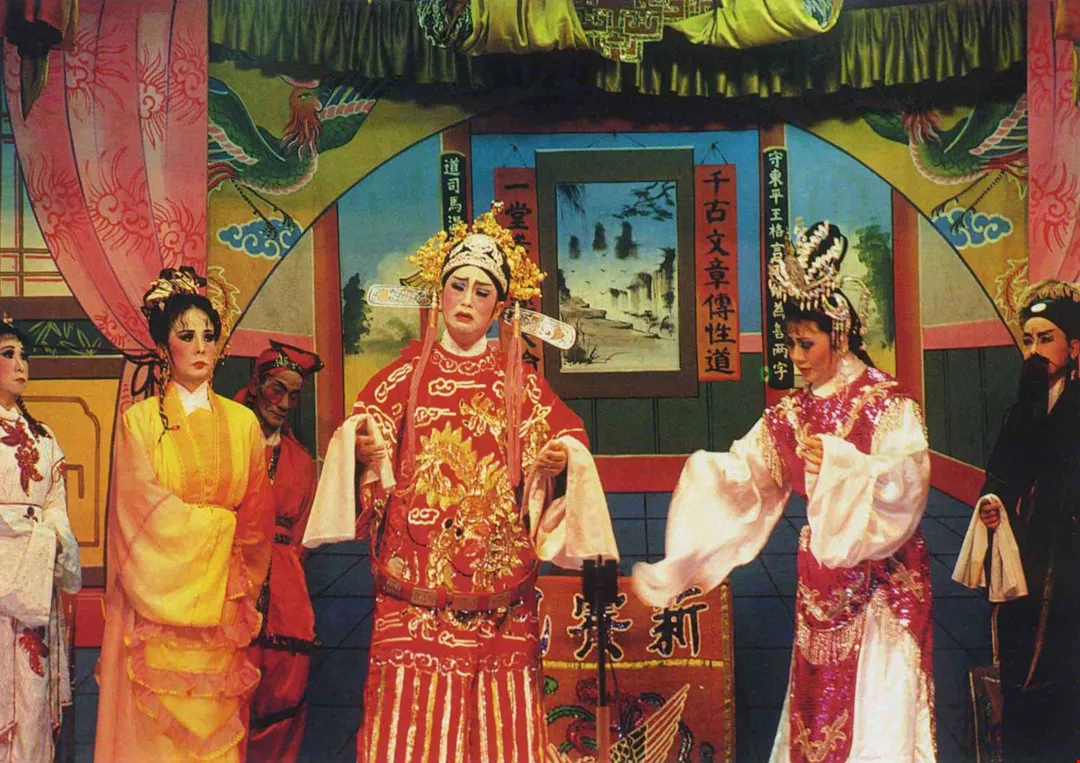
Looks familiar? It's known as "Fujianese opera" in Singapore, but the influence of Taiwanese street opera can be seen in the style of performance, the stories and the costumes.
Driving into town from Changi Inter- national Airport in Singapore you follow a boulevard that is planted on both sides with neatly spaced bushes and trees, and on reaching the city itself you see serried ranks of high-rise buildings and clean, orderly streets where everyone seems to be speaking English. Turn on the television in your hotel and the first thing you hear is a greeting in English, Chinese, Indian and Malaysian.
In this modern, multi-ethnic city state, the bamboo-scaffold outdoor stages that are erected for Taiwanese street opera have become for Singaporean Chinese a window onto their own traditional culture.
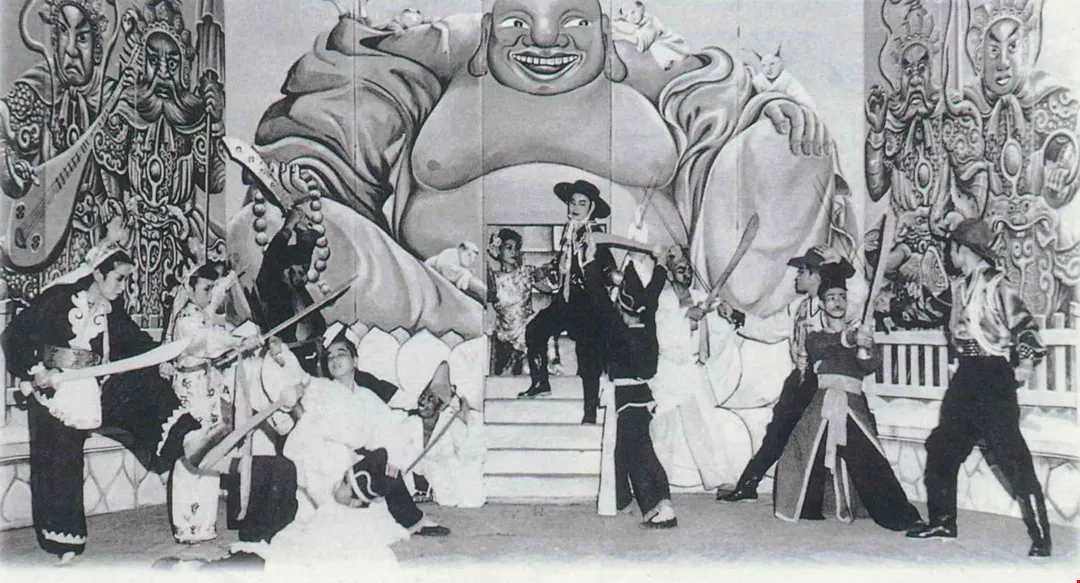
Fancy machine-operated sets and western-style outfits were some of the novelties used to attract audiences as competition heated up between the different opera troupes. (courtesy of Singapore History Museum)
Believe it or not, Singapore is currently the world's busiest spot for ko-tzai-hsi (Taiwanese folk opera). In an age where traditional drama can barely compete with newer entertainment media like film and television, the Lorong Koo Chye Sheng Hong [city god] Temple in Singapore is still able to stage over 100 days of Taiwanese opera every year. The world capital of folk opera
The 28th day of the fifth month in the lunar calendar is the birthday of Lorong Koo Chye, a guardian deity venerated as the city god. The icon was brought to Singapore eighty years ago from Anxi in Fujian province, at the request of local followers-ethnic Chinese from southern Fujian, Chaozhou and Guangdong-who remain devoted to the god for his remarkable efficacy. What originally began as two days of thanksgiving opera gradually extended to 50 days, 70 days, and now in the 1990s over 100 days of performances. "There are 101 days of opera this year, running from the 31st day of the third lunar month to the 28th day of the sixth month, but it's still not enough," says Tan Thiam Lye, honorary secretary of the Sheng Hong Temple Association. "Many of those who hoped to sponsor performances have had to wait until next year!"
Because the season is so long, every Fujianese opera group in the city gets invited to perform, along with ko-tzai-hsi troupes from Taiwan and Xiang opera troupes from mainland China. This year's program included a ko-tzai-hsi troupe from Xiamen in China, bringing a repertoire that included a new version of Turandot, and performing for 22 days on the trot at a total cost to the organizers (including performance fees, airtickets, food and board) or around S$200,000, or roughly NT$4 million. As Singapore audiences know well, for good opera, the city god temple is the place to go. One regular, a lady in her sixties, says that her husband drives her to the temple every day, half an hour by car, to see the shows. So far this year she has seen nearly two months' worth of operas.
At this time of year there is intense competition among different troupes-some of which are otherwise lackadaisical about live performance-to impress their audiences with new operas, costumes and scenery, and sometimes with guest appearances by top opera stars from Taiwan. Frankie Hu, an upholstery businessman and regular attendee, recalls last year's performance by the locally renowned Xiao Kee Lin Troupe of the butterfly-metamorphosis scene at the end of Liang Shan Bo and Zhu Ying Tai, for which the troupe's leader Liu Huchen-known as "Tiger God"-used fishing line and remote control to bring the butterfly fluttering up from the grave, caught beautifully in the soft glow of the stage lighting.
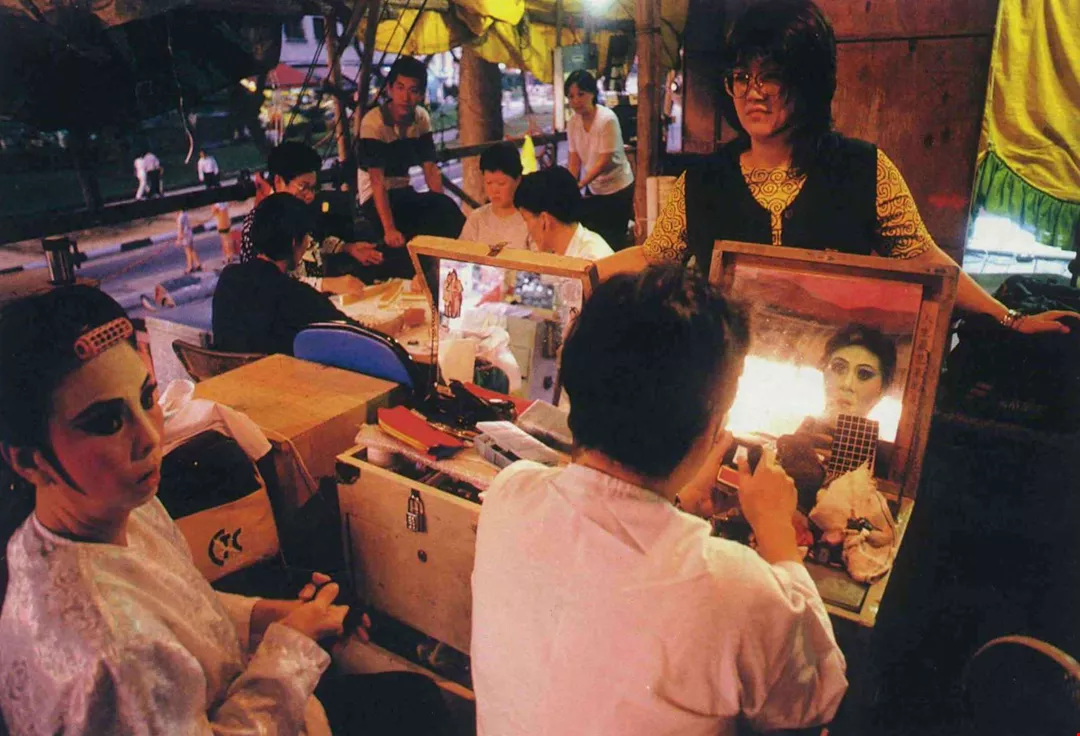
Troupe members who aren't playing lead roles relax over a game of mahjong before the start of the show. There are still around a dozen professional Fujianese opera companies in Singapore.
Assistant curator at the Singapore History Museum Ken Cheong, who has written a thesis on Fujianese opera in Singapore, describes the annual performances at the city god temple as a "theatrical jamboree, and a big incentive for opera troupes who usually play for tiny audiences." The three-way support between temple, believers and opera groups makes this a vibrant, living theatre which doesn't need to rely on government support. The three flowers of Taiwanese opera
Ko-tzai-hsi is a product of Minnan (southern Fujianese) culture, for which various forms of local opera from the Zhangzhou area of Fujian were merged in Taiwan to create a new operatic form. When this was in turn transmitted back to the Fujian region it was named "Xiang" opera, and because of the migrations of the Minnan people and touring performances by troupes from Taiwan, Xiang caught on in Southeast Asia, becoming known in Singapore as "Taiwanese opera." At the time of WWII, when the Japanese occupied Singapore and Malaysia while holding Taiwan as a colony, ko-tzai-hsi was renamed "Fujianese" or "Min" opera.
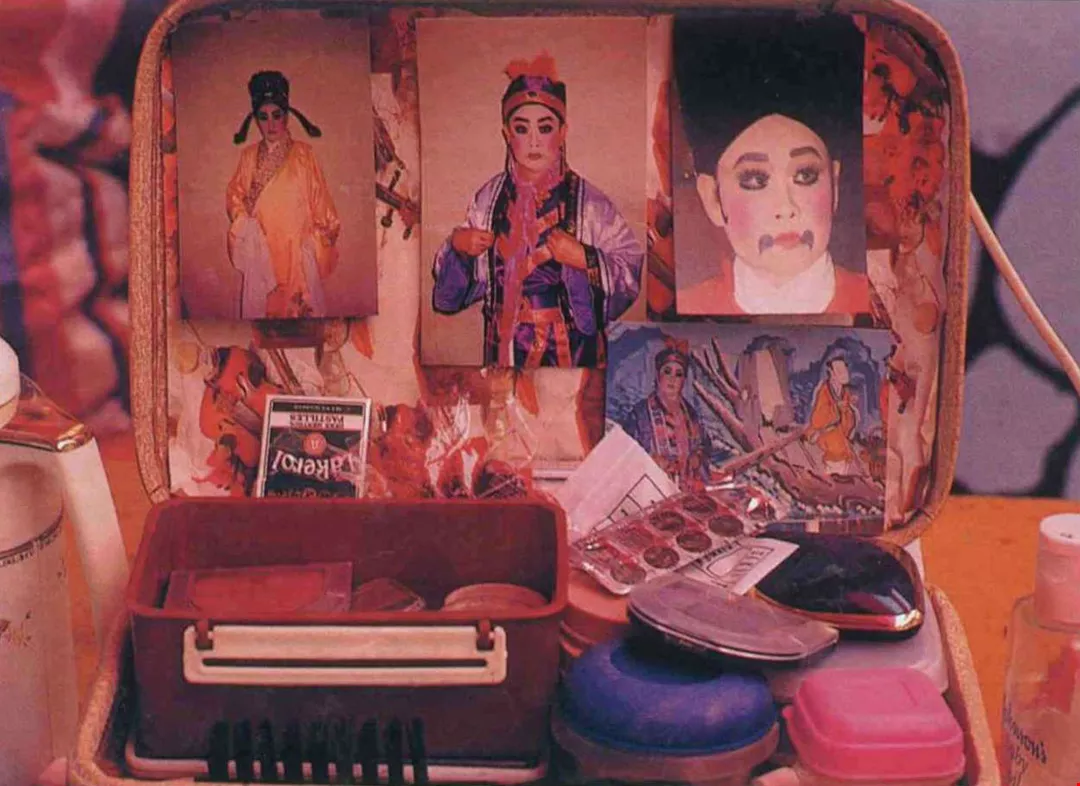
Photos decorate the compact make-up case. Life imitates drama and drama imitates life.
The chairwoman of the Taipei Society of Contemporary Opera Shen Hui-ju, who has studied the links between ko-tzai-hsi in Taiwan and Singapore, explains that this form of opera was already popular in Taiwan by around 1930, and started to take off in other places where Minnan was widely spoken. With its combination of intelligible language, upbeat melodies and everyday dialogue, ko-tzai-hsi rapidly caught on throughout Southeast Asia, particularly among the large Minnan population of Singapore-where it launched a whole new chapter in the development of local opera. Go South policy
Before 1930, when Singaporeans were still in the dark about ko-tzai-hsi, what was popular was gaojia opera, based on traditional Nankuan music. Then an opera group from Taiwan, the Phoenix Troupe, visited Singapore and Malaysia after giving some shows in Xiamen, and became an instant sell-out hit. The Phoenix Troupe continued working in Singapore for several years before returning to Taiwan in triumph.
The box-office success of the Phoenix Troupe inspired other ko-tzai-hsi companies to try their hand in Southeast Asia, and in addition to performing at established venues they began carving up the market for temple shows in Singapore. Unable to resist the ko-tzai-hsi onslaught, local gaojia troupes either folded or simply converted themselves. The Xin Sai Feng Fujianese Opera Troupe, one of the most prominent in Singapore today, turned to ko-tzai-hsi in 1936. "It was a matter of survival," says the troupe's third-generation leader Wei Mufa, recalling his father's decision at the time. "Since Fujianese opera was taking over it made sense for us to follow the trend."
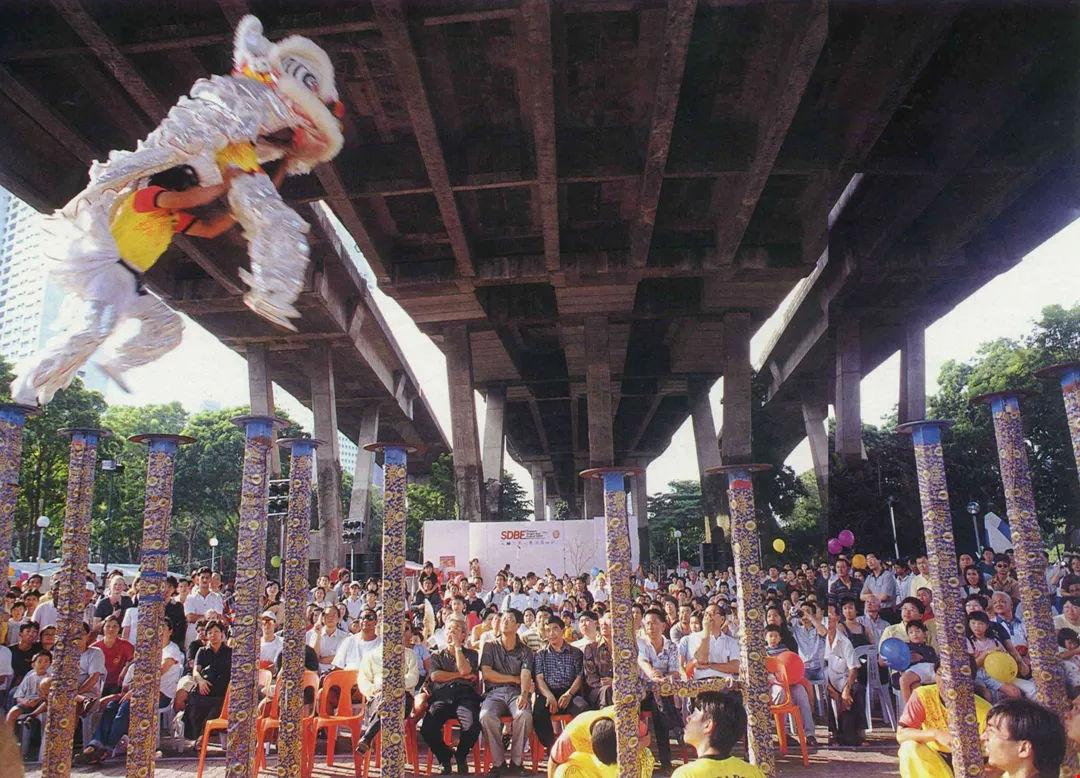
In multi-ethnic, multilingual Singapore, traditional drama and other customs help maintain the memories and culture of the Chinese. The picture shows a Cantonese lion dance during celebrations for Dragon Boat Festival.
Cashing in
The post-war period of the 1950s and early sixties was a boom time for Fujianese opera in Singapore. Opera companies and impresarios from Taiwan recruited the best performers they could get hold of and one after another came south to cash in on the craze. The enthusiasm of opera fans in Southeast Asia made it an unforgettable time for the performers. Liao Chiung-chih, a winner of the National Culture and Arts Award, spent a year and a half in the region during that period, performing with the Peony-Cassia Troupe. Actors' fees for touring overseas were little different from what was paid in Taiwan, but there were big earnings to be had in tips from fans. A wealthy businessman from Brunei once stuffed a red envelope containing 1,500 ringgit-equivalent to over NT$20,000-into Liao's handbag. "That night," she recalls, "I hid under my quilt counting the money, and was so happy that I couldn't sleep a wink. I've never made so much money in my life." Aside from red envelopes there were all sorts of other gifts. One fan used to bring her a baked chicken every day, and another took her to get dentures made and to buy clothes for her son. One lady, a godmother of Liao's, had a gold medallion made for her, which together with its chain came to seven taels in weight.
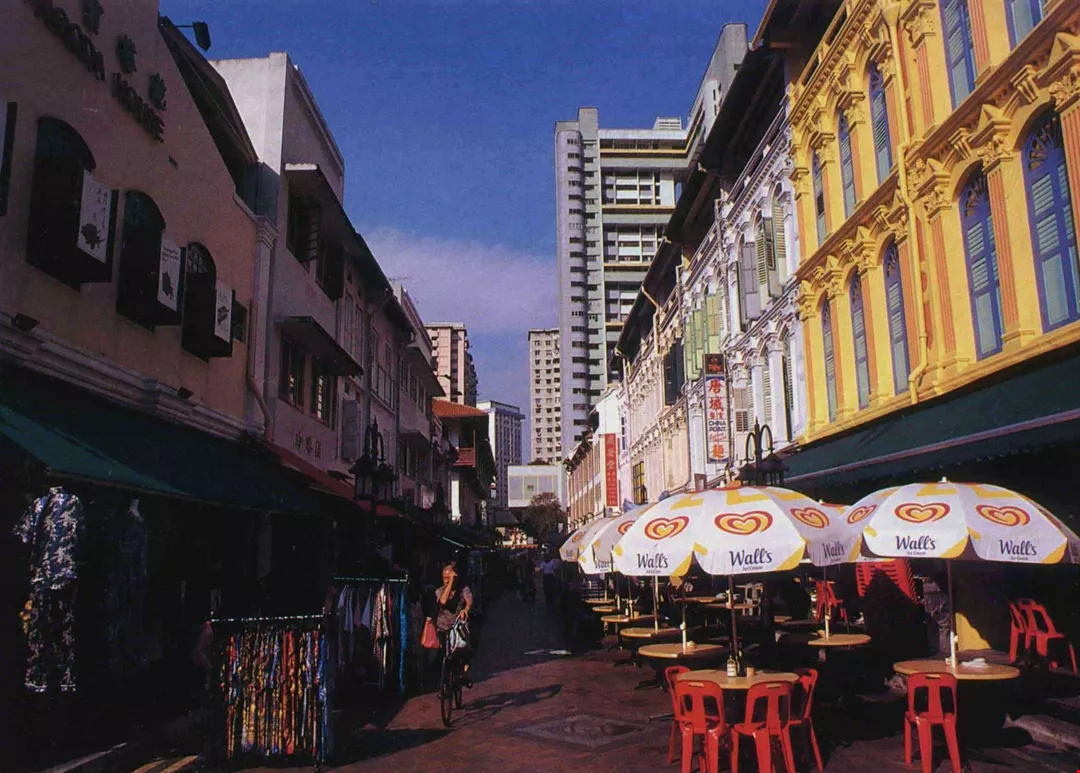
As the city's old buildings and traditional cultures slowly vanish, Singaporeans, with their western-style education, have begun to wonder about their own identity. The redevelopment of the ethnic Chinese Kreta Ayer district has drawn much attention.
Mechanical scenery
At that time, Fujianese opera troupes were sprouting up throughout Singapore. The artistes were young and good-looking, and often figured in the celebrity rankings compiled by local entertainment weeklies. The leader of the Xin Kee Lin Troupe, Jin Shanghua, along with the actress Lin Jinzhi from the same group, starred together in a film of a Fujianese opera entitled The Drunken Assault on Jinzhi. Also the sisters Yingying and Yanyan from the Ying Yan Fujianese Opera Troupe frequently went to Hong Kong to make movies, and together with Xiao Juan they appeared in the Taiwanese-language film Red Tears of Blood. Many of the Fujianese opera groups also made recordings for Singaporean television, and over 50 such operas were produced for TV.
At that time local troupes were competing for audiences with troupes from Taiwan. The shows were mainly staged at theaters and other entertainment venues, which also hosted performances of Peking opera, Cantonese opera, Hainan opera and Malaysian opera, so it was a challenge for the opera troupes to come up with new ideas.
"It cost a lot of money to stage a Fujianese opera in those days," says Liu Huchen, leader of the Xiao Kee Lin Troupe. One time for a story set in Shanghai, The Shooting of Yan Ruisheng, they drove a real car onto the stage. And at the end of Delivering the City-girl, the eponymous heroine rode off on a real horse. There was so much scenery that it took six or seven lorries to transport it. When an opera called for warriors, they would come flying into view above the heads of the audience, suspended on ropes, and in big fight scenes the stage would go dark, leaving nothing visible except for the light of flashing swords in mid-air. Recalls Liu with a smile: "For one opera the set featured a big Buddha whose stomach opened to reveal a secret stairway, and at the end the protagonist departed in a flying gondola. Those were the days when mechanically operated scenery was particularly popular, and in the business it was what we meant when we said 'Cheat to eat!'"
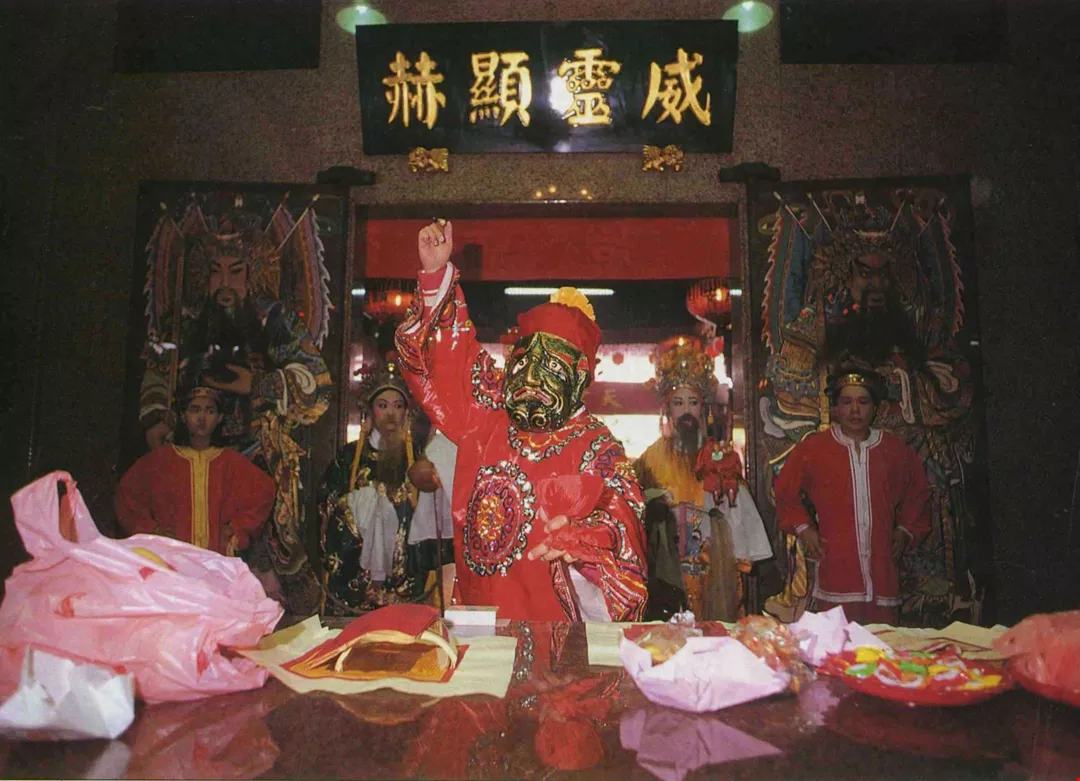
Traditional drama is closely connected with religious faith, and the operas that are staged for temple thanksgiving celebrations are a way of expressing people's wish for a blessed life. The picture below shows a c harm intended to ensure that everything goes smoothly on stage.
In addition to introducing mechanical sets, the Fujianese opera groups adapted to keep up with developments in the movies. When the film Mambo Girl was all the rage, the Fujianese troupes suddenly started doing musicals-which they described as "modern Fujianese opera"-wearing contemporary costumes and mambo-dancing to accompaniment from piano, saxophone and drums. It certainly testifies to the eclectic nature of ko-tzai-hsi, and the opera troupes' imaginative instinct for self-preservation. Coarseness vs. refinement
Good times don't last forever, and traditional opera was soon facing stiff competition from movies and television, while the glory days of the old venues faded out. Meanwhile the younger generation was becoming more westernized, and as multilingualism spread Fujianese opera could no longer rely on a captive audience of Minnan-only speakers.
The times moved on, and with the launch in 1977 of the Singapore government's Mandarin campaign, which included a ban on television programs in other Chinese dialects, the audience for Fujianese opera melted away. Matters weren't helped by the uneven quality of the troupes and the widespread perception that Fujianese opera, with its aging casts, its sometimes slapdash performances and its nonsensical plots, was simply crass. In the stories, a down-on-his-luck aristocrat might continue to appear dressed in sequined finery, or in a scene where the protagonist was in a state of anguish, the supporting actors would just stand around blankly.
"Some Fujianese opera really is very crude," says Frankie Hu, a keen photographer who often comes to watch the operas. "They don't walk or talk properly, they sing pop songs all day long and the leading ladies are fat."
Dr Chua Soo Pong, director of the Chinese Opera Institute in Singapore, explains that Fujianese opera is performed without a script. Instead the players act out a story that the director has mapped out for them beforehand. Because of the limited cultural aspirations of the cast and their habit of sprinkling smutty jokes throughout the dialogue, the shows can be rather coarse. "One way of attracting young audiences back to Fujianese opera is to bring in refined productions from elsewhere," suggests Chua.
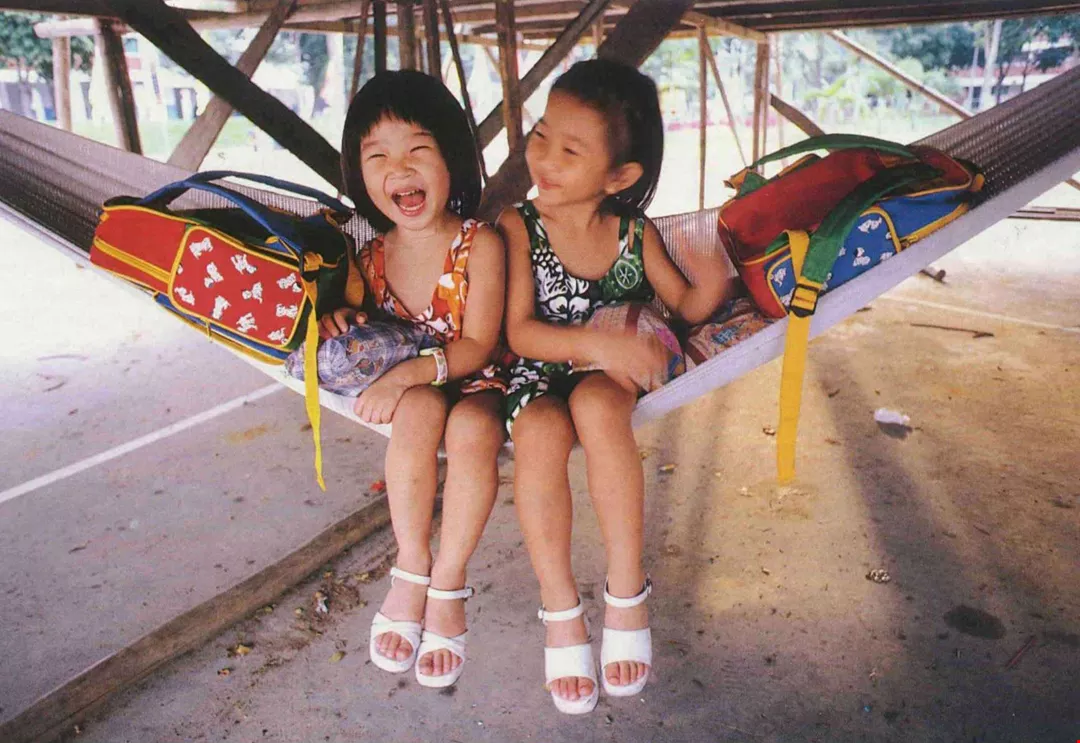
Playing on a hammock under the stage. For the children of this immigrant community, street opera provides a first encounter with traditional Chinese culture.
This is an idea that many have considered, given the contrast between the crudity of street opera, with its improvised performances, and the sophistication of the carefully scripted and rehearsed productions that can be seen in the theater. Even the actors themselves feel that if it's not in a theater, then it ain't art. "We do over 100 operas, and we too would like to perform in a theater, but apparently we're not classy enough!" says Wang Chuhua, leader of the Shuang Ming Feng Fujianese Opera Troupe. Or as another performer says, it would be enough if she could perform just once in her life in a real theater. TV opera saves the day
It was during the 1970s and 80s, when ko-tzai-hsi was on the way out in Singapore, that opera groups from Taiwanese TV stations began performing in Southeast Asia, so initiating a second springtime for Fujianese opera in the region.
The most popular such group at the time was the TTV Joint Opera, which was invited to do a series of shows at the People's Theatre in Singapore. The 40-plus members of the group, including stars Yang Li-hua, Wang Chin-ying, Hsu Hsiu-nien and Li Ju-lin, turned out in force to effect the transition from television back to stage. The TTV group trained together for three months, rehearsing from scripts specially revised for the stage, working on their technique, and obtaining new costumes, props and scenery. By introducing the softer style of make-up used in television opera and adding a few new ballads, they created a fusion of the best in stage and television opera, and filled the 2000-seat auditorium to capacity night after night. Demand for tickets was so great that after a month they had to extend the run by another two weeks. Singapore had become a second home for ko-tzai-hsi.
What exactly is the appeal of Taiwan's televised operas? "In a word: beauty!" says Sim Siew Tin, executive secretary of the Fujianese Association's Xiang Opera Troupe. "Beautiful actors, beautiful costumes, beautiful sets and beautiful locations." At the peak of televised ko-tzai-hsi's popularity, TV opera films from Taiwan were the hottest and most expensive item in Singapore's video rental stores. Fujianese opera groups in Singapore also began copying stories from Taiwan videos. Says Cai Jianfu, a board member with the Sai Feng Min Opera Troupe: "Videos of Yang Li-hua, Yeh Ching, Huang Hsiang-lien, Sun Tsui-feng, whoever...you just grabbed anything decent and went off to make your own version."
Promo flyers for live opera at the time highlighted the fact that opera companies were staging new productions using scripts expressed over from Taiwan. Borrowing from the appeal of televised opera in this way proved to be highly effective, and audiences once again began emerging from their front rooms to enjoy the spectacle of outdoor opera. "Seeing that time was right, many performers broke away to form their own groups," says Ken Cheong. The fever has waned since those days, but there are still 13 groups performing in Singapore today, the more prominent of which present up to 200 performances during the course of a year.
But audiences find that while the stage shows are similar to their television equivalents in terms of plot, make-up, costume and singing, things remain much how they always were in terms of the shapes and ages of the actors, and in the way that the operas are acted out. It is still very much an outdoor-style performance, and this remains one of the characteristics of Fujianese opera in Singapore. This is live theatre!
In the suburbs of Singapore, dominated by the high-rises of the government housing projects, redevelopment of old communities has resulted in temples being torn down and merged into newly constructed "joint temples." It may be this god's birthday on one day and that god's birthday on the next day, which means plenty of occasions for setting up opera stages in open areas around the nearby apartment blocks.
The matinee performance attracts only a handful of onlookers, and is a chance for juniors in the company to try out their skills playing servant girls, young soldiers and eunuchs. After the show is over some of the cast play mahjong on the stage, while others go off on errands. Mostly the troupe works from an established repertoire, and it is frequently the case that come 6 p.m. the actors still haven't been told what they'll be performing in two hours time. All they get before the show starts is a brief outline to remind everyone who enters and exits in each scene. For a new production the cast gathers at around five in the afternoon to hear the director explain the story and assign roles, and to run through some action moves. "We do whatever story we think of on the day," says Cai Jianfu. "It's not all fixed in advance."
Eight o'clock approaches, and with a slam of the clapper-boards the musicians start "warming-up the stage." Today the cast have been told they will be presenting an opera entitled Eternally Illustrious. In the wings, the princess is getting ready to enter for Scene One. She raises her forefinger while keeping her other fingers curled, and at this signal the percussionists to one side of the stage strike up a rhythm on the gongs and drums, to which the other musicians add a melody in the "seven-character meter." The princess now comes on the stage singing to the same tune. Next to enter is the emperor's son-in-law, who starts to address the princess, both actors knowing through years of experience how to carry forward the dialogue: "Aiya! Princess. Listen... to... my... words... aah...." The actor playing the emperor's son-in-law raises the pitch of his voice and draws out his words, and as he lifts his thumb the musicians break into another melodic form. In this way, relying on mutual understanding and a few gestures to communicate, the cast and musicians act out the well-known tale of The Orphan of Chao, about an old family retainer who saves the life of his young master.
As to how the performers choose what to sing, it depends on how tragic or comic the plot is, and also sometimes on how they feel on a given day. "Today my voice is OK so I can do a few soprano numbers," says Qiu Meiqi of the Shuang Ming Feng Troupe, "but if I haven't got the voice for it then I stick to songs that don't go so high. So it goes." Qiu's attitude neatly sums up the flexibility of Fujianese street opera.
"A lot of people look down on the street opera troupes, but I think that this type of improvisational performance, in which so much depends on context, is actually art of the very highest kind," says Yung Sai-shing, professor in Chinese Studies at the National University of Singapore. "Show me the mom who keeps stopping in the middle of making dinner to check a cookbook and measure out quantities of salt and MSG." Whether it's high art or low art, traditional drama does after all exist in its own traditional settings and have its own characteristics. And it would be wrong to criticize outdoor theater by imposing on it the viewpoints of Western or modern professional theatre, or of pure art. Theatre of life
has attracted widespread attention of late and been in newspapers almost every day. The multi-ethnic state used to emphasize "forgetting where you come from," but as old buildings disappear one by one and the city takes on a new face, those of the younger generation, educated in English and attuned to Western culture, are beginning to wonder about their self-identity.
Lin Xiaosheng, curator of the Singa-pore History Museum, says: "Quite clearly, Singaporeans are beginning to develop a consciousness about the place they live, and are concerned about the erosion of traditional culture." It is only in the last five years that the museum itself began recruiting staff with both English and Chinese language skills, and systematically building up a collection of local opera artifacts.
Yung Sai-shing says: "Traditional opera is a medium through which an ethnic group forms an identity and provides support for its members. Like the upsurge of interest in Cantonese opera in Hong Kong recently, I think it's all part of a longing for home that surfaces when people feel a crisis of identity."
As demonstrated by the stages that are built outside temples, religious thanksgiving provides the main role for Fujianese street opera. Before the start of each matinee, it is customary for the cast to present a series of short scenes about mythological figures by way of prologue to the main feature. Solemnly and silently, the actors first portray the three immortals representing good luck and long life, paying their respects to the gods. Then one dons a green mask and takes up an inkbrush to depict the god of literature granting honors to deserving scholars, after which comes a scene of Maid Ma making her longevity offering. Lastly the Tiaojia official parades around the stage holding up a scroll bearing the name of the patron of the performance, who, together with family members and guided by temple officials, then lights incense to each of the gods. One temple follower, Liao Yushan, says: "Business has been going well for me in the last few years, all due to the gods' blessings, and this is the seventh year I've come to give thanks by backing an opera."
What all these thanksgiving operas have in common is their expression of people's wish for a good life. Such operas preserve the original form of traditional opera and constitute an important element in the art and the community-building of an immigrant society. In all such immigrant societies, townsfolk associations, temples and opera troupes are bound in a tight triangle of connections. And when opera like this is transplanted into the professional theater, the domain of pure artistic expression, it loses all semblance of what it originally was. Close encounter of the first kind
"When we were children a lot of people went to watch the operas, and we had to bring a straw mat and four nails along to 'stake out' a good spot in front of the temple. There were so many people that it was hard just squeezing your way out to go for a pee," recalls Chua Soo Pong.
"The adults watched the opera while we kids checked out the stalls and munched snacks. All the traditional novels I read when I was a child were bought during those operas," says Koh Eng Soon, a freelance writer who collects historical material about opera.
"Why play immortals? Who is the God of literature? For many people Fujianese street operas, free and open to all-comers, provided a first encounter with Chinese cul-ture, and that was especially so for me," says Ken Cheong. A number of Singapore University students have recently been doing field research into traditional opera because the Fujianese opera troupes, with their close involvement in religious culture, provide the best window onto traditional culture.
Another stage has been erected among the apartment blocks, and after dinner, old ladies in comfortable clothes emerge to spread themselves out across chairs in front of the stage, chatting away and swapping little things to eat. Mothers with young kids in their arms come out to share in the fun, and one buys a little bell for her toddler. With the bell in her hand the child looks towards the stage, where a magnificently costumed actress is performing, her hair festooned with colored ornaments. Amid the sound of gongs and drums, another youngster begins her first encounter with traditional culture.


@List.jpg?w=522&h=410&mode=crop&format=webp&quality=80)


