Green Hills and Hamlets--A New Approach to Community Building
Sharon Wu / photos Hsueh Chi-kuang / tr. by David Mayer
April 2002


Unlike the "one town, one distinct- ive product" model typical of community building in Japan, the town of Sanpoku-machi has had the 48 hamlets within the town's jurisdiction each come up with one unique thing about itself that it can focus on as an asset in the local community building movement.
Faced with depopulation and an economy in transition, Sanpoku-machi has managed, thanks to a community building effort spanning many years, to establish its "one hamlet, one theme" as a new way of going about community building. How did it turn the trick? How did the residents there capitalize on local resources and traditions to reaffirm the worth of their traditional hamlets and make life in Sanpoku a more spiritually edifying experience?
The town of Sanpoku-machi is located on the coast of the Japan Sea in northern Niigata Prefecture, not far from the border of Yamagata Prefecture (where O-Shin, the heroine of a famous 1980's TV series, was from). The town has a population of only a bit over 9,000 and covers a total land area of over 20,000 hectares. Located within the town are Sasagawa Nagare (a national scenic area on the coast noted for its oddly shaped cliffs and rocks), a prefectural nature park, the Ohgawa River (famous for its annual salmon run), and Mt. Nihonkoku. Nearly 300,000 tourists visit Sanpoku every year to swim in the sea, climb mountains, hike, and enjoy the beautiful scenery.
Shoichi Sato, head of the planning section at Sanpoku town hall, explains that "Sanpoku has always been an important tourist destination thanks to Sasagawa Nagare, but then the rest of the local economy stalled and young people started moving away. That's why we launched our community-building movement. We were looking for a way forward." Unlike many other localities, they didn't build a yacht marina or a golf course in hopes of attracting big-spending jetsetters. Instead, they looked inward, to their own traditions, to find the best things about the town. They hit upon the idea of focusing on one distinctive theme for each of the town's 48 hamlets.
Many of the 48 hamlets of Sanpoku-machi are scattered along the town's 26 kilometers of coastline. Mountain forests account for 93% of the town's total land area. The town also has five fishing ports, and is the top salmon producer in Niigata Prefecture. The town's abundant natural resources have given it ample opportunity to develop into a major tourist destination.
Sato looks back with pride on the results that have been achieved over the years in Sanpoku's community-building movement: "We decided to identify what was unique about the local community, and to follow a development path that would affirm the value therein. The most important part of our community-building movement has involved developing local resources and getting people to feel that they are the ones in charge of the movement. Each of the 48 different hamlets within the confines of Sanpoku-machi has launched a community building project designed to accentuate its own special character.
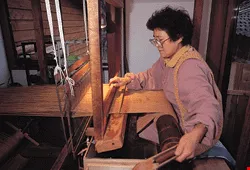
These ladies are quite attached to their hand-woven shina cloth, and tend to think of each item like a daughter.
Shina cloth
The best known of these projects is the "Nariwai no Sato" project at Kaminari Hamlet. It is housed in a traditional Japanese home of the sort you see all the time in Japanese TV shows. The outside walls are covered with bamboo to protect from the heavy snows for which the region is famous.
On the day I visited, a couple of women in their 60s were there weaving shina cloth. They were filling an order for a buyer, and explained: "Shina cloth is made using a special weaving technique that we've been using in Sanpoku for over a thousand years." For women from the local area, it's a technique that must be mastered, for they use it to make all sorts of everyday household items, including bed covers and cloth curtains.
Shina items may look quite simple, but a lot of work goes into them, starting with peeling the bark from the shina tree. The ability to make shina cloth is gradually dying out, but the artisans of Sanpoku are doing their best to keep it alive. By putting on demonstrations and getting the word out and around, they've found several young and highly educated women who are interested in taking up the craft. They are now hard at work at Nariwai no Sato, learning the secrets one warp and weft at a time.
To promote shina cloth weaving, the women assembled a group of 21 local people to put up ¥500,000 each (about US$3,700) to establish an association. The prefectural government and town hall kicked in more funds, bringing the total to ¥27 million, to buy an old house and build it into Nariwai no Sato. There they began designing handbags, door curtains, dolls, and decorative cloth items, and started taking orders from customers. The products command a very good price. The group leader is Chikako Kunii, who says: "These hand-made items have commercial value, but for us they're like daughters. We put our hearts into our products."
A small handbag from will run ¥12,000, a medium-sized bag goes for ¥18,000, and a large one costs ¥20,000. A door curtain sells for about ¥44,000. These items sell very well in spite of the hefty prices, and Nariwai no Sato is already making a profit even though it hasn't been in business very long. This is a reflection of the strong Japanese tradition of buying souvenirs while out traveling. It just so happens, and happily so, that this custom has given these women artisans a chance to keep their craft alive.
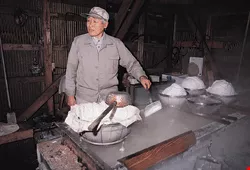
Hiroshi Sato built a salt plant on the seacoast to make salt using techniques he learned as a boy from his father and grandfather. He runs a program to let people come in and have a go with his traditional salt manufacturing techniques.
Salt of the sea
The hamlet of Nakahama also has a well known project going. It focuses on salt-making methods formerly used in the area. The history of salt manufacturing in Sanpoku goes back a long ways. As early as the 9th or 10th century, the local method of boiling salt brine in earthenware pots was already quite well known. This fascinating technique has now been almost completely replaced, however, by the electrolytic process.
But it will never die out completely as long as Hiroshi Sato has anything to say about it. Thanks to the 1997 repeal of Japan's Salt Monopoly Law, private parties are now free to engage in salt manufacturing. Sato, an avid devotee of traditional salt manufacturing methods, has taken advantage of the new legal environment to resume making sea salt, an activity that he remembers helping his father and grandfather with as a young boy. The first step is to make bamboo grates and stack them one atop the other, several deep. Salt-laden seawater is then poured continuously over the bamboo, which speeds up evaporation. Once the brine has become sufficiently concentrated, it is transferred to big ceramic pots for boiling. Beginning from scratch, Sato has gradually built up a small salt manufacturing plant on the coast of the Japan Sea.
Sato lights up whenever he starts talking about salt: "Salt is the most important seasoning there is. Medical researchers are beginning to point out that the nutrients in hand-made salt may be better for your health." Standing behind a big pile of piping hot salt that looks from a distance like freshly steamed rice, Sato peers through squinting eyes at the salt, which is at over 100oC: "There's something very beautiful about the old way of making salt."
Thanks to media coverage by NHK and Asahi Shimbun, people all over Japan know about Sato's salt manufacturing operation. He has received over 8,000 postcards in the mail, all of which sit on his little workbench. People want to know how his process works, so they can make natural Sanpoku salt themselves. "We now have two professional salt makers in Sanpoku-machi, and I've also taken on a younger guy as my apprentice." Sato is thrilled at the support, and to have successors. As he stands over the brilliant white salt, a smile spreads across his face.
A school built from cedar
Also important to the local economy is Japanese cedar. Some 93% of the town's land area is classified as mountain forest. Of that, 45% is Japanese cedar. But the introduction of cheap imports from mainland China in recent decades has forced the people of Sanpoku-machi to think hard about the future of the forestry industry that has grown up around the Japanese cedar.
In response to a changing market, the people of Sanpoku-machi have come up with a strategy of using locally produced Japanese cedar in their own local building projects. They've used it to make desks and chairs for the local junior high, and the cafeteria at a local community center. But perhaps the most notable project has been Hachiman Elementary School, which was built 11 years ago. According to Shoichi Sato, "This is the first school in Japan to be built completely from Japanese cedar. It cost ¥800 million (about US$6 million), and all of the wood was Japanese cedar from right here in Sanpoku." Local carpenters took part enthusiastically in the construction of the school, and the community learned a lot in the process about planning a Japanese cedar building and carrying out its construction.
There are only one or two hundred students at Hachiman Elementary, but the locals pulled out all the stops in building their school. Everywhere the happy kids turn, the pleasing sight of Japanese cedar meets their eyes, in the cafeteria, gym, classrooms. . . . And in the corridor there is a big wooden panel with the handprints of all 105 students who were enrolled in the school at the time of its completion. Sato exclaims with pride, "Japanese cedar has a warm feel to it. It's easy for kids to be open to the world in an atmosphere like this!"
Hometown sake
Shina cloth, salt, and cedar are just a few of the themes of Sanpoku-machi's community-building movement. Each hamlet has chosen a theme for itself. Although the local town hall played a key role in getting the movement started, local residents eventually took over as the driving force. During a visit to Kichijo Kiyomizu spring in the hamlet of Ohgoto, Shoichi Sato ladled himself up a mouthful of spring water and said, "It wasn't easy at all to find something unique to focus on in each of our 48 hamlets. But we did it. Ohgoto, for example, used to have a little reservoir, fed by spring water from the foothills of Mt. Karei. It's very cool and refreshing, so the residents decided to establish an Ohgoto Spring Memorial.
The people of Ohgoto use the spring water from Kichijo Kiyomizu and Mt. Karei to make tea and cook. "You can use this water for your own consumption, but you can't take it and sell it," explains Sato. Anyone selling it would have to negotiate a thicket of health standards, otherwise they would be breaking the law. No one is breaking any laws, but the residents of Ohgoto use their water to make Nihonkoku Shu, a distilled spirit that has become famous throughout Japan. It is even available at Narita and Haneda airports, and sells quite well.
Combing the town
As the trip progressed, I found my bags stuffed with more and more souvenirs-a bottle of Nihonkoku Shu, a shina cloth handbag. . . . Rambling from Mr. Sato's salt plant to Hachiman Elementary School, I pretend I am traveling back in time to my own school days. And we move on to many other charming little hamlets, including Fuya (noted for its lion dance), Koizawa and Nakatsu Minamoto (beautiful natural scenery), and Ohtori, where the clam cherry trees they planted a decade ago now provide the stage for an annual cherry viewing season.
Traveling around in a child-like frame of mind, I relive the dreams I once dreamed. If you would like to get back a piece of your childhood yourself, Sanpoku may be just the place for you. As you wander among the 48 hamlets there, finding what each one has on offer, you might just remember what it felt like as a kid to run around with a map in hand, searching for hidden treasure. Who said you couldn't go home again?

@List.jpg?w=522&h=410&mode=crop&format=webp&quality=80)

@List.jpg?w=522&h=410&mode=crop&format=webp&quality=80)


