The Foundation for Taiwan's IC Manufacturing Industry
Jack Chang / photos Chiu Sheng-wang / tr. by Phil Newell
June 1987


This February, a "new shop" opened in Taiwan. Although the storefront wasn't anything special, the investment behind it was stunning. This new company is called the Taiwan Semiconductor Manufacturing Company (or TSMC).
The company is temporarily housed in the Electronics Research and Service Organization of the Industrial Technology Research Institute, and its main work is the production of integrated circuits. At present it produces about seven or eight hundred six-inch silicon wafers a month. (In producing circuits, it is necessary to first complete them on the silicon wafers before they are cut into chips.) By the end of the year, it is estimated that production could reach 10,000 total units.
TSMC is building a second "shop," in the Hsinchu Science-Based Industrial Park. The combined investment for these two establishments is approximately NT$10 billion (about US$300 million). The reason for such an enormous investment is simple: without it, there is a danger of falling behind.
Minister Without Portfolio Li Kuoting this May hosted a special conference on "Very Large Scale Integration [VLSI] Technology Systems and Their Uses." In his opening statement he noted that between 1979 and 1986, the global income in the area of electronic equipment went from US$100 billion to over twice that amount. Moreover, in many countries employment in the electronics industry far exceeds that of other industries. And it is likely that the industry will only increase in importance.
Now the government of the ROC has already decided to focus on electronic information systems as a key industry. In order to stay on the "cutting edge" of this technology, it is necessary to get into the VLSI field. And that is why it is so important to establish this new company.
In the past, Taiwan has been primarily doing downstream assembly of circuit boards from imported IC's. The boards are then reexported. But this industry is full of difficulties, as was revealed during the 1983 worldwide shortage of IC's when many assembly operations were left without necessary parts. At the midstream stage, Taiwan itself produces few IC's-- far less than domestic demand--and most of these end up in low-tech items such as toys and wristwatches. As for the upstream stage of research and development, the current situation is also not satisfactory.
Three years ago a group of overseas companies such as Vitalec, Quasel, and Mosel wanted to return to Taiwan to establish a facility for producing VLSI IC's. Since they were unable to raise the necessary capital to produce the items themselves, they needed help. Unfortunately, at that time Taiwan lacked the large-scale production facilities required, and the VLSI's ended up being produced in Japan and Korea. As Wayne Shen, manager of sales and marketing at Mosel, pointed out, it was hard to find private investors because the IC industry requires a large, high risk investment.
This occurrence spurred the government to make a decision to develop a local VLSI industry. The decision to establish a VLSI company was formally announced in September of 1985, and the head of the Institute for Industrial Research, Morris Chang, was assigned responsibility for planning.
It was decided that the company was to be publicly run, and its main job to undertake production for VLSI design companies. The government share of the investment was 48.3 percent. Philips Company of the Netherlands put up 27.5 percent, while various private companies in Taiwan provided 24.2 percent. Philips makes for a logical investment partner because Philips consumer electronics products already dominate the European market, and it is the only company in the world which can really compete with the Japanese in this field. From the point of view of the president of Philips, Cor vander Klugt, Taiwan is a logical partner both because of the strong government support for the project and because of the high standards and skills of Taiwan's labor force.
Besides being an investment partner, Philips is also a channel for technology transfer to Taiwan. There is a trend toward this style of cooperative venture in the semiconductor industry because of the extremely large financial base for R&D which can be established.
TSMC is in the "manufacturing service" industry. That is, it does the manufacturing work on special order from design companies. It has no particular brand name or product, and does neither design nor marketing. In this way it is quite different from the integrated operations of Japan and Korea.
The potential market for VLSI is quite large. Likely customers for the services of TSMC would include the large number of Japanese and American companies who find that integrated operations infringe on their designs and steal their R&D. In this sense, notes Morris Chang, who is concurrently chairman of the board of directors of TSMC, this high degree of product security may be TSMC's greatest lure. Furthermore, many design firms cannot afford their own manufacturing operations. TSMC can fill this gap.
In addition, in the crucial area of efficiency (determined in the VLSI industry by the percentage of units out of the total produced of which the quality is satisfactorily high) preliminary indications are that Taiwan's capability is quite good.
Morris Chang notes that manufacturing is only a first step. He hopes that Taiwan can progress step by step from manufacturing through automation, improved quality, and higher technology at first, and then sales. TSMC's technical and engineering personnel will also benefit from exposure to transferred technology, and can gain some experience in questions of design. After these steps have been completed, one can begin to speak of setting up "integrated operations." Only then can Taiwan reach its main goal of producing its own products under its own label to compete in the international market.
Though TSMC is still a bit short on experience, its potential is boundless. Indeed, youth is its greatest asset.
[Picture Caption]
This engineer is holding one silicon wafer, which can be cut into over 200 IC's like the one below. What you see behind the engineer is a complex circuit design map, which is an enlarged version of what is on a chip.
The director of the Industrial Technology Research Institute, Morris Chang, is the driving force behind the ROC's NT$10 billion IC project.
Minute equipment and technology are key features of the VLSI industry.
The cleanliness of the workshop is one of the most important factors affecting the efficiency and wastage in production.
TSMC's General Manager James Dykes has had long experience in the world of semiconductor management. Behind him are two assistant general managers: Tsung Fan-cheng (left), and Hung Tie-cheng.
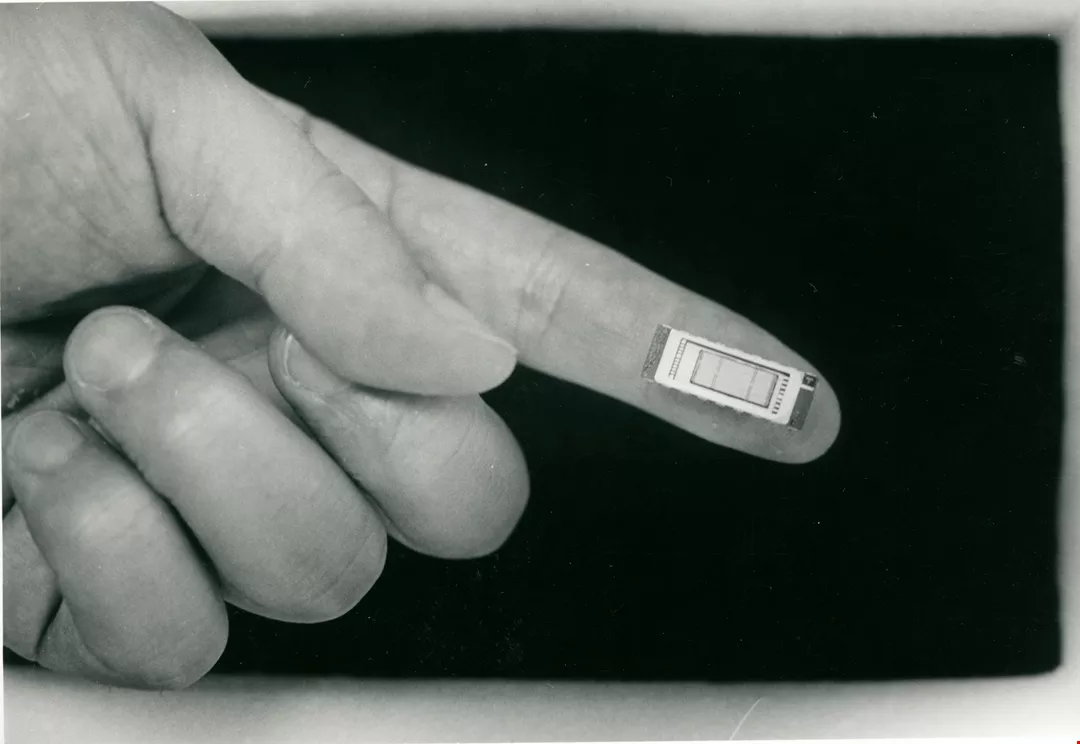
This engineer is holding one silicon wafer, which can be cut into over 200 IC's like the one below. What you see behind the engineer is a complex circuit design map, which is an enlarged version of what is on a chip.
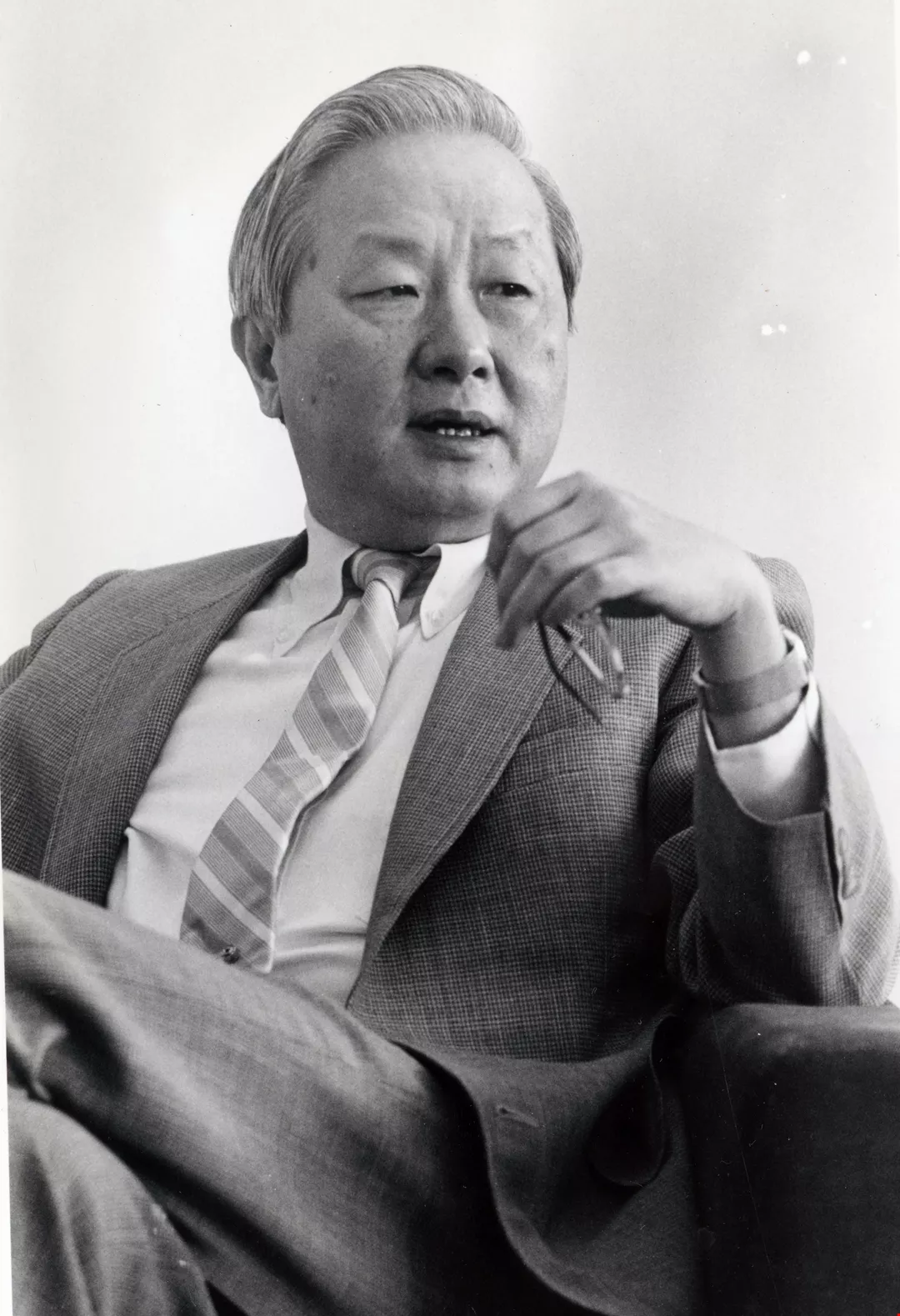
The director of the Industrial Technology Research Institute, Morris Chang, is the driving force behind the ROC's NT$10 billion IC project.
@List.jpg?w=522&h=410&mode=crop&format=webp&quality=80)


