

"During the darkest days forTaiwanese literature, he lit a lantern molded from 'native soil.' During the most confused and misdirected days for Taiwanese literature, he pointed a path with Taiwanese consciousness. With his life, he has created a milepost in Taiwanese literature."
Thus was summed up the unique position occupied by Yeh Shih-tao, a senior figure in the history of literature in Taiwan, during the speech made upon presentation to him of the 1998 "Oxford Prize for Literature" at Tamsui Oxford University College.
Yeh-a veteran of two rounds of combat over "native soil" literature, a victim of injustice during the White Terror era, and the author of nearly 100 volumes-turned 80 in November 2004, yet his mind remains clear and sharp and he radiates enthusiasm and energy. He not only is still active in the realms of literature and academia, but also shows no hesitation to join political events and espouse views on current affairs. He has always been true to the ideals he has advocated for literature itself-involvement in the world and refusal to remain silent. Since his Outline History of Taiwanese Literature led the community of local writers "out of Egypt," his "apostle"-like perseverance and indomitability have never ceased to impress observers.
In person he is even more amazing. On any given day you are likely to find young people, bookbags on their shoulders, milling about in front of his home. It is clear that the inspiration they receive from his vivid and lively remarks-cynical and critical of the world, spiced with humor, and with a streak of melancholy-is no less than that from his written words.
He himself is the tenacious, contradiction-filled "authentic Taiwanese native" of his writings. He is himself a metaphor, one that is accessible to us and well worth pondering over.
In contrast to the love of quiet one generally finds among older literati, Yeh Shih-tao lives in a place that is embedded in the world of daily life and commerce.
Yeh has settled down in a freestanding multistory concrete house on a bustling commercial street in the Tsoying area of Kaohsiung City. When the steel roller shutter of the Yeh abode is pushed up out of sight, one finds the entrance to the house occupied, somewhat bizarrely and very obtrusively, by a table, which must be moved out of the way every time someone goes into or out of the house. Yeh explains that it is there to keep neighborhood dogs from wandering in and making a mess on the floor.
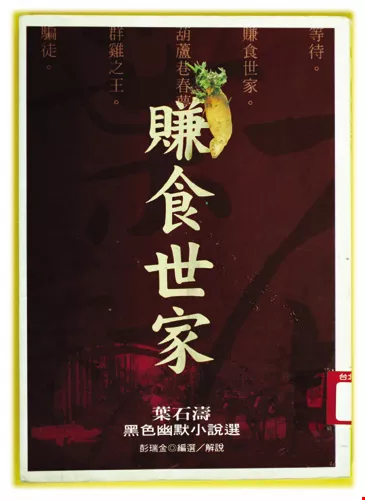
Yeh Shih-tao has published nearly 100 volumes of writings, including fiction, essays, and literary criticism. Many books which have long been out of print, still popular after all these years, are regularly featured on library waiting lists.
Yeh and his wife Chen Yueh-te go to bed every night at 7:30 and rise at 3:30 a.m., when they enjoy a stroll. If you call his house you'd better let the phone ring a good long while, because after all people his age move slowly, and you have to give them enough time to pick up. With elderly folks living on their own like this, inevitably there are scary moments, but fortunately the Kaohsiung literary community is close-knit, and people look after one another. For example, last year Yeh had a diabetic crisis, after which he just lay in bed without going for medical attention. When doctor-poet Tseng Kuei-hai heard the news, he called in an ambulance and had Yeh taken to his personal clinic, where he treated him free of charge.
For a time in the hospital, Yeh showed little fight or will to live. But after old writer friends reminded him "your mission is not yet accomplished," within a week he was back on his feet and returning home to recuperate. By early autumn he was as active as ever in his various circles. "I thought that in the hospital it would be great having nurses to wash me, but they all turned out to be male nurses," he quips slyly in a tone you'd be more likely to expect from a young man, making light of that time in his characteristically humorous fashion.
Besides teaching a class in the Graduate Institute of Taiwanese Literature at National Chengkung University in Tainan once every two weeks, Yeh is also naturally the guest of honor at lectures, seminars, and conferences which take his work as their main theme, and are very much in fashion in literary circles these days. In addition, from time to time university professors bring their students to Tsoying to personally experience the charisma of the master writer. "My schedule is really full, and each time I only get a few days rest before the activities start again." A copy of The Da Vinci Code has been sitting on his desk for some time now, but he has never found the time to finish it, and has also found it impossible to continue with his own writing: Bird Cage, the fourth and latest book in his Calabash Alley Spring Dream series, sits untouched, only half-finished.
"My eyes aren't what they used to be, especially my left eye, because a rash on my eyelid spread into the eye itself, so now it takes much more effort to write or read," he says. But still he scans three or four newspapers a day, and also keeps an occasional eye on what is coming out of the literary world.
With the wall closest to the road insulated by a bookshelf, on the outside is the haste and noise of a busy post-industrial society, but inside one feels that the decades have been kind to this literary soul. The fires of passion for reading and writing have not dimmed: they burn today as incandescently as ever.
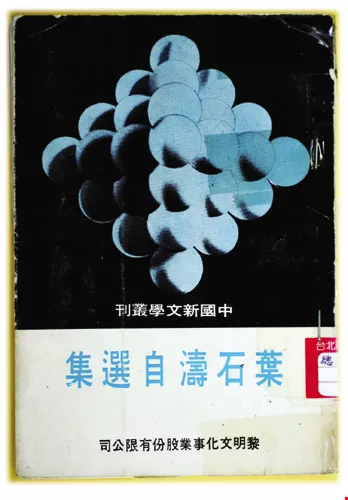
Yeh Shih-tao has published nearly 100 volumes of writings, including fiction, essays, and literary criticism. Many books which have long been out of print, still popular after all these years, are regularly featured on library waiting lists.
Those who have written critiques or biographies of Yeh inevitably mention his patience and dynamism, as well as his bold but measured literary style. One is often moved when reading the history of his life, not only because his life experiences fit right into the topsy-turvy self-identification process that is part of contemporary Taiwanese literature-in this sense he is like a living textbook of literary history-but also because his life has been packed with so many events that in the imaginations of so many ordinary people are "classic" parts of the lives of "the writer." These classic events have been interspersed with conflict and contradiction, and for young people with an interest in literature, his journey has been one climax after another, not only fascinating but inspirational.
Looking at the man through a microscope, his has much in common with many life stories that involve awakening through the bitter experiences of life. As a youth Yeh was intoxicated by French romanticism. But later he made a 180-degree turnaround, advocating a realist approach focused on Taiwan's "native soil": "Where there is no land," he declared, "there is no literature."
Yeh began writing at age 16, and by age 19 he was assistant editor at the well-known magazine Literary Taiwan. He wrote steadily for over half a century, but it has only been in his old age that kudos has come from all sides, recognizing him as someone "all of us" can be proud of.
Mired in poverty, Yeh often wavered between his creative ideals and the difficulties of daily life. From time to time he moaned that "writing is a punishment handed down by heaven, a divine retribution one cannot escape from." It has even happened that lack of nutrition caused him to suffer anemia and fainting spells, seriously affecting his work. But even in his old age, he can't stop. Recently he began working a new vein with his friend Chung Chao-cheng, something they call "erotic literature." They are more excited about the topic than kids one-quarter their age.
From the perspective of historical evolution, Yeh Shih-tao's use of language is replete with the scars of colonialism. As a child he spoke Taiwanese. Later he entered a public school, where he first encountered Japanese, and there experienced his first loss of language. After the Nationalist government took over Taiwan, creative writing in Japanese was halted. Yeh had to resort to reading the Kangxi Dictionary and meticulously studying a side-by-side Chinese-and-Japanese edition of Dream of the Red Chamber, filling it with notes from cover to cover. He says it took five or six years before "I could escape the dead soul of Japanese literature that had bound me," and begin to "write in wretched Chinese."
Yeh's career has spanned the eras of Japanese-language and Chinese-language writing in Taiwan, and he has been through two periods of controversy over "native-soil" literature. He has never been far from the center of the storm, but, after his experiences in the White Terror of the 1950s, he also learned how to be prudent and cautious in expressing himself. He loves reading, but it was also because of reading that he ended up in prison. For many years after leaving prison he devoted his energies to writing a history of genuinely Taiwanese literature, emphasizing "Taiwanese consciousness"; but at the same time he has opposed any sweeping "de-Sinification" of the local cultural scene.
How often the words "but also" recur in the sentence of life! You can say Yeh is sharp-edged, but he is also deeply tolerant; you can say he is repressed, but he is also full of passion.
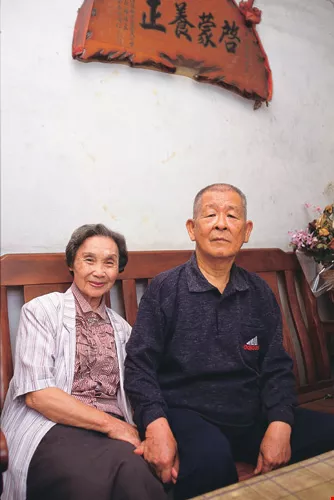
Yeh Shih-tao is shown holding the hand of his wife Chen Yueh-te. Together they have not only survived the vicissitudes of more than half a century of Taiwanese history, but have faced side-by-side the harsh choices that practical day-to-day life imposes on the creative writer. Though these long-lived partners still occasionally do some verbal sparring, there is no doubt that the tenderness remains.
Yeh was born in 1925 into a Tainan landowning family. As eldest grandson, pampered from birth, he was deeply immersed in the rhythm of life of the landlord class. He describes himself as a pudgy kid, afraid of his own shadow, who talked non-stop. "I was like a sparrow chirping all day long."
When studying in Tainan Second Senior High School, he first encountered world literature through Japanese translations, and got the notion "to become a novelist-certainly not one of the so-called 360 serious professions!" He first tried his hand at creative writing in his third year of middle school. His first completed work, "Offerings to Matsu"-a tale set against the background of Taiwanese popular customs-was cited by the magazine Taiwan Literature as "an outstanding piece of writing."
Though the story did not get published in the end, this experience gave Yeh the motivation to keep trying. Two years later, "A Letter from Lin"-a young man's flight of fancy deeply influenced by French romanticism-was published in Literary Taiwan. Through it, Yeh had the opportunity to meet the magazine's director, Nishikawa Mitsuru, and to join the publication's editorial staff. From this Japanese man of letters, Yeh learned that "the basic requirement of a writer is that he live earnestly, passing his days in constant struggle, writing until his very last breath."
Through this connection, Yeh also got the chance to come into contact with important writers from Taipei literary circles, and in 1943-at the height of World War II-he became embroiled in a battle between two major literary magazines over the direction Taiwanese literature should take. Literary Taiwan and Taiwan Literature hurled accusations of "crap realism" and "phony romanticism" at each other. Fighting shoulder to shoulder, Yeh became fast friends with Chang Wen-huan, Lu Ho-juo, Lung Tsung-ying, and other Taiwanese writers, and found his thinking much enlightened as a result. It was the budding of his sense of Taiwanese consciousness.
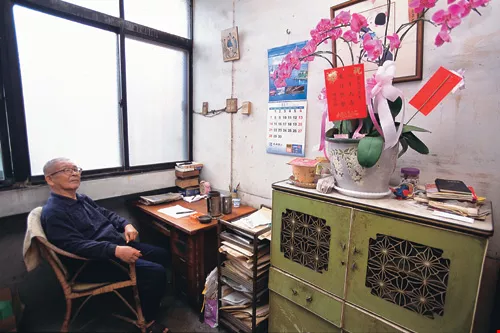
Despite being no spring chicken, Yeh Shih-tao keeps churning out creative works. Insulated from the cacophony outside, with a hand heavily marked with age spots he spells out his love for this land one character at a time.
After the war, Yeh worked in various schools in southern Taiwan. At first it was his dream to "learn Chinese and become a genuine Chinese writer." But after the outbreak of the second "native-soil" literature debate in the "Bridge" supplement of Sinsheng Daily News in 1949 (the first had been in 1936), author Yang Kuei and others were arrested one after another for what they were saying and writing. Yeh, who participated in the general discussion, was also thereby dragged into the shadow of the White Terror. "Fear dominated all aspects of daily life, to the point where though you ate, you didn't taste your food, and though you slept, you didn't really get any rest."
Political persecution finally caught up with Yeh in 1951, when he was arrested and imprisoned. He was only 27 at the time. His detention was not, ironically, the result of anything he wrote, but rather of his possession of books purchased long before, and his acquaintance with some members of the Taiwan Communist Party. He was convicted by a military court under the Act for Discovery and Eradication of Bandit Agents, specifically for violating Article 9: "Failure to report known information." He was sentenced to five years in prison, and spent three years behind bars.
From his incarceration to his return to the prose stage at age 41, Yeh spent 14 years in the literary wilderness. During this time he married and had children, and his attention was fully occupied with the tribulations of daily life, given the economic difficulties that his family faced after losing their landed wealth.
But when he returned, he did so with a bang, launching one explosive device after another into Taiwanese literary circles. He wrote several well-received novels in this period, including Prison Notebooks, Luo Sanrong and Four Women, and Calabash Alley Spring Dream. He also wrote landmark works of literary criticism, such as "Taiwan Native-Soil Literature" and "Taiwanese Authors and Their Fiction over the Past Two Years." It is important to remember that this was a time in which it was very much taboo to challenge the "greater China" ideology of the authorities, and in which literature published in Taiwan made the landscapes of mainland China more familiar to readers than Taiwan's own rivers and mountains. Against this backdrop, Yeh's works on Taiwanese literary history laid the foundations of theories emphasizing Taiwanese consciousness, creating a tradition of Taiwanese literature going back to Lai Ho. His achievement has had a profound impact on all research into Taiwanese literature ever since.
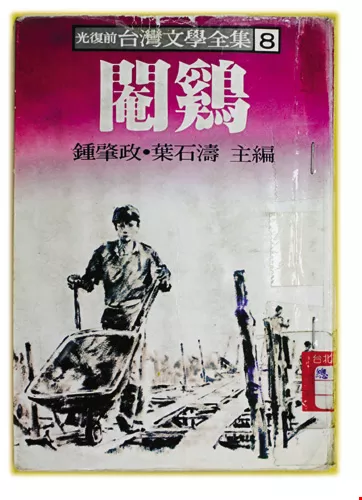
Yeh Shih-tao has published nearly 100 volumes of writings, including fiction, essays, and literary criticism. Many books which have long been out of print, still popular after all these years, are regularly featured on library waiting lists.
In the article "Taiwan Native-Soil Literature," Yeh stressed: "From the Japanese era to the present day, Taiwanese writers have been like apostles bearing heavy crosses, or like Don Quixotes tilting at windmills. To create their own literature, to carry forward the legacy of the past and leave something to the future, they have had to limp along a rocky path strewn with thorns."
He was even more outspoken in "Taiwanese Authors and Their Fiction over the Past Two Years": "To disdain local consciousness is to be without a national style, and literature without a national style has no reason to exist."
In 1977, his article "An Introduction to the History of Native-Soil Literature in Taiwan" (in Hsia Chao magazine) took the lid off the long-simmering conflict over identification with the "native soil" (i.e. Taiwan). The third war of words over native-soil literature followed soon thereafter.
Chen Ming-jou, chair of the department of Taiwanese literature at Providence University, says this article was an especially noteworthy proclamation. It not only hearkened back to the native-soil concepts Yeh was espousing in 1965, it also contained the most important statement of what he meant by the term.
In the article Yeh declared: "There is one prerequisite that should be upheld for Taiwan's native-soil literature: it should comprise works that 'place Taiwan at the center.' In other words, they should look at the world from the standpoint of Taiwan."
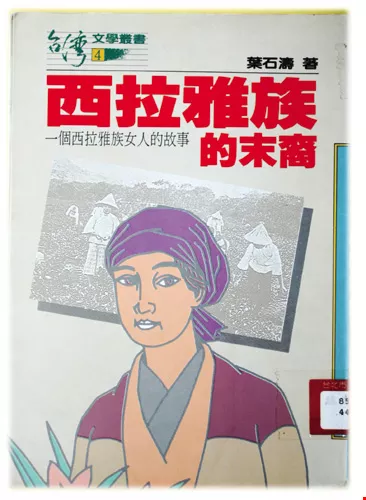
Yeh Shih-tao has published nearly 100 volumes of writings, including fiction, essays, and literary criticism. Many books which have long been out of print, still popular after all these years, are regularly featured on library waiting lists.
As the controversy over native-soil literature spread, writers like Wang Tuo, Yang Ching-chu, Chen Ying-chen, Peng Ko and Yu Kuang-chung fired fusillades back and forth. But Yeh, given his painful experiences under the White Terror, remained circumspect in this period. He did not play an active role in the invective, and insists to this day that he did not take part in that intellectual struggle.
Yet it cannot be denied that he sparked the fires of the native-soil literature debate, helping Taiwanese literature make an even more decisive turn. From that point on, Taiwanese consciousness began to make great strides.
Assistant Professor Peng Jui-chin of Providence University's department of Taiwanese literature sums up Yeh's overall role in Taiwanese literary history by describing him as a standard-bearer. It is hard for us today to imagine, says Peng, the risks he faced and the courage required back in those days when the White Terror reigned above and the black hand of criminal collusion with authority ruled below. Author Chung Chao-cheng, born the same year as Yeh, goes even further: "I have always had a deep sense of dependence on Yeh Shih-tao. I have always felt that as long as he was among us, our group of the helpless with nowhere else to turn would have a pillar of strength, so at least we could show some kind of front, no matter how weak and pathetic."
The brilliance flowing from Yeh's literary criticism inevitably causes many people to overlook his even more prolific and no less noteworthy works of fiction.
From A Letter from Lin, Spring Wrongs, and Matsu in March, to Prison Notebooks, Calabash Alley Spring Dream, and Last Descendant of the Siraya People, Yeh's fiction evolved from romanticism to the realism which he later invested such effort in extolling. His writing style gradually lost that fanciful touch, and his focus became increasingly internalized into literary idealism. Thus you can say that Yeh's later works are realist in craftsmanship, but that the driving force behind them is idealism.
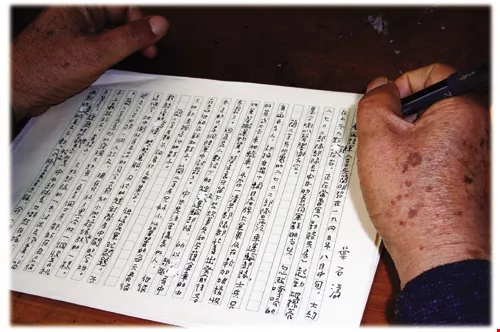
Despite being no spring chicken, Yeh Shih-tao keeps churning out creative works. Insulated from the cacophony outside, with a hand heavily marked with age spots he spells out his love for this land one character at a time.
Many people feel that Yeh deserves the credit for pioneering the humorous style that is so characteristic of Taiwanese literature. But Peng Jui-chin points out that Yeh's humor is one laced with mystery, despondency, and heaviness, even cruelty and desolation. It doesn't exactly want to make you want to chortle.
Calabash Alley Spring Dream, published in 1968, is representative of his opus. The story takes place in a little alley, home to complex human relationships. It explores the absurdity of life, the desires and genuine concern the residents of such small lanes feel for each other. Far from coolly ignoring one another, the neighbors become deeply wrapped up in each other's lives.
The books Prison Notebooks, Red Shoes, and Chien Ah-tao-Taiwanese Male, are based on Yeh's own experiences in the White Terror, and on the February 28 Incident of 1947. They are highly autobiographical in nature, with the descriptions of inner feelings and psychology chillingly realist in style.
Last Descendant of the Siraya People, on the other hand, revolves around a woman of a lowland Aboriginal tribe. It turns paternalistic social values upside down, and takes traditional Aboriginal ideas as its foundation. In exploring the topic of land, it deftly transcends nationalism, and also avoids the accusatory perspective that is today a customary part of feminism, instead demonstrating a novel and captivating optimism.
In the book, Pan Yin-hua is an Aboriginal woman who works as a servant in a Han Chinese landowning household. After she and the family's second son have a son of their own, she opts not to accept an easy life in the big house, feeling she cannot accept the indignity of being "cared for like livestock." So she takes the child back to the land that originally belonged to her, because: "One day would surely come when she would find a new love and build a new tatakak [home], and find a strong and vigorous man who, like herself, belonged to the wilds."
WordplayYeh has always insisted on Taiwanese consciousness, but has also been through many transformations, pioneering new creative lands. Last Descendant of the Siraya People was like a preview, and now, 15 years later, at the age of 80 he has opened up a new phase of "writing on the edge." He is working on so-called "erotic literature" (or, perhaps better, "literature of passion"), the roots of which he himself declares can be traced back to his own Oedipal complex of love for his mother.
"In this world, no woman can compare to my mother," says Yeh, sitting by a gate of the old Tsoying city wall, not far from his home. He seems filled with nostalgic longing when he says this, and his expression is like that of a boy.
Yeh's mother developed a character that combined the traditional and the modern. On one hand, she was forced to endure the agony of foot-binding as a child. On the other hand, because her father was a member of the commission on educational affairs in the Japanese colonial government in Taiwan, he had little choice but to set an example with his own family and allow his daughter to undergo a modern Japanese education.
It is said that when she was elderly Yeh's mother lived for a time in Yeh's home in Tsoying. Though she was, as Yeh is now, already 80, still she would often make her way over to the beauty parlor across the street to have her hair done. "And she was a generous tipper," says Yeh. It is a great joy to Yeh to know that his mother was able to live her life in accord with her casual, elegant, light-hearted manner right to the end of her days.
Perpetual (e)motionHe is at an age where one should find tranquility, but as soon as Yeh Shih-tao gets jawboning, he comes out with endless criticisms about politics, education....
Yeh's most recent major discourse on literature was made in summer 2003 at Tokyo University. In that speech he argued that only realism is adequate to express the past suffering of Taiwanese people. He also stated that currently literature in all countries is facing the problem of "loss of time and place." Writers are too focused on the fleeting moments of modern urban life, he opined, overlooking people's relationships with history (time) and the land (place).
Yeh consistently emphasizes the importance of nativist writing to all young lovers of literature, trying-spiritedly as always, and single-handedly if need be-to halt the movement of modern literature into what he sees as the wrong direction. The flag-bearer of days gone by has not gone anywhere. And his manner of speaking-humorous and intimate-has a great deal of practical persuasiveness.
"What's this 'Internet literature' everyone is talking about? It's just plain nonsense. Young people need to show concern for our history and land. There are so many themes, such good themes, that we can write about them for a long time to come and still not exhaust them," says Yeh with typical straightforwardness.
Always passionate, though Yeh gets tangled up in contradiction, melancholy, disappointment, and even angst, he will never give up. Yeh Shih-tao is every elderly person that we can see shopping in the market, walking a mountain road, or sitting in a study. He is our past, present, and yes, our future, deeply implanted in our lives and our land.
Today, when "Taiwan consciousness" has become a virtual cliche, there is no harm for us in looking back over this literary life of a man awakened to consciousness. Perhaps if we look deeply enough at what lies behind the passion and tenacity of someone like Yeh, we will find that it is the dynamic energy of this land itself. If we extend a hand to him, we just may grasp the key that will open the door to the next turn in history.
Italy has Calvino, Japanese has Kawabata, Latin America is the home of magical realism, and Africa seems much nearer to us thanks to the pen of J.M. Coetzee.
But who does Taiwan have? Whose writings make it possible to keep our memories from slipping away? Whose poetic renderings lift our island out of the commonplace?
This series on “Contemporary Taiwanese Writers” series will take readers into the hearts and souls of our major literary craftspeople, casting an eye over the limitless breadth of modern Taiwanese literature, in hopes that we can keep our island’s song resonating into the future.

@List.jpg?w=522&h=410&mode=crop&format=webp&quality=80)


