

They live to chase waves. Their greatest joy is to stand on a surfboard. To be closer to the sea, they've even moved from the big city to places like Toucheng, Kending or Taitung. Their priorities are the reverse of most people's, with careers, families and love lives all secondary.
Even in Taiwan, where surfing still hasn't made the big time, steady growth over the last decade has created a significant population of surfers, a surfing industry, and a "surfing scene." Here, like everywhere, surfing isn't simply a form of physical activity. A distinct culture, sense of identity and way of life connected to surfing are all gradually developing too.
The days of summer may have reached their end, but the surfing season isn't over. So long as the surf is up and surfers still hear its call, they will continue to chase waves. As far as they are concerned, summer is endless.
Among the many households of this residential neighborhood, this one is a bit different: the ties that bind here aren't those of blood.
At first light the members of this "family" set out in their two cars and motorcycle. From Hengchun, it takes them 20 minutes to reach Jialeshui. They bring beach umbrellas, books and cameras-not to mention the most important accoutrements of all: surfboards. Thus begins a day of leisure.
"To spend this day together, we started planning a month ago," explains Lisa, who carries a nine-foot board along the beach with her boyfriend Yu Yungjie as they prepare to enter the water. In order to get closer to the beach, Lisa quit her job as a clothing designer in Taipei and moved to Hengchun. In the blink of the eye, seven years have passed.
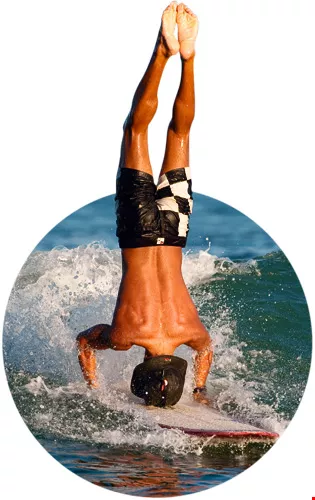
The blue skies, beaches and waves of Jialeshui in August bring surfers from all over. Occasionally you'll overhear Japanese, English or Spanish. At mid-morning, when the waves are best, they'll reach the height of a man and a half. It's truly like paradise.
This group of surfers has come from all over Taiwan for Kending's surf, and they each have their own stories to tell.
Lisa, who graduated from the fashion design department at Shih Chien University, designs a variety of small bags, which she takes out at night to sell on the tourist-thick streets of Kending. On days when the surf is good, she sets aside her design work, picks up her surfboard and drives to the beach. Ah-Xian is a pastry chef at the Kending Howard Hotel. The diminutive Pei-pei, meanwhile, works at a surf shop.
Surrounded by the sea, Taiwan has quite a few excellent surfing spots, but Kending, brimming with tropical flavor, is particularly excellent, a holy place of sorts for surfers. The seabed here is either coral reef or a mix of gravel and sand. "A stable seabed isn't easily swept up and changed by the waves," explains Yu Wenjie. "The stability and frequency of the waves here are both excellent."
Apart from the athletic techniques involved in surfing, knowledge of waves and other environmental aspects is also important. Surfers first learn the basics, such as how to recognize the direction of incoming waves, rising tides, falling tides, right-breaking waves, and left-breaking waves.
"When you're at it longer, your understanding grows, and your observational powers get keener," says Yu. "You pay attention to the seabed, noting whether it's sand or gravel." He explains that the impact of the waves moves sand around, so that sandy beaches are less stable and their waves less consistent. If the seabed is coral reef or gravel, the waves will be more regular-much to the delight of surfers. Around the world the most famous surfing beaches all have seabeds of coral or gravel.
In recent years, surfers have been able to consult the Internet for real-time surfing conditions at many beaches. And of course there's always word of mouth. "When I was in Taipei and I knew the waves were good, I'd close up and make my way to the beach," says Zhuang Chunxin, a dentist. Since the Xueshan Tunnel has been opened, travel times from Taipei to Yilan have dropped. Every day you can see cars with surfboards going through the tunnel toward Honeymoon Bay, the north dike of Toucheng, and other northern surfing spots.
But for some, those trips aren't enough. Two years ago, all for her love of surfing, Zhuang left her position in Taipei and opened a clinic in Hengchun, where she sees patients only from 8:00 to 12:00 a.m.
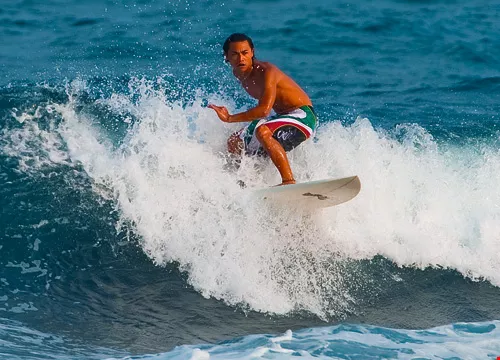
Different techniques, different poses. Standing on a surfboard fully expressing a sense of freedom while at the same time finding a unity with the rhythm of the waves-that's the most enthralling aspect of surfing.
Just how enthralling is surfing?
Surfing is an athletic activity on the water's surface that taps into the energy of the waves. There are many techniques beyond the surfing poses familiar to most people.
In recent years, bodyboards, those boards that you see people riding on their bellies, have been growing more popular, especially among female novices. Because you don't stand up on those boards, the technical level required isn't nearly as high. Those new to the sport can get a better feel for the speed of a wave while prone.
There are also highly skilled surfers who surf with plates from fast-food restaurants, or simply body surf. But whatever method they use, surfers slide down from the crest of a wave, using the energy of the wave to propel themselves forward, while adopting various positions and changes of posture. Some keys for novices: first get used to swimming in the ocean, and then go a step farther to understand the special characteristics of waves and the nature of the ocean.
In actuality, paddling with your arms is the first surfing technique to learn. You use the long sweep of your hands through the water to move your board out to a suitable spot to catch a wave. There you wait, either sitting or prone. When a wave comes, you've got to first paddle with your hands to catch the wave, and then you've got to push yourself up with your arms. Finally, you stand up-left foot forward and right foot back-and enjoy the wonderful feeling of surfing, as you rapidly slide through the water, riding a wave.

Surfing during the day and working at night, the proprietor of a pizza truck on Kending's main street is a serious surfer.
The origins of surfing in Taiwan can be traced back to the 1960s, when American military personnel were stationed in Taiwan. Quite a few American soldiers in the Jinshan-Yeliu area organized surfing clubs. The existence of those clubs is the earliest record of surfing in Taiwan. Scholars of surfing have researched how those sprouts took root through the 1970s, and then grew throughout the 1980s and 90s. With that steady growth, surfboards began to be imported.
"In the years after 2000, surfing here started to develop rapidly," says Moh Chi-yung, an associate professor at National Taiwan Sport University. "There was a lot of media attention, interest from celebrities, and a growing oceanic consciousness. There was also the emerging conception of Taiwan as a 'maritime nation.' All of these were contributing factors." It's easy to understand how surfing's development would have been stunted in its early decades here, when the flow of information was blocked as a result of martial law and even going to the beach was discouraged.
In the era of rapid growth after 2001, surfing began to diversify. Apart from a small number of activities sponsored by surfing associations and clubs, the government and corporations got in on the act with their own promotions, and the activity gradually gained social acceptance.
Although many members of the Taiwanese public may be strangers to surfing culture, for visiting foreign surfers, the surfing scene in Taiwan has made it a much more attractive destination.
Takashi was charmed right away, on his first visit to Taiwan six years ago: "I live in Nagoya, and the waves there are small. A lot of surfing magazines in Japan had been introducing the surfing scene here in Taiwan. It caught my attention." In order to spend more time surfing in Taiwan, he applied for a working vacation here.
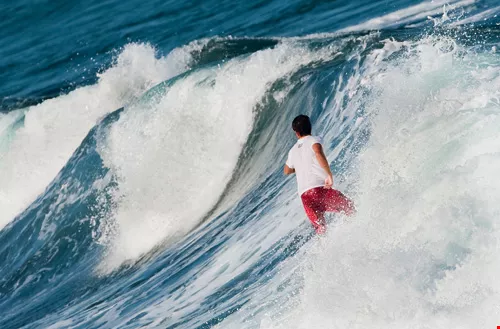
Different techniques, different poses. Standing on a surfboard fully expressing a sense of freedom while at the same time finding a unity with the rhythm of the waves-that's the most enthralling aspect of surfing.
"Taiwan's waves are bigger than some, smaller than others. About a man and a half tall, they may pale in comparison to the 15-meter waves in Hawaii, but they're big enough," says Yu Yongjie. At some surfing beaches, the face of waves can exceed two meters. Typhoons can bring them to six meters, creating the "tubes" that are much loved by the highly skilled. These take surfers toward the beach within walls of water. They're truly addictive.
With surfing becoming more common and the population of surfers growing here, organizers have been checking out Taiwan as a potential site for international competitions. The prestigious International Surfing Association selected Taitung's Jihui fishing harbor to hold a professional competition and in the process gave a seal of approval to Taiwan's surfing scene.
Meanwhile, Taiwan has given birth to two of its own groups of surfers: seasonal and regular. "Seasonal surfers are those who occasionally surf in the summer. Regular surfers are like us," explains Yu, who moved to Toucheng from Taipei in order to surf. "Most seasonal surfers are college students, who treat surfing as a water activity to pursue during summer vacation. All summer long the water from Jinshan to Toucheng to Kending is full of surfers. But once summer is over, the crowds thin."

We want to surf! If there are no waves, then you can seek to satisfy your yearning on a cement wall.
But the growing numbers of surfers have also caused problems. In recent years, various surfing beaches have seen the rise of self-policing efforts, with norms transplanted from abroad. These involve keeping surfing beaches clean and respecting the order and culture of surfing.
"Surfing requires you to study, respect and merge with nature," says the surfer Liu Shijie. "It requires an attitude of finding harmony with the sea. People can disappear at any moment, and when you're immersed in nature you get a greater sense of humanity's insignificance."
What's more, surfing also has various rules, such as not "stealing" someone else's wave.
"Surfing requires a lot of space," says Li Youlin. "When a wave comes, whoever has the right of way rides it, but you've got to be concerned about public safety." In the early years of Taiwanese surfing, surfers lacked a conception of wave rights, and every year there would be instances of people getting slammed by surfboards as a result. These incidents resulted in injuries and even deaths in some cases. The tragedies were largely caused by seasonal surfers who lacked experience.
When the typhoons come every year, they present an even bigger test for surfers' safety.
"Typhoon Muifa, Hit and Run: Surfers Risk Lives Chasing Waves!" "Amid Sea Warning for Typhoon Aere, Surfers Still Hit Beaches".... The big waves during the typhoon season always bring surfers into the water. There have even been instances of surfers ignoring direct warnings from the Coast Guard not to enter.
In August some big waves from Typhoon Muifa pulled a woman surfer into the sea. The Coast Guard spared no effort to save her, but she had already fallen into a severe coma by the time they reached her.
"Whenever we hear news of this sort, we get very depressed," says Zhuang, who notes that surfing is a small-time sport that rarely garners media attention. "But every summer during typhoon season, satellite news trucks go to the coast to report on these incidents. They mold the image that the public has of surfers."
"Those who surf during typhoons hurt the image of surfers," says Zhuang. "It's true that the biggest waves are associated with typhoons-particularly just before and just after. But when the actual typhoons hit, experienced surfers don't go into the water because, in addition to safety concerns, the strong winds cause the waves to break extremely irregularly, making surfing impossible."

Different techniques, different poses. Standing on a surfboard fully expressing a sense of freedom while at the same time finding a unity with the rhythm of the waves-that's the most enthralling aspect of surfing.
Riding the surf under blue skies and feeling the wind and the power of the waves-nothing is so satisfying and beautiful for the 100 or so surfers who come out on a good day at Toucheng's North Dike.
"Surfers are pretty two-faced when it comes to dealing with people," Yu Yungjie notes. They're friendly and typically have smiles on their faces, "but they're also selfish because surfing is a solitary activity, so they focus on themselves."
"But if you really love surfing, you have to care about the marine environment. Surfers are in the water day after day. If the water is polluted even just a little bit, surfers will feel it."
In recent years, Yu and his surfing compatriots from various locales have become active environmentalists. In July more than 500 surfers protested the illegal construction of the Meiliwan Resort Hotel in Taitung. To demonstrate their concerns, they brought their surfboards to the beach and stuck them upright into the sand.
"Environmental consciousness has been gradually emerging among surfers," says Zhuang Chunxin. Whether you're talking about Meiliwan, or nearby Jihui or Dulan, all are among the best surfing spots in Taiwan. Why wouldn't surfers want to protect those places?
After a day of wind and rain created by a typhoon-a beautiful day for surfing-the surfers still hadn't had enough, so they gathered together with beers in their hands to watch a surfing documentary: The Endless Summer, from 1966.
The film is about two youths who pack up their surfboards and travel to some of the world's greatest surfing locations. It's a dream all surfers can relate to. "A surfers' paradise must be an environmental paradise too," says Yu of his dream beach.
That's a paradise that anyone could appreciate.
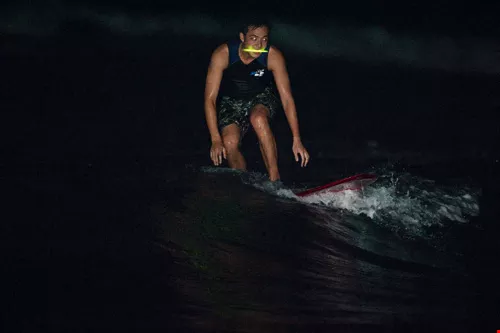

In recent years, celebrities' interest in surfing has been a big factor in its growing popularity. The photo shows the television actor Yao Yuanhao taking a break from his shooting schedule to surf in Kending's Jialeshui.
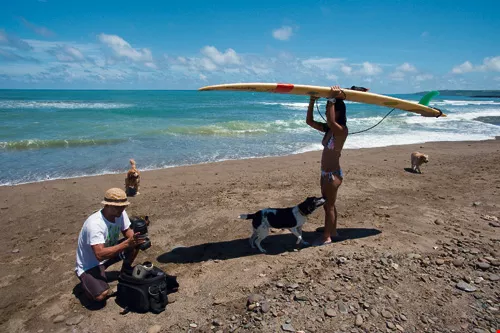
Bringing their camera, their dog and their surfboards, Yu Yongjie and his girlfriend begin a day at the beach.
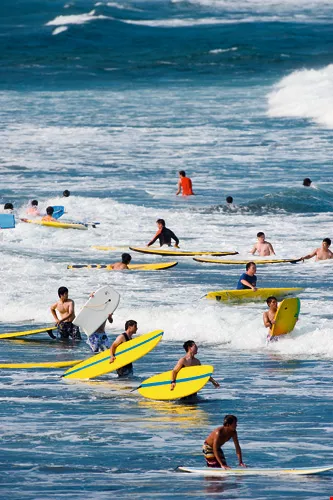
For serious surfers, surfing season extends all year long. But for occasional surfers, summer is the best time. The photo was taken at Wushi Harbor in Yilan.

Exhausted after a long day, it's time to go home.

To live near the beach, surfers accept all kinds of jobs that aren't nine to five. The photo shows "Yudan" ("Fish Egg"), who has found work as a shepherd since moving to Toucheng.
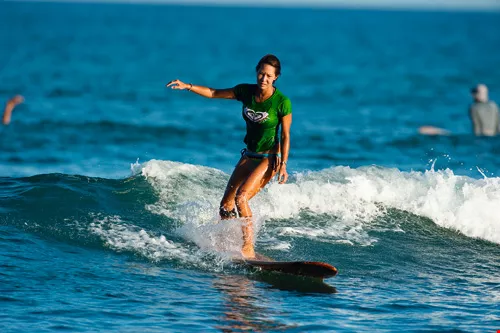
Taking off her dentist's coat, Zhuang Chunxin undergoes a transformation. Surfing gives her boundless joy.

@List.jpg?w=522&h=410&mode=crop&format=webp&quality=80)

@List.jpg?w=522&h=410&mode=crop&format=webp&quality=80)


