Temple Painting Restoration—High Tech Joins the Fray
Sam Ju / photos Jimmy Lin / tr. by David Smith
January 2014


Paintings can bring the sacredness of religion vividly to life. Unfortunately, however, they don’t last forever. Temple paintings in Taiwan eventually fall victim to the ravages of time as they crumble and lose their color.
The Ministry of Culture carried out restoration projects in 2013 at Chaotian Temple in Beigang, Yunlin County, and Daitian Temple in Kaohsiung City, bringing back the original brilliance of old and weathered paintings that “living national treasures” had executed many years before. The work done there stands now as a benchmark of quality in the field of painting restoration.
Regardless whether they’re painted on wooden doors or stone walls, temple paintings are affected by incense smoke and Taiwan’s island climate. Grime and decay are inevitable.
For this reason, the National Center for Research and Preservation of Cultural Properties (NCRPCP) has established a special restoration team that uses high-tech methods to work its magic. So far, the team has restored a wall painting at Daitian Temple in Kaohsiung (painted by Pan Li-shui) and the door guardians on 12 doors at Chaotian Temple in Beigang (painted by Chen Shou-yi).
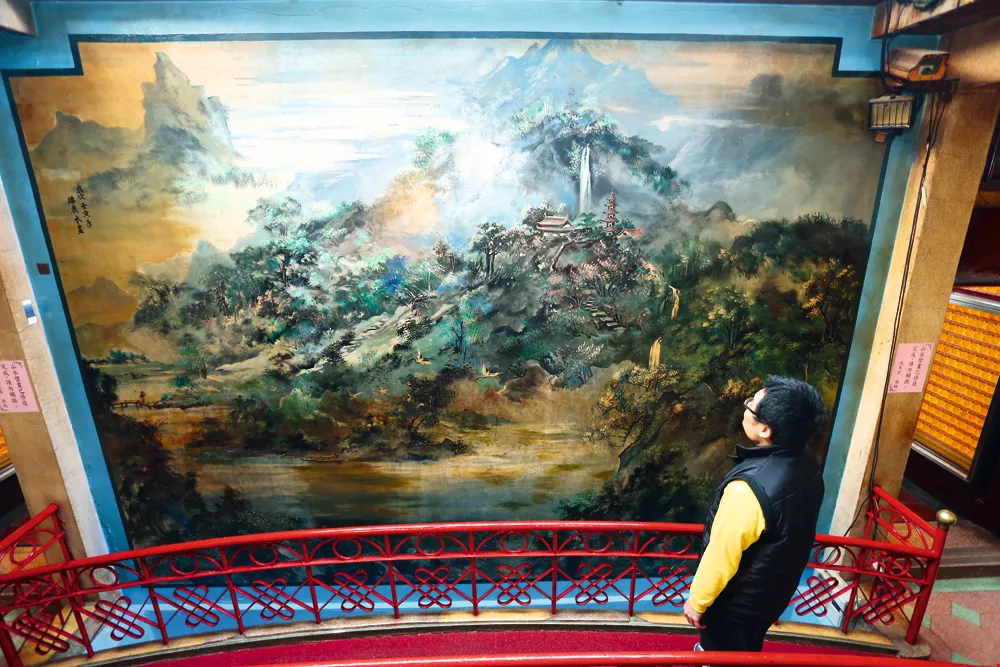
Now that the wall has been treated to remove sulfate, and its colors have been retouched, the landscape painting at Daitian Temple is looking new again.
Pan Chun-yuan (1891–1972) and Chen Yu-feng (1900–1964) were among the first generation of Taiwanese-born temple painters. Both hailed from Tainan, and both received their training under Lu Pi-sung, a master of the Southern School of inkwash painting.
Their sons Pan Li-shui (1914–1995) and Chen Shou-yi (1934–2012) carried on with their fathers’ craft with such success that pretty much all notable temple paintings in Taiwan were done by one or the other of them.
The seven wall paintings in the main pavilion at Dalongdong Baoan Temple in Taipei, for example, as well as the door guardians at Sunfong Temple in Kaohsiung, are Pan’s masterpieces, while the door guardians at Longshan Temple in Taipei City and at Qingshui Zushi Temple in Sanxia, New Taipei City, were executed by Chen. The works they left behind are popularly regarded today as national treasures.
The temple paintings most recently restored by the NCRPCP are Chen’s door guardians at Beigang’s Chaotian Temple.
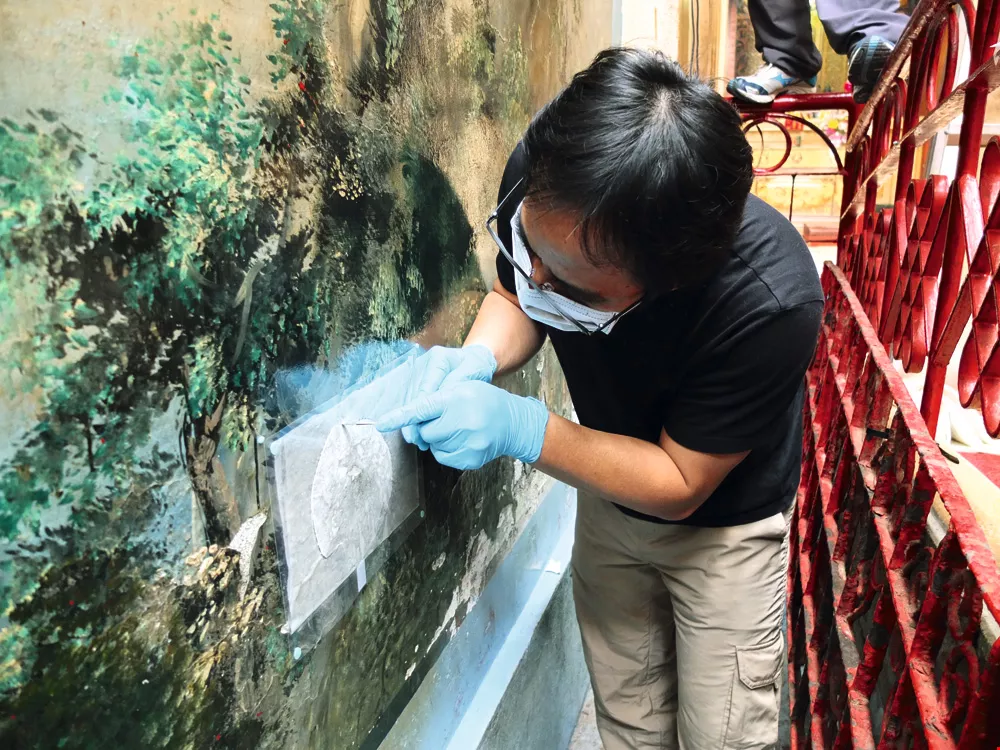
The landscape painting on a wall at Daitian Temple was seriously affected by efflorescence of the concrete. Members of the restoration team used scalpels to remove the painting in pieces from the wall, which they then treated to lower its sulfate content.
Built in 1700, Chaotian Temple was designated as a national historical site in 1999. In addition to its patron goddess Mazu, the temple also has side pavilions devoted to the worship of other deities.
Six of the doors painted with Chen’s door guardians are in Lingxu Pavilion and the other six are in Jukui Pavilion. Both of these pavilions are passageways that lead to side pavilions dedicated, respectively, to the Emperors of the Three Offices and the Lord Emperor Wenchang. At Lingxu Pavilion, the door guardians depicted on the two doors of the central doorway are martial and civil deities of the usual sort. But another 22 figures, painted on the pairs of doors to the left and right, represent the ten Heavenly Stems and 12 Earthly Branches of the traditional Chinese calendar.
Zhou Zhiming, a member of the NCRPCP restoration team, stresses the unique artistic and cultural value of the paintings at Lingxu Pavilion: “This is the only ancient temple in all of Taiwan with door guardian paintings depicting the ten Heavenly Stems and 12 Earthly Branches.”
On the doors of the left and right doorways of the Jukui Pavilion, meanwhile, the guardian figures represent the 24 Solar Terms into which the traditional calendar divides the year. They symbolize the passing of the seasons.
Years of exposure to incense smoke turned these paintings dark and sooty long ago. The task of bringing back the original colors posed a huge challenge.
拷貝.jpg?w=1080&mode=crop&format=webp&quality=80)
Every artist who does traditional temple paintings is a living national treasure. Shown here are paintings by Pan Li-shui and Chen Shou-yi. The work by Pan, Zhong Kui Takes His Sister Back Home to Mother (left), is one of seven wall paintings at Dalongdong Baoan Temple in Taipei. The work by Chen (right) is a depiction of civil and military officials that serve as door guardians at Beigang’s Chaotian Temple.
The restoration team got started at Lingxu Pavilion and Jukui Pavilion by photographing the paintings with infrared and ultraviolet imaging devices. Analysis of the images revealed a four-layer composition: a coat of primer, a layer of colored paint, a protective coating (e.g. clear varnish), and a layer of grime.
The team made 24 startlingly faithful reproductions of the painted doors, in two sets of 12 each. One set was used to carry out “dry run” restoration work. The other set was installed in the temple to replace the original doors while the project was in progress.
Once the actual restoration work got started, explains team member Cai Yulin, the first task was to remove the grime. In many places, the grime had eaten into the protective coating, but it never broke through to the colored paint, so the removal operation didn’t involve anything deeper than the protective coating.
Grime removal was similar to the way a surgeon cleans a wound. With a cotton swab in hand, the restorer would dab away at the dirty surface, switching to a scalpel to scrape away anything especially stubborn.
But as the work progressed, there were a lot of delicate features that had to be protected, such as the deities’ whiskers and hair, and fingerprints that the painters had left behind. To make sure an inadvertent moment on a restorer’s part would not cause damage, a special protective compound was applied where needed.
Most importantly, before applying any foreign substance to the colored layer, regardless whether to fill in a crack or to add new coating, the restorer first had to apply a coat of isinglass to isolate the new application from the original coloring.
Apart from protecting the original work, the layer of isinglass confers the added benefit of reversibility. In the future, if it is necessary to restore the work again, or if some new material is developed that would make for an improvement, the isinglass will facilitate removal and replacement.
After the third reconstruction of Chaotian Temple was completed in 2002, restoration of the paintings got underway. The project dragged on for several years, however, so the NCRPCP joined the fray in 2010. After three years of further research and restoration, work on the 12 door guardians was finally finished in October 2013 and the doors were reinstalled in the temple.
Whereas incense smoke caused the damage at Chaotian Temple, the culprit behind damage to Pan Li-shui’s landscape painting at Daitian Temple in Kaohsiung was salt.
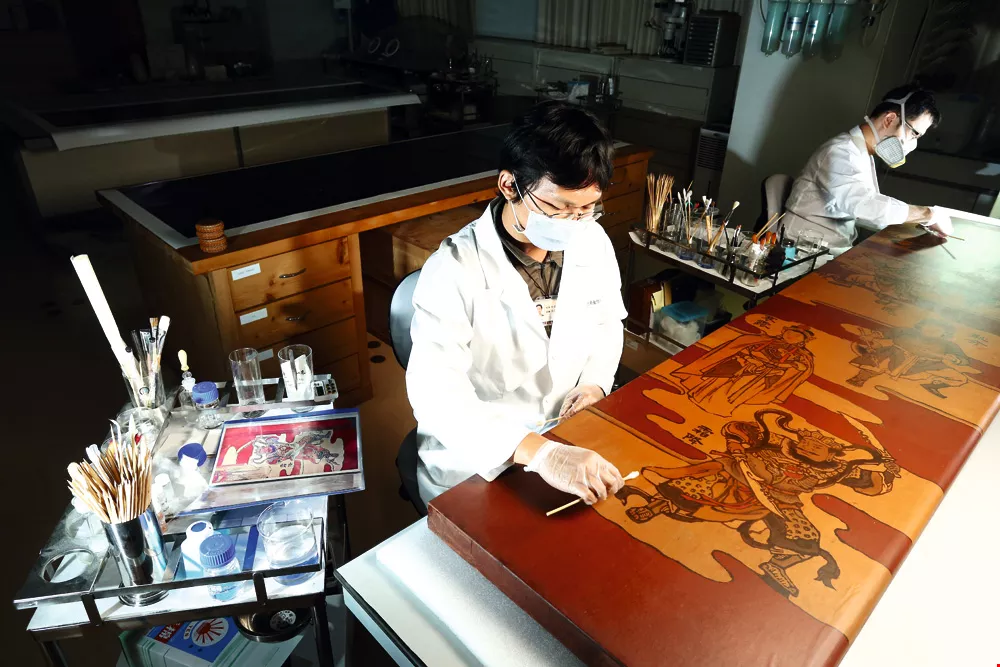
After scientifically measuring the degree to which grime had encroached on a painting, restoration experts took the door away to clean it, apply protective measures, and retouch the colors.
During the Japanese colonial period, the area around Kaohsiung City’s Gushan District was called Hamasen in Japanese. In the 1930s, the area attracted an influx of people relocating from Tainan County. With them they brought their faith in the Five Royal Lords. They eventually came to do their worship at Daitian Temple, built in 1954.
When Daitian Temple was expanded in 1959, Pan Li-shui was hired to do a painting measuring 4.7 by 3.5 meters. He completed it in 1962. The subject matter of the painting departed from the usual religious stories, which is extremely rare in Taiwanese temples. According to a study by Hsiao Chong-ray, a professor of history at National Cheng Kung University, this is the only landscape painting done by Pan in Taiwan.
It is an oil painting applied directly to a concrete wall right in front of a pond. Over the years, the sodium sulfate in the concrete and the moist environment combined to cause serious efflorescence of the concrete, especially in the lower part of the painting, which depicts forest and meadows. People had been calling urgently for 20 years for someone to solve the problem.
Daitian Temple was designated in 2008 as a historic architectural site. Over the course of years of international exchange, the NCRPCP had developed expertise in the handling of efflorescence, and in 2012 it launched into a project to deal with the wall painting at Daitian Temple.
.jpg?w=1080&mode=crop&format=webp&quality=80)
Every artist who does traditional temple paintings is a living national treasure. Shown here are paintings by Pan Li-shui and Chen Shou-yi. The work by Pan, Zhong Kui Takes His Sister Back Home to Mother (left), is one of seven wall paintings at Dalongdong Baoan Temple in Taipei. The work by Chen (right) is a depiction of civil and military officials that serve as door guardians at Beigang’s Chaotian Temple.
The restoration team used infrared and ultraviolet imaging to determine the area covered by the efflorescence and how far it had progressed, then set about getting rid of it. The key was to repeat certain steps over and over again to gradually lower the sodium sulfate content in the concrete, so that efflorescence wouldn’t recur.
Team member Shao Zhongwang explains that the first step was to divide the places where the wall was already blistering into a number of separate parts. Then, mulberry paper backed with gum arabic was adhered to the painting. Taking a scalpel, the workers then peeled the pieces of the painting from the wall, pressed them flat, and stored them safely away to be reapplied after the wall was treated.
To treat the wall, pieces of cloth coated with sepiolite, a clay mineral composed of complex magnesium silicate, were applied to the wall to draw out the sodium sulfate. More than 50 pieces of sepiolite cloth were applied. After a while, they were removed and the sodium sulfate content was measured. New pieces of sepiolite cloth were then applied, and the process was repeated over and over until the sodium sulfate was down to an acceptable level.
The previously removed parts of the painting were then coated with gum arabic and pieced back together on the treated wall, and the coloring touched up as necessary so that there wouldn’t be any jarring mismatch at the border of the treated area. But restoring the painting too close to original condition, it turns out, would be overdoing it.
This may sound contradictory, but it is an ethical principal of scientific restoration that in the interests of authenticity, a restorer should—without affecting the visual appearance of a painting—leave evidence to distinguish the restored portions from the original artist’s work. They should not pass off their own work as the original, nor attempt to “improve on” the original work.
NCRPCP director Li Lifang notes that scientifically based painting restoration is a relatively young discipline in Taiwan: “In the past, restoration of temple paintings was generally looked upon as simply one step in a larger renovation project, so it wasn’t done so professionally.”
The members of the NCRPCP’s restoration team, less than ten in total, have received academic training in art, chemistry, forestry, and many other fields. These “physicians,” charged with keeping Taiwan’s cultural heritage in good health, have done an amazing job on the door guardians of Chaotian Temple and the wall painting at Daitian Temple. A new high-prestige professional specialty is born!
.jpg?w=1080&mode=crop&format=webp&quality=80)
Chaotian Temple at Beigang in Yunlin County draws lots of worshippers. The late Chen Shou-yi, a master of traditional painting, executed the door guardians there. Years of incense smoke left his work covered with grime, but a recent restoration project has returned the guardians to their former glory.
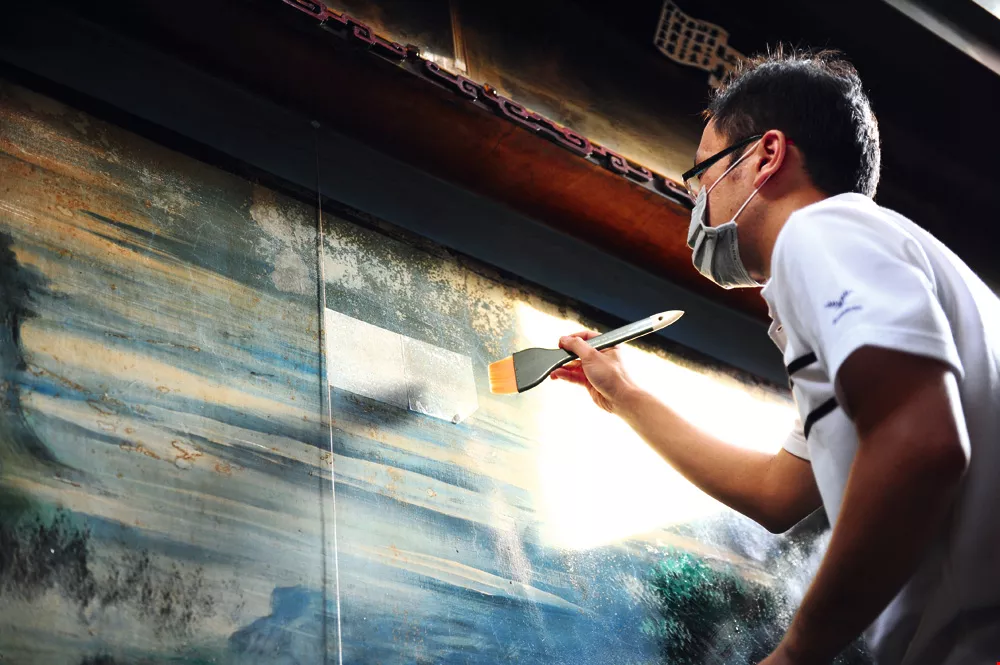
The landscape painting at Daitian Temple in Kaohsiung was executed by the late Pan Li-shui, a noted master of traditional painting. After chemical testing, the surface of the painting was cleaned.

@List.jpg?w=522&h=410&mode=crop&format=webp&quality=80)

@List.jpg?w=522&h=410&mode=crop&format=webp&quality=80)


