Walking a Fine Line The Survival of a Chinese Temple in a Small California Town
Cheng Yuan-ching / photos Cheng Yuan-ching / tr. by Phil Newell
August 1993


There's nothing very strange about seeing a white, yellow, or red traffic stripe on the street. But in the city of Oroville, California, about 200 kilometers north of San Francisco, there are some stripes painted in bold green across the roadways.
If you follow the green, at the end of the stripe you will find a rather venerable and perfectly maintained Chinese temple - the Lieh Sheng Temple, or the "Temple of Assorted Deities."
Travelling along California Highway 99 north, as you approach Oroville there is a clear landmark: the Oroville Chinese Temple, State Historic Site. Driving through the interchange as directed by the sign, you run right into the city.
Oroville is a quiet little town, with only about 10,000 people, and but a solitary person of Chinese ancestry. The residents mostly live by farming and ranching, and there is still some of the Old West in the air. The buildings are wood-built, none over three stories. Their town hall is more like a townhouse, no larger than the typical administrative offices in a rural township in Taiwan.
The town has only one main street, less than two kilometers from end to end. Except for the area around the interchange, the streets are two lane affairs. No matter - they are lined on both sides by refreshing ranks of trees, and there is a pervasive sense of "green. " On the shaded roads, a green line runs parallel to the white and yellow ones. And when you ask how to get to the Chinese Temple, folks needn't hem and haw about left turns here or right turns there; they just waggle their fingers at the green and say, "follow that stripe!"
Why paint a green line on the road? Jim Carpenter, Director of Parks and Trees for the town government, explains that the purpose is to give visitors some direction so that they can find this aged artifact without hassle--simple as that.
How is it that a tiny town with only a single Chinese-American has an old temple that makes the residents so proud?
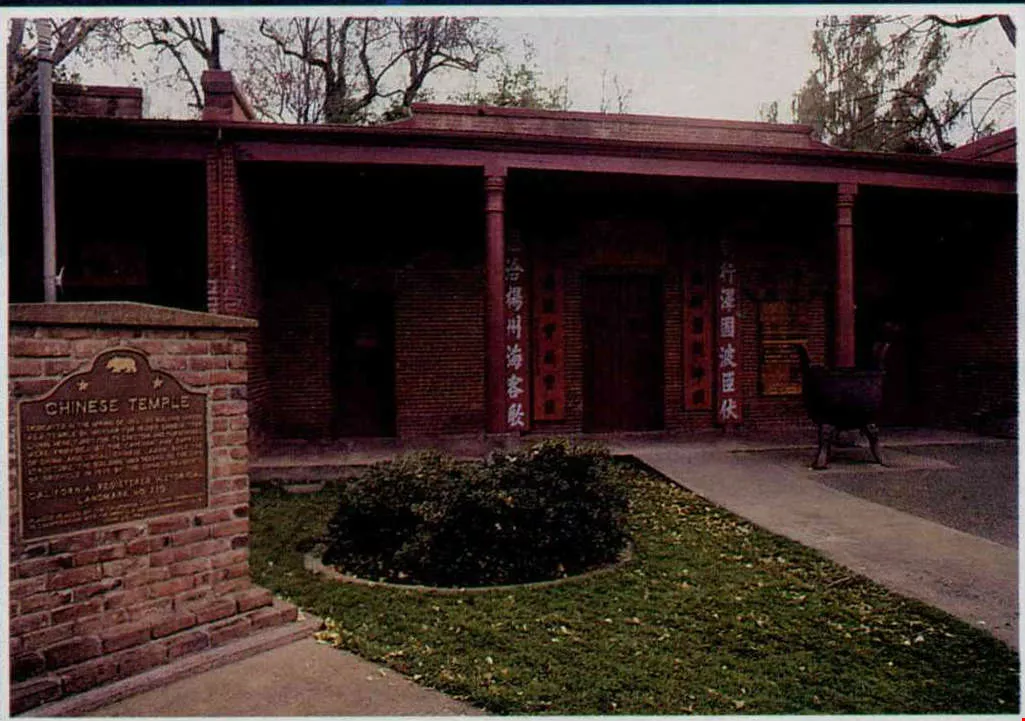
You can find State Historic Site 770-the Lieh sheng Temple-by following the green line. With a rich collection, it is the foremost of California's "Big Three" temples.You can find State Historic Site 770-the Lieh sheng Temple-by following the green line. With a rich collection, it is the foremost of California's "Big Three" temples.
A city made from gold:
At the beginning of the 19th century, after gold was discovered in the hills of northern California, the place became a magnet for " 49ers" to come pan for the yellow gem. Because the process of panning takes a lot of water to wash the mud and dirt away and screen out the bits of precious metal, early mining sites were all set up near rivers, so that water would be easily accessible.
Concentrations of miners gave rise to related businesses like general stores, pharmacies, saloons, blacksmiths, and laundries. And where there are opportunities to make a living, people will naturally form together into communities.
Oroville is a classic case of a town built on gold. A hundred or so years before, the area was quite desolate. But because there were veins to be mined, and it was right on a river, a town took shape.
Gold fever brought countless Chinese to the New World to seek their fortunes. Because there were few overland roads, spots accessible by river transport became important. After coming through San Francisco, gateway to northern California, Chinese with gold on the brain who were heading to the mining areas north of there would follow the Sacramento River straight up to the city of Sacramento, now the state capitol. From there they would float down the Feather River to Oroville.
Records from 1850 show that there were about 2,200 Chinese in the vicinity of Oroville. Most were miners, working the two abandoned mines in the area.
Americans who had been first on the scene had long before given up on these mines and moved on for better pickings farther north. In order to avoid confrontation with the hostile white miners, the Chinese tended to stay in gold streams or mines that had been abandoned, hoping to squeeze a small fortune out of the mud and gravel.
Director Carpenter states that by 1860, San Francisco aside, this was one of the towns in the United States with the highest concentration of Chinese. Though most Chinese deliberately hid themselves to avoid the surveys of the local government, according to contemporary government estimates there were as many as 10,000 Chinese in the area. This was, so to speak, the golden age for Chinese in Oroville.
Chinese retained their own customs, and over time a distinct Chinatown took shape. Liu Po-chi, a writer who specializes in the history of overseas Chinese in the United States, in his book The Lost History of Overseas Chinese, describes Oroville in this way: "There were many general stores, medicine shops, and laundries to provide local Chinese with the basic necessities.... To attract customers, the Chinese Theater would even bring in opera singers from San Francisco to perform."
On two forsaken structures on a street corner to the left hand side of the Lieh Sheng Temple, you still see signs reading "Chinese Laundry" and "Club. " From the fact that they had a club you can tell that the Chinese community couldn't have been small.
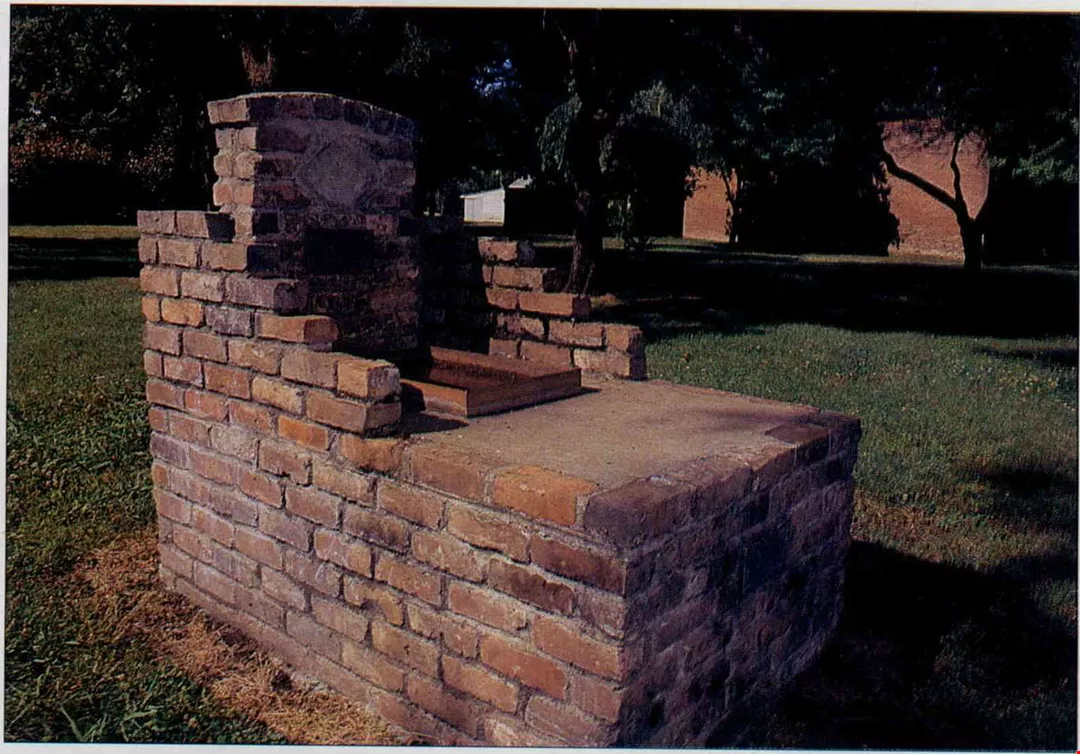
An altar used for offerings to Heaven and Earth is headed "peace to All Under Heaven.".
Restoring the old appearance:
Wherever Chinese settled in, they naturally brought their beliefs and customs. In that age when medical care was scarce, it was often impossible to do anything for people infected by disease. In addition, workers in the mines often faced unpredictable dangers, and there was periodic havoc wrought by fire or flood. To seek escape from these perils and ask the patronage of the gods, money would be collected to build a temple.
In the 1850s, the Chinese of Oroville constructed a wooden temple, but this was destroyed by fire not long thereafter.
Chinese began erection of a new temple in 1858, this time using more durable red brick; work was completed five years later.
There was a turbulent period around 1869 with a move to "discriminate against the Chinese," and local Chinese buildings and objects were often destroyed by local residents. But the temple at Oroville fortunately survived.
After all that, in 1907, an unprecedentedly calamitous flood struck the Chinese district. The wooden theater and storehouse were obliterated, never to be rebuilt. Although the brick temple did not collapse, a number of important old objects were damaged.
After the flood, most of the Chinese were left without means to rebuild their homes, and they left in large numbers to make new lives for themselves. Only a certain Chan family remained behind, looking after the temple. Though they had no way to restore it to its former condition, they did as much as they could to preserve the artifacts and objects, and paid the taxes to reserve the rights, hoping that the day would come when the structure could be renovated.
In the 1930s, noting that the temple had reached a terrible state of disrepair that would be difficult to reverse, and after lobbying by several interest groups in Oroville, the Chan family turned the temple over to the city government. Although the town assumed title to the property, they did nothing to restore it.
Later, a local women's group began to raise funds and purchase building materials, and with the labor contributed by individuals, union, and then convicts, preliminary reconstruction was begun in 1949. The goal was to open it to public visitation as a museum.
Later on, the reclamation work came to include the Garden Courtyard and the Tapestry Hall, and the task was completed in 1963.
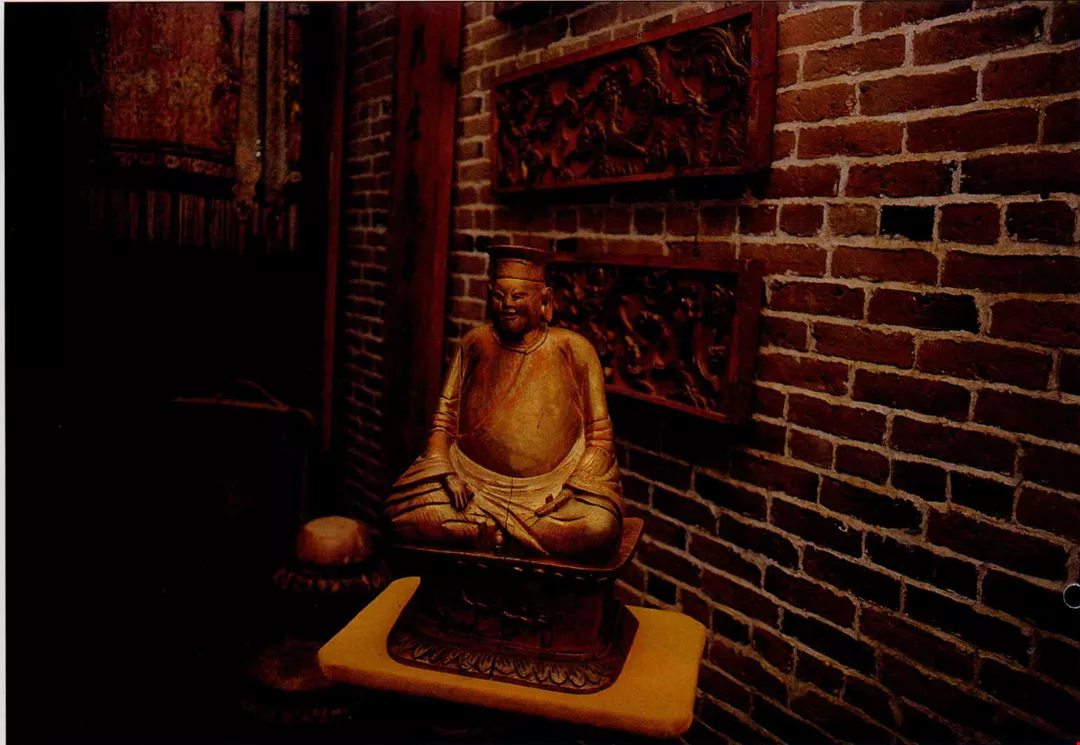
A gold-painted Mitreya is usually laughing; look closely and you'll see this one is a bit different than the traditional mold.
Living history:
"Of course people didn't rebuild the temple for the benefit of Chinese, " says Jim Carpenter. The fact is that the Lieh Sheng Temple is part of the history of California and the United States, and looking after it is equivalent to capturing a piece of the past.
The Lieh Sheng Temple translates into English as the "Temple of Assorted Deities," and is devoted to Confucian, Buddhist, and Taoist deities. Its collection of artifacts is so rich that it is considered the foremost of "California's Big Three" temples. In fact, it is not simply a temple, but is a compound including the Main Temple, the Chan family shrine, the Display Hall, the Tapestry Hall, and the Garden Courtyard and Memorial Pavilion.
Though the temple itself is only about as big as a basketball court, the land it sits on extends well out in all directions. The property is liberally sprinkled with peach, pear, fig, loquat, and persimmon trees, creating some life on the otherwise empty grounds.
On a lawn to the left of the temple is a small red-brick altar for offerings, with the plaque above reading "Peace for All Things Under Heaven. " It is provided for believers to worship Heaven and Earth. There is also a large iron censer in front of the temple, engraved with the names of benefactors as well as bird, flower, tree, lion's head, and wild animal decor.
There is a commemorative tablet on the other side of the temple. It explains that in 1962 this temple became the 770th State Historic Site.
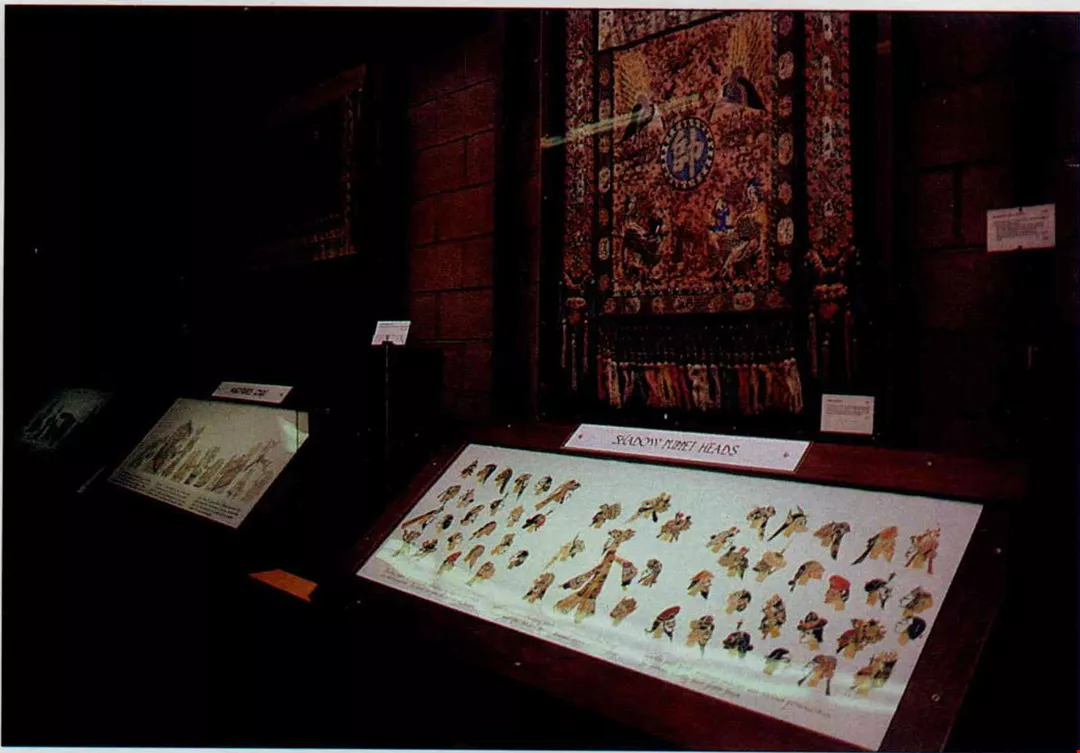
After years of reworking, the old and worn shadow puppets reappear in the embroidery hall.
Rich holdings well-kept:
At the door of the temple, a horizontal tablet along the top reads "Lieh Sheng Temple." The couplet running vertically down the two sides reads "Power That Can Tame The Floods" and "Celestial Blessings Follow the Travelers From China. " There are ten additional tablets hung from the ceiling just inside the door, but they are nearly black from the smoke from the incense of worshippers. On the platform for the deities, Matsu, Kuan Kung, and Hua T'o sit majestically. Dragon heads, lion heads, and paper lamps line both sides. Off in a corner are divining sticks for visitors to draw when they come to ask for assistance.
Besides the main temple, on the left flank is a Chan family shrine, headed by a horizontal tablet reading "Chan Who Repressed the Bandits. " Inside is a sacred tablet inscribed "Official Chan Who Protected the Nation and Guarded the People. " The ancestors of this Chan clan came from Taishan County in Guangdong Province, and the shrine commemorates the ancestors who pioneered that place.
Two buildings back is the well-known "Moon Temple. " It gets its name from the doorway, round as a full moon. It symbolizes the eternal cycle of life, death, and rebirth, and the beauty and perfection of circularity. The holy place inside is given over to a golden image of Mitreya.
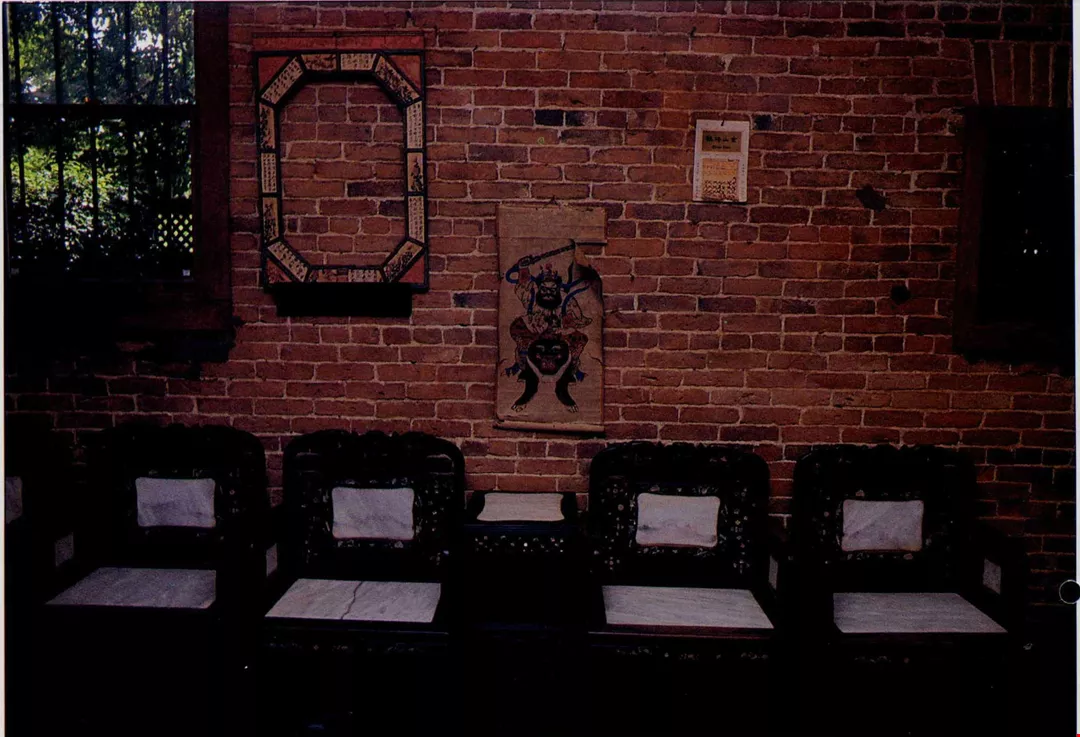
Lieh Sheng's precious holdings have survived floods and anti-Chinese discrimination.
Glory days:
Still another structure is the Tapestry Hall, completed in 1968. A number of exquisite Chinese tapestries, temple festival flags, antiques, opera props, and so on, are collected inside.
On the right as you enter, there is a display book provided for visitors to peruse. In it are pasted old photos about the lives of overseas Chinese collected over several decades by agencies of the Oroville town government.
Among them are several recording the celebration of the opening of the temple: one of a parade of people, with placards being carried in front calling for silence and clearing of the road, the divinities making their inspection tour from a palanquin, and believers following up the rear. This image brings the customs of Chinese at that time back to life. From the houses lining the street and the faces of the curious looking on, it seems that Chinese gods did indeed " immigrate" to America along with the sons of Han.
Another section is the Display Hall. It mainly exhibits items for eating, dress, residential life, and transport commonly used by Chinese at that time. For instance, there are embroidered shoes, ch'i-p'ao dresses, bowls and chopsticks, incense, ivory fans, censers, account books, and mahjong sets ... even grave markers are set out.
Besides providing spiritual guidance, the Lieh Sheng Temple also serves a ritual function. According to Jim Carpenter, it has been the case that Chinese on their way to try their luck in Las Vegas make a special trip out to the temple to pray for luck in striking it rich the modern way.
Next time you find yourself heading to San Francisco, don't forget to take a side trip to Oroville. Just follow the green stripe and it will lead back to the days of glory and tragedy for Chinese miners of old.
[Picture Caption]
p.122
You can find State Historic Site 770-the Lieh sheng Temple-by following the green line. With a rich collection, it is the foremost of California's "Big Three" temples.
p.123
An altar used for offerings to Heaven and Earth is headed "Peace to All Under Heaven."
p.124
A gold-painted Mitreya is usually laughing; look closely and you'll see this one is a bit different than the traditional mold.
p.125
After years of reworking, the old and worn shadow puppets reappear in the embroidery hall.
p.126
Lieh Sheng's precious holdings have survived floods and anti-Chinese discrimination.
p.127
Lieh Sheng's deities carried on this palanquin during processions; it hasn't been used for a long time.
p.128
From this old photo of a temple procession, you can see evidence that religious beliefs followed the Chinese to America.
p.128
Displayed in the temple is a history of the Chinese of Oroville.
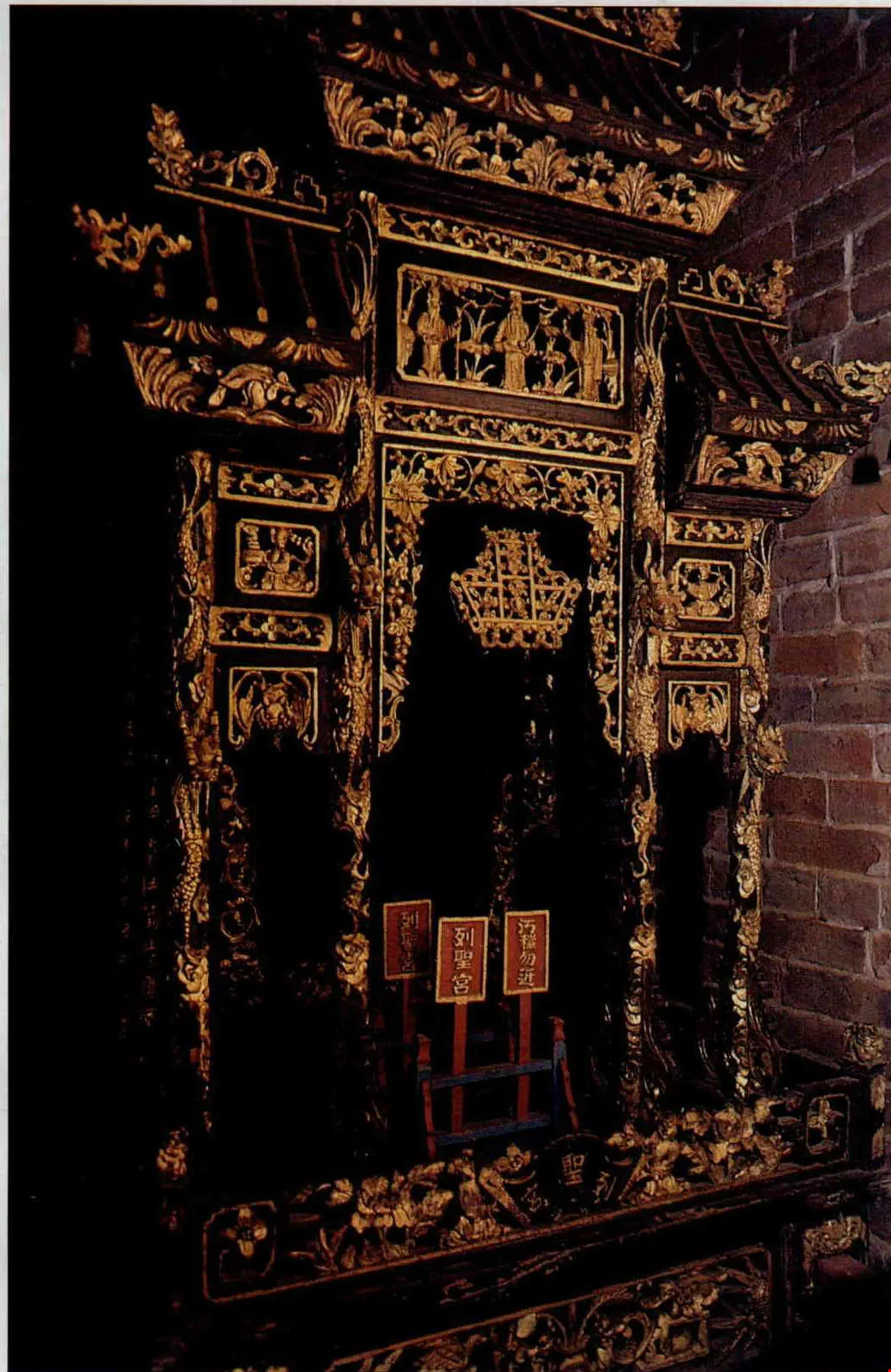
Lieh Sheng's deities carried on this palanquin during processions; it hasn't been used for a long time.
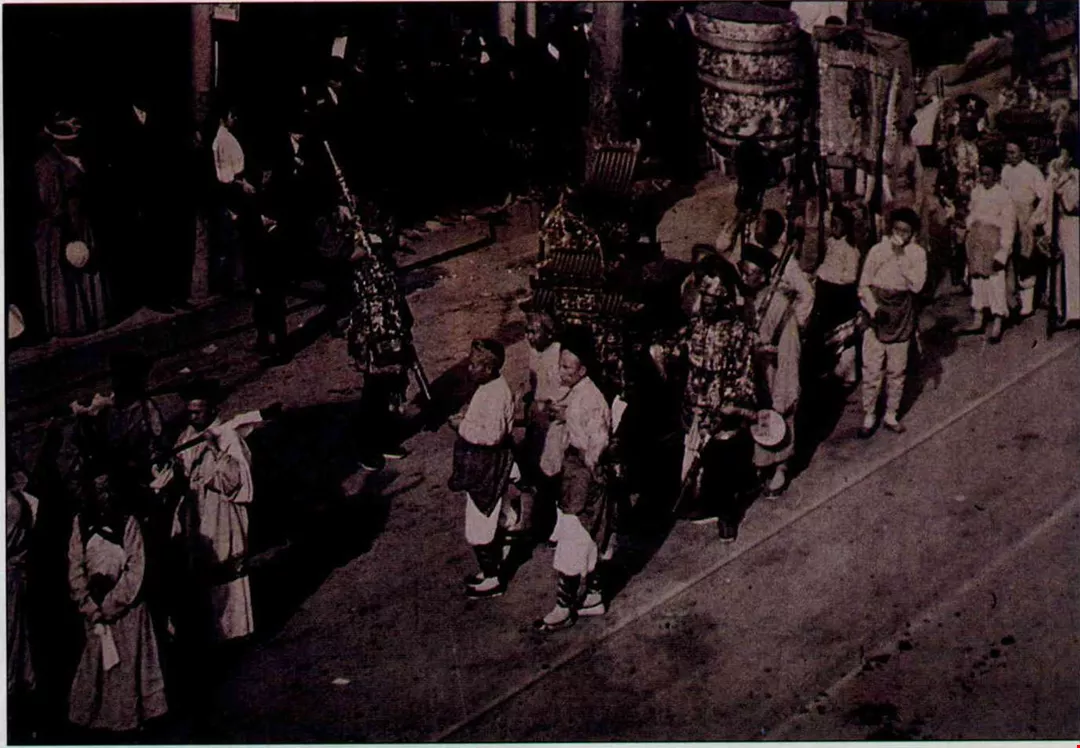
From this old photo of a temple procession, you can see evidence that religious beliefs followed the Chinese to America.
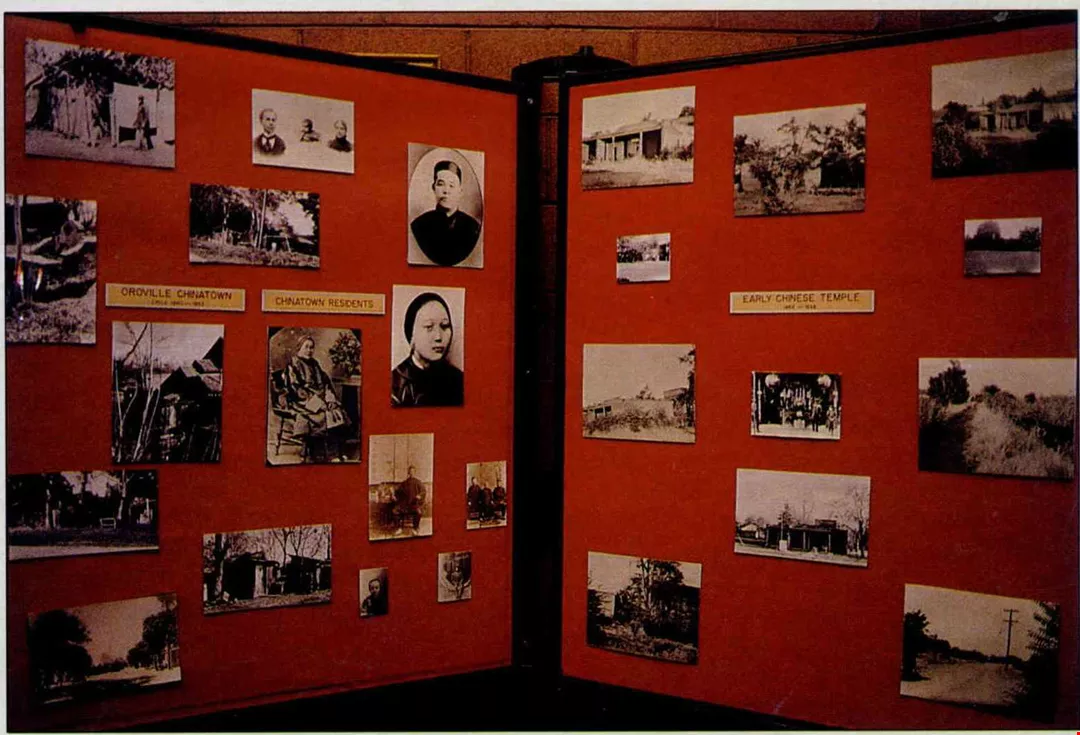
Displayed in the temple is a history of the Chinese of Oroville.

@List.jpg?w=522&h=410&mode=crop&format=webp&quality=80)

@List.jpg?w=522&h=410&mode=crop&format=webp&quality=80)


