Redeeming the Earth:Taiwan Recycles Former Landfills
Lin Hsin-ching / photos Hsueh Chi-kuang / tr. by Josh Aguiar
December 2011


If someone told you that former landfills were gaining popularity as tourist destinations, you could hardly be blamed for dismissing the notion as preposterous. Yet somehow many of these unsightly legacies bequeathed by Taiwan's material growth in the last century have been transformed by over 20 years of grooming and greening into relaxing spaces for urban dwellers. Just how was it possible to expunge the fetid associations from the collective consciousness?
If one makes the journey up the coastal highway towards Kee-lung, just a little past Ba-douzi Fishing Harbor is a site that many bloggers tout as a great place to visit with the kids: Chao-jing Park. Framed by mountain and oceanic splendor, the park also offers crisp, verdant open spaces. In the distance, Mt. Ji-long is visible, as is the mountain resort town Jiu-fen, forming an unbroken arc of natural beauty that draws appreciative holiday crowds.
Back in Tai-pei in the mountainous district of Mu-zha is a secret haven for remote-control aircraft aficionados. Even on workdays you'll see aviation enthusiasts of all ages with their beloved personally customized gadgets, matching skills with one another. On clear days, brightly colored fighter planes and helicopters race energetically against a sunlit blue backdrop, looking like something out of an animated film.
"Whenever work's not going the way it should, I come to this place. It's not easy to find as expansive and green a spot as Fu-de-keng Park in Taipei," avers a Mr. Chen.
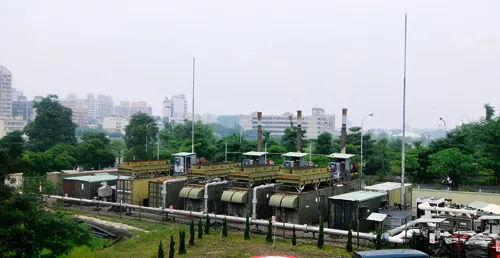
Methane gas is a valuable landfill byproduct that, if processed properly, can generate millions in energy revenue. Here we see the methane-fired electrical generators at Kaohsiung Metropolitan Park.
"Fu-de-keng?" The name may sound oddly familiar. Then it hits you: this rendezvous for remote-control aviators in its previous avatar was none other than the Fu-de-keng Landfill. And the now poetic Chao-jing Park was once the Ba-douzi Landfill many years ago.
Similar transformations have taken place at locations throughout the country. Kao-hsiung Metropolitan Park attracts 1.2 million visitors annually, and San-xia Carbon Neutral Park has become a hit with backpackers who take advantage of the free, renewable-energy-powered lodgings. But before their remarkable metamorphoses, both places were nothing more than heaps of malodorous refuse.
In terms of image, one would be hard pressed to find a duo more diametrically opposed than trash dumps and public parks. Understanding how one could be converted into the other requires an examination of the history of waste management in Taiwan.
As is the case with many developing nations, Taiwan's economic planners in years past placed a high premium on growth with hardly a thought for the environmental costs. For a long time, local governments handled waste disposal. In most cases that simply meant finding an unused, low-lying plot in which to unload the garbage. The more high-minded districts would conceal the rubbish under a thin layer of earth, but stingier- administrations might be content to simply let it fester in the open.
Given enough time, in the absence of any environmental safeguards, landfills began to emit foul odors and gave rise to cesspools. They became breeding grounds for flies and mosquitos. In addition, when organic trash was broken down by microorganisms in an airless underground environment via the process of anaerobic fermentation, marsh gases containing copious amounts of methane were released, essentially turning the grounds into giant tinder boxes.
The wake-up call came in the early 1980s, when a series of marsh-gas-related blazes at the "garbage mountain" in -Neihu, at that time Tai-pei's primary dumping site, caused extensive damage. In 1984, the Executive Yuan promulgated the Municipal Waste Disposal Plan, charging local governments with the task of establishing sanitary landfills conforming to various preventative standards. Specifically, it required landfill side slopes to be lined with waterproof membranes and called for the installation of a network of drainage pipes to control and treat methane emissions and liquid sewage. Landfills were to be covered at the close of each day to reduce the spread of noxious odors and to speed along biodegradation.
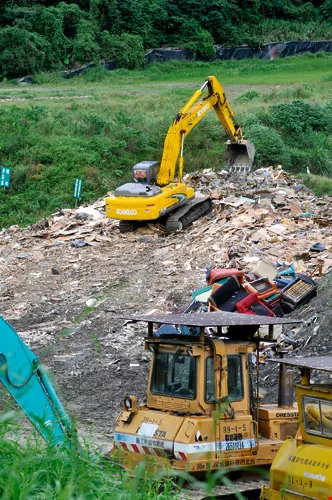
Garbage has come part and parcel with the ascendancy of human civilization. Though it may be concealed within the ground, trash continues to exert an insidious influence on the environment. Here we see a part of the old Shan-zhuku Landfill.
This policy held sway for the next 20 years, and at its peak there were 321 such sanitary landfills located primarily in mountain valleys or low-lying areas on the outskirts of major cities, like black holes sucking away all the deleterious byproducts of economic progress.
There comes a day when even the vastest of holes is filled to the brink, but that didn't discourage a growing populace from generating more rubbish. Back then, no one entertained the thought of separating different types of trash. Every-thing, whether kitchen scraps, plastics, Styrofoam, metals, human waste, or dead plants and animals-even substances like medical waste products or soil containing toxic levels of mer-cury-was lumped together haphazardly, thereby exerting uneven degrees of harm on nearby soil, the air, and groundwater.
In the 1990s, the public began clamoring for higher environmental standards. Finding dumping sites was becoming more difficult. Relations with adjacent communities were becoming more strained, culminating in protests throughout the island in which angry citizens blockaded the entrances to dumps. In order to assuage popular indignation, the government hastened to set up trash incinerators. Burning replaced dumping as the primary means of disposal, though landfills were retained as a supplementary measure.
In 1997, the Environmental Protection Administration took things a step further with the launch of the "4-in-1" Resources Recycling Program, a phased implementation of waste recycling and reduction. After more than 10 years of diligent effort, the daily amount of trash generated by the average person today is 0.4 kilograms, down from the peak of 0.85 kg some years ago. According to government statistics, 99.99% of all waste was handled "acceptably" in 2008, as opposed to 60.17% in 1989. Taiwan's landfills have long since been retired, and even the active incinerators today have days in which they are shut down early due to the lack of trash.
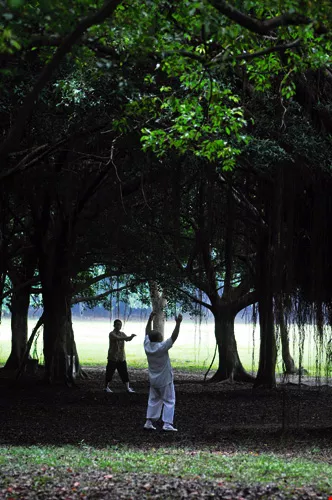
By painstakingly ameliorating the soil and cultivating trees beginning at the sapling stage, Kaohsiung Metropolitan Park has been able to overcome the inherent difficulties in reclaiming former landfill earth. Today, the park displays a beautiful and flourishing landscape.
Taiwan possesses limited land resources, a fact which naturally lent urgency to the question of how to best rehabilitate the scarred countryside. It certainly would have been a waste to just let a bunch of plots many tens of hectares in size lie in abeyance.
Chou Li-chung, section chief in the EPA's Air Quality Protection and Noise Control department, the agency handling the reclamation of the former landfills, comments that the environmental damage caused by the trash is not so easily undone. Even though the landfills have been closed down, there continues to be seepage of contaminated water and the creation of unwholesome marsh gases, both of which require long-term monitoring in order to curb pollution or any threats to public wellbeing.
Over time, disintegration reduces the volume of trash, but it does so unevenly, resulting in surface soil with uneven degrees of subsidence (caving or sinking), which makes it a tenuous base of support for buildings. After reviewing parallel circumstances in other countries, it was decided that the safest alternative was to turn the former landfills into recreational parks.
Landscaping a region ravaged by years of contact with garbage is a formidable task. In the first five years after the landfills closed the soil was extremely unstable with average subsidence rates of 30-50%. The land clearly needed time to heal.
Only after five years were up did the bureau launch any greening efforts. Chou explains that in the majority of landscaping the planting of grass and trees is undertaken simultaneously. The buildup of marsh gases precluded planting trees for a while; at the peak, underground temperatures soared as high as 40-50 °C, and "the bigger the tree, the deeper the roots; the deeper the roots, the faster it dies." The work had to proceed in step with the gradual amelioration of the ecology, beginning with planting grass. Trees would have to wait until the gasses subsided, a new grassy ecosystem gained a foothold, and the soil had improved sufficiently.
Notwithstanding the many years since the landfills were last in use, the soil has remained poor, and that has impeded plant growth. Thirty-seven of Fu-de-keng's 98 hectares were used as a landfill until its closure in 1994. Though a lush carpet of grass now extends across its length and breadth, tree growth has been rather spotty. There are presently only 3800, and the survival rate for saplings is roughly 50%.
This is exactly the problem confronting the developers of the Shan-shui Ecological Park, located on the site of the old Shan-zhuku Landfill in Tai-pei. They've been trying to plant cherry trees and tung oil trees in accordance with the wishes of nearby residents, only to be thwarted at every turn. Only hardier indigenous varieties like the banyan, Chinese tallow, green maple, and golden rain tree have the requisite toughness to survive where the others have perished. In the meantime, the planners' vision of a scenic natural paradise may be difficult to attain.
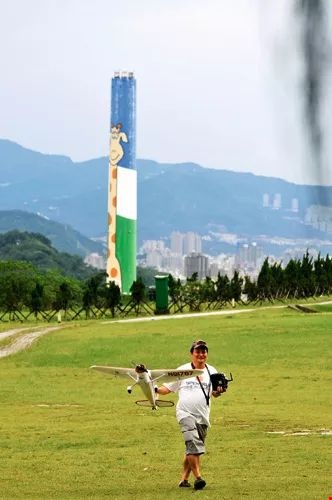
The teeming city of Taipei has an expansive green oasis in Fudekeng Park in Muzha where people can race remote-control airplanes to their hearts' delight.
Yet there are many instances in which the ingenuity of the government developers will prevail over inhospitable circumstances to turn a former landfill into an attractive destination for vacationers.
A prime example is Fu-de-keng, which despite its tree struggles, has done well solely on the strength of its expansive green meadows, which are especially popular with remote-control plane enthusiasts who take advantage of the open spaces to fly their contraptions with a reckless abandon. The embankments that were once used to keep in the trash have been repurposed as grass-sledding slopes of four different grades. The park even provides the necessary equipment to visitors free of charge. At every holiday the park resounds with childish laughter, and people vie with one another over limited grass sleds.
The former Shan-yuan Tanzi Regional Landfill in San-xia has adopted an even more creative approach. Now called the San-xia Carbon Neutral Park, it is a place where people can lodge for free, and what's more, by being able to say they've stayed in a dump, they'll forever have an interesting conversation icebreaker.
Park guide Guo Hong-yuan says that the old landfill serviced the Greater San-xia/Yingge area. With a scant surface area of 18 hectares (of which only eight actually held any trash), it really doesn't have the size to support a full-fledged recreational area. To overcome that shortcoming as well as its disadvantaged remote location, the developers had to employ extra creativity in cultivating a unique identity.
After discussions with the New Tai-pei City Environmental Protection Department and outside experts, they decided on an approach combining frank assessment of historical legacy with a contemporary low-carbon tourism ethos, resulting in the creation of a park where people can learn about conservationism. In addition to the basic work of greening and revitalizing the local ecology, they also built a lodge that brings together a number of renewable energy sources: a system for recycling rainwater and solar and wind energy. The lodge, which accommodates one family per day, has been such a hit with the public that it is already booked solid through the remainder of the year.
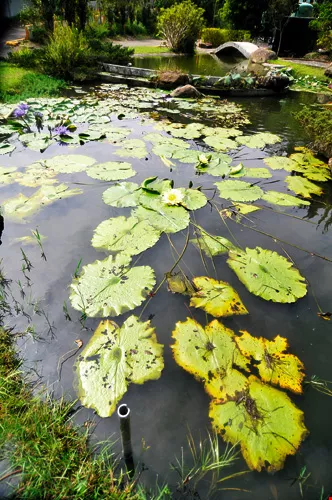
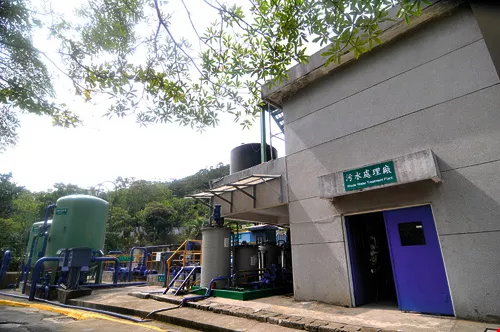
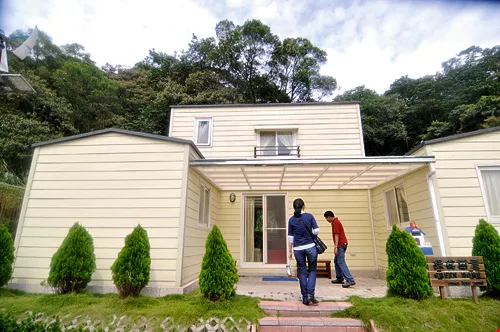
In preaching the gospel of conservationism, Sanxia Carbon Neutral Park uses its inglorious legacy as a potent symbol even as it strives to restore the local ecology. Above we see a pond with water lilies in full bloom. The photos at right show the lodge-which is entirely powered by renewable sources, and where visitors can reside for free-and the sewage treatment facility, where visitors can get an understanding of the kind of work that goes into protecting the environment.
The landfill byproduct that was once the bane of all sanitation professionals, marsh gas, has been transformed by the blessing of modern technology into a valuable source of renewable energy.
John Lin, assistant manager at Veo-lia Environmental Services Taiwan, a com-pany at the vanguard of the biogas industry in Taiwan, explains that landfills, pigsties, and bogs-generally any place rich in organic matter-are all likely repositories of marsh gas. Methane is the most prevalent component of this gas, comprising usually 50-70% of the total, followed by carbon dioxide. Easily combustible and hot burning, methane is 22 times more potent a greenhouse gas than carbon dioxide. Any time there is a buildup of methane underground at a concentration exceeding 5% there is a palpable threat of self-ignition or even detonation, which were the main causes of the fires that occurred with regularity earlier in Taiwan's landfills.
In order to prevent such mishaps, the relevant government agencies set aside funds to draw off and burn the gas periodically. It wasn't until 10 years ago that they hit on the current strategy of letting private companies do the work and retain the profits from selling the harvested energy.
Currently, Fu-de-keng, Shan-zhuku, and Kao-hsiung Metropolitan Park (formerly Xi-qingpu Landfill) all have sizeable biogas electrical generators, which simply use biogas as a substitute for the usual diesel fuel in the generators' internal combustion engines. According to estimates, 0.75 cubic meters of biofuel typically yields one kilowatt-hour of energy. At the largest operation at Metropolitan Park, they produce as much as 26.8 million kWh annually, roughly enough to power 7000 households. The operation also generates over NT$36 million in annual revenue, an impressive figure.
In preaching the gospel of conservationism, Sanxia Carbon Neutral Park uses its inglorious legacy as a potent symbol even as it strives to restore the local ecology. Above we see a pond with water lilies in full bloom. The photos at right show the lodge-which is entirely powered by renewable sources, and where visitors can reside for free-and the sewage treatment facility, where visitors can get an understanding of the kind of work that goes into protecting the environment.
With the landfills having undergone redemptive transformation, it's tempting to indulge the thought that no work remains undone. But earth that has been blighted by trash needs to be meticulously cared for, lest some of the old demons rear up once more.
At popular Chao-jing Park on the north coast the ocean's continual erosion of the sea wall there is sweeping some of the old buried trash out to sea and, much to the chagrin of the local residents, noticeably polluting the water. Though the government already has plans to shore up the wall, the residents are insisting that the only permanent solution is to completely clear the mounds of subterranean garbage. They've even launched a Facebook campaign to pursue that aim.
The Neihu "garbage mountain," which is in the midst of being cleared, is further proof of the extensive work that remains to be done. From 1970 to 1985, it was the only landfill for the entire city of Tai-pei. Environmentalism was at a very crude stage in those days, and the landfill, which was located in the environs of the Kee-lung River, was continually fingered as the culprit responsible for the river's pollution. -Neihu eventually became hot real estate, and as prices shot upward, property owners and residents put continual pressure on the government to act. A resolution was passed in 2003 to clear each remnant of the trash, with the work actually commencing in 2006.
Disposing of junk that has accrued over years and years is a deceptively complex task. A shocking array of items-household trash, plastic products, dead batteries, electrical cords; Buddhist figurines, coins, jewelry, gold bars and other precious things; even weapons like hand grenades and mortars-were ensconced within the rubble, and the need to separate them was beyond the abilities of a screening machine, requiring in addition painstaking human labor. Because the earth being excavated presented a biohazard, there was the additional question of finding a suitable dump for the former dump. Overall, the problem has turned out to be far more textured than initially thought, thus prolonging the time needed for completion.
For many years, the Earth has tacitly and stoically endured human desecration, but improved attitudes and technology perhaps will make it possible at last for her to breathe a sigh of relief. While it's a given that the greening and resuscitation of the land is evidence of humanity learning and growing from past mistakes, there is perhaps a deeper symbolic meaning, as well: it is perhaps the best way to expiate our sins against the land.
In preaching the gospel of conservationism, Sanxia Carbon Neutral Park uses its inglorious legacy as a potent symbol even as it strives to restore the local ecology. Above we see a pond with water lilies in full bloom. The photos at right show the lodge-which is entirely powered by renewable sources, and where visitors can reside for free-and the sewage treatment facility, where visitors can get an understanding of the kind of work that goes into protecting the environment.

@List.jpg?w=522&h=410&mode=crop&format=webp&quality=80)

@List.jpg?w=522&h=410&mode=crop&format=webp&quality=80)


