
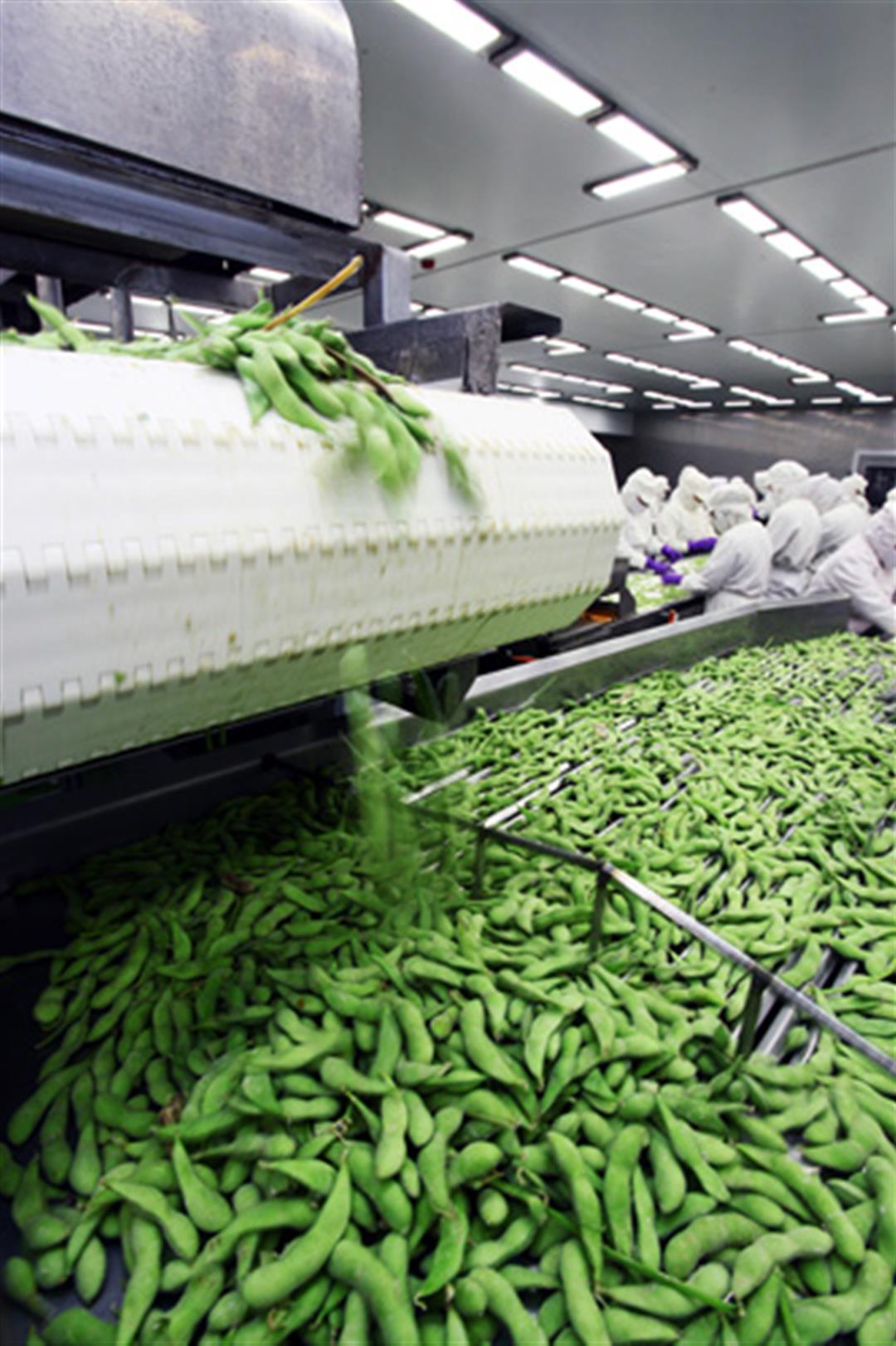
Taiwan-produced high-quality frozen processed edamame—green, immature soybeans still in the pod, widely consumed as bar food in Japan—has successfully fought off a challenge from mainland China and since 2008 has reclaimed top market share for imported edamame in Japan.
The strategy on which Taiwan edamame growers have relied can be summed up as “the four-hour freeze.” If edamame are frozen within four hours, then they taste remarkably fresh when consumed.
Behind the “four-hour freeze” lies the revolutionary transformation of Taiwan’s edamame industry. Every link in the chain is involved, from R&D into varieties to unprecedented scales of mechanized farming to improvements in processing. Last year frozen edamame exports hit 30,000 metric tons, generating US$60 million (NT$1.8 billion) in revenues, numbers that had for many years been thought to be forever out of reach.
In particular, the Kaohsiung #9 variety, known as “Green Crystal,” has performed exceptionally well, besting competitors from mainland China, Thailand, Indonesia, and the US, and has become a legend in its own time in the world of edamame.
February marks the spring crop cycle for edamame, which can be grown year-round and yields two harvests per year. We have come at this time to Qishan District in Kaohsiung, which, together with one other district in Kaohsiung and eight townships in Pingtung County, has since 2007 been designated by the Agriculture and Food Agency of the Council of Agriculture as a special export-production zone for edamame. This area, which generates over NT$1 billion per year in foreign-exchange income, has been dubbed “green gold territory.”
Hou Zaobai, though only 37, is already a veteran edamame farmer. Under a guidance program run by the Kaohsiung District Agricultural Research and Extension Station, since 2002 he has rented 220 hectares (ha) of land from the Taiwan Sugar Corporation for planting edamame (currently rent is NT$50,000 per year per hectare), making his farm an enormous operation in comparison to the average of about one hectare of arable land per farmer in Taiwan.
Farming at this scale has been an incredible boost for the productivity and international competitiveness of Taiwan’s edamame, and is a far cry from the image most people have of farm villages consisting exclusively of tiny fields cultivated by elderly farmers.

Frozen edamame exports from Taiwan/source: Directorate-General of Customs
“Green gold territory,” which radiates outward from its hub at Ligang Township in Pingtung County, has 19 farmers who, like Hou, operate large farms (from the smallish at 100 ha to the largest at 400). Over half of these farmers are under 40 years of age.
These young farmers, by raising green soybeans—not exactly what one would call a high-profile crop—have earned themselves enough money to drive around and inspect their fields in imported luxury sedans.
“You can really get out and about on farms like these—you aren’t tied down to a desk somewhere,” exclaims Hou, who before going into edamame farming was a soybean dealer, helped his father-in-law run a jewelry shop, and ran a bamboo-shoot processing operation.
Hou sure makes it sound easy! But driving around inspecting fields is not joyriding. As manager of the entire farm, Hou has to keep a close eye on how the edamame are growing, taking note of where weeding is needed, where fertilizer must be added, what order the fields should be harvested in…. He has to orchestrate everything, including a workforce of about 10 persons.
Edamame have two crop cycles in Taiwan, the spring crop running from January to June, the autumn crop from August to January.
Hou tells us that planting and harvesting are the busiest times of year, and employees can earn NT$40–50,000 per month, plus up to NT$50,000 in monthly bonuses for those who specialize in machine maintenance and repair.
Specialized equipment—things like seeders, harvesters, and field management machines—is also exorbitant. A single harvester alone, whether imported ready-to-go or assembled yourself from imported parts, costs over NT$10 million, and at a conservative estimate of 100 ha per crop cycle, you have to invest at least NT$30 million (about US$1 million) in machinery alone.
Hou reveals that, leaving rent aside, production costs run to NT$80,000 per hectare. With yields at about seven to eight metric tons of edamame per hectare, prices have to reach at least NT$200 per kilogram for farmers to make a profit.
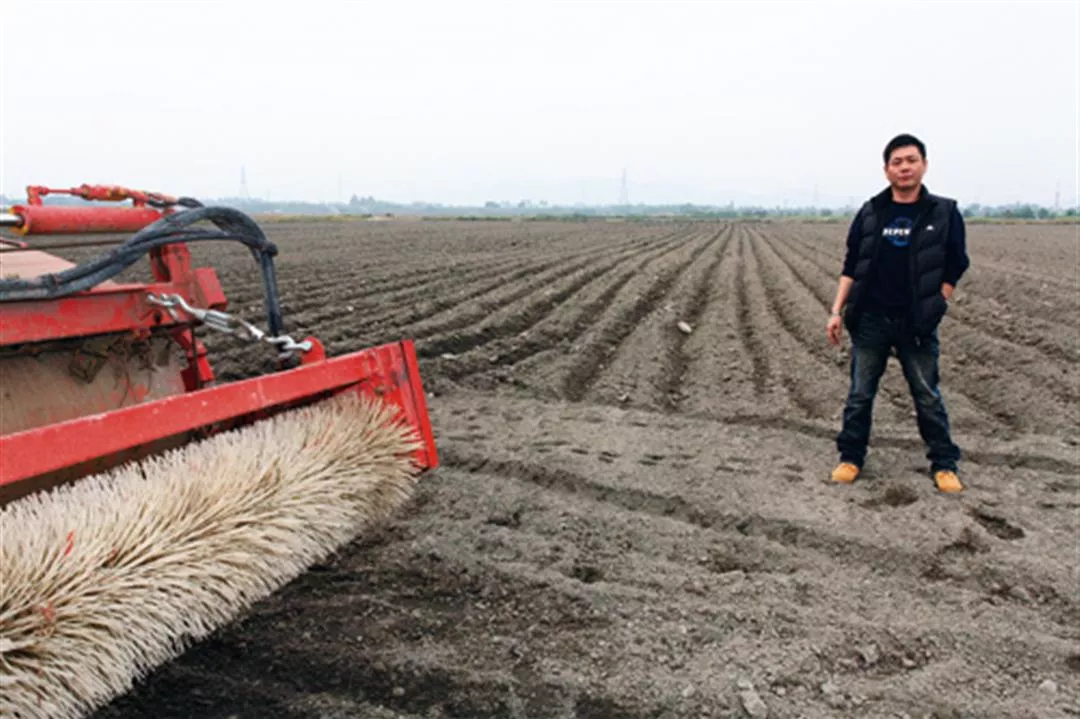
Taiwan Sugar Corporation has leased 2500 hectares of land to help create large edamame farms in southern Taiwan. The photo shows grower Hou Zaobai on his 220-hectare farm.
Taiwan currently has eight processing firms handling edamame, down from a peak of 34; there has obviously been a huge shakeout in the industry as Taiwan’s fortunes as an edamame exporter have waxed and waned.
Trade statistics show that frozen edamame exports from Taiwan peaked in 1987, at over 42,000 tons. At that time, all the farms in Taiwan cultivating green soybeans were small in scale and were not mechanized. But as there were no real competitors for frozen edamame imports into the Japanese market, Taiwan supplied virtually the entire amount.
Liu Kuei-ping, chairman of the Young Sun Frozen Foods Company, recalls that before 1990, mainland China’s share of Japan’s frozen edamame market was less than 2%. He never expected that there would be such a rapid shift in relative status virtually overnight.
Back in 1989, the ROC government began to permit Taiwanese firms to invest in mainland China. Of the 30 or so frozen food companies of that time, at least 10, attracted by the low wages of workers in the mainland, took seed soybeans from Taiwan and began to cultivate edamame in the mainland for export to Japan.
But even in the early 1990s, because the mainland’s processing industry had not yet gotten its feet on the ground, Taiwan still took top honors, and in fact exports hit their second highest figure ever in 1991, at 41,000 tons. But it was all downhill after that, as Japanese orders began to shift over to mainland China, and by 1995 exports to Japan had fallen to 27,000 tons.
In 1996, the struggle seemed to reach a turning point when mainland exports surpassed those of Taiwan, which fell to only 25,000 tons. It had been taken for granted for 30 years in Japan that Taiwan was its number-one source of edamame, and no one expected that the day would come when the title would change hands.
The turn of the century brought no improvements in the situation. In 2000, mainland exports of frozen edamame to Japan surpassed 50% market share for the first time, rubbing Taiwan’s nose in the dirt. The gap between the two reached its highest point ever in 2001, when the mainland hit a 58% market share, and Taiwan, with only 29%, was left scrapping with Thailand and Indonesia for the dregs of the market.
Things looked bleak indeed for frozen food processing firms still in Taiwan, and Liu Kuei-ping began to wonder if even a return to 30,000 tons would be forever beyond reach.
It was in 2001 that Chou Kuo-lung, associate researcher and head of the agronomy lab at the Kaohsiung District Agricultural Research and Extension Station, was instructed to turn his attention to R&D into new varieties of soybeans. He then asked Liu Kuei-ping, who at that time was director of the Taiwan Regional Association of Frozen Vegetable and Fruit Manufacturers, to tell him about the production and marketing situation for edamame. The answer he got was discouraging: “Edamame from Taiwan have at most five good years left.”
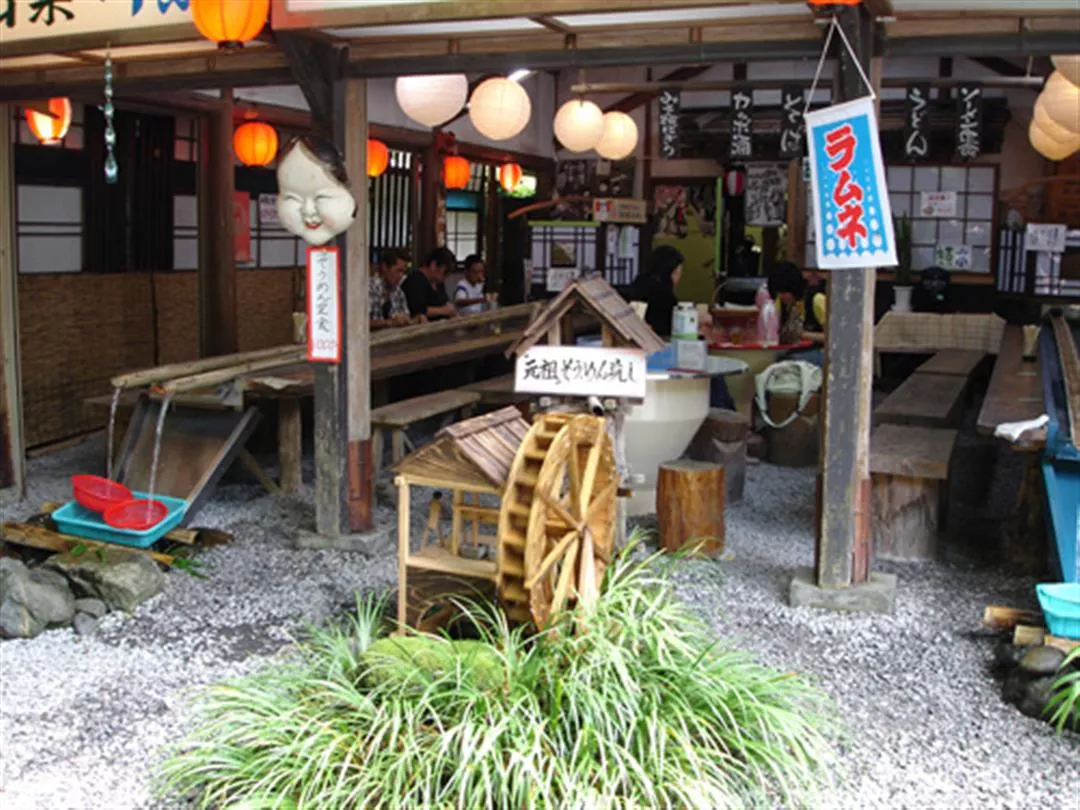
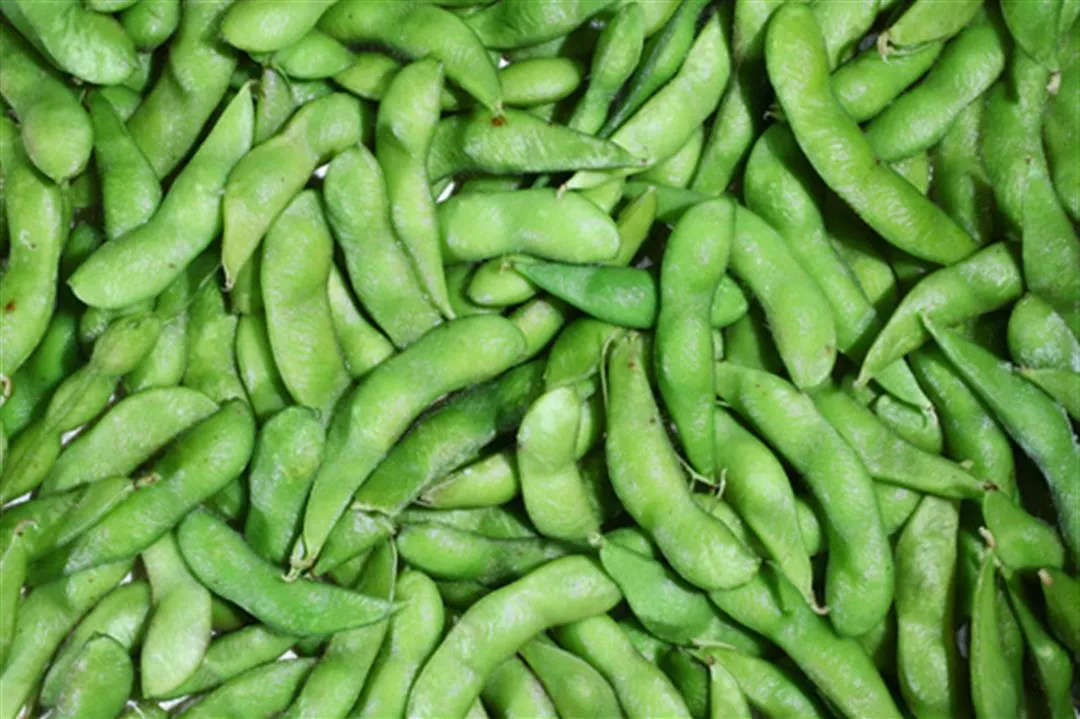
Edamame are popular as bar food in Japan, and frozen edamame from Taiwan account for over 40% of all Japanese imports of this vegetable.
Chou, a fighter by nature who practiced kendo in school, thought to himself: “I just got appointed, and haven’t even started doing anything yet, and I’m told we’re doomed! But I’ll be damned if this industry collapses on my watch!”
Chou and Liu decided to join forces and break out of the impasse rather than just waiting to be destroyed.
Liu took Chou and a group of Taiwan businessmen—now united by their fight against a common enemy—to have a look at soybean production areas in Zhejiang and Fujian in mainland China. They were dumbfounded upon seeing soybean farms covering hundreds of hectares.
But Liu also noticed that the machinery left laying about in the fields was actually cobbled together out of obsolete parts, that mechanization was done in a haphazard fashion with some links in the production chain not mechanized at all, and that management was lax. He figured that someday something would go wrong with soybeans grown in this fashion. Another thought also flashed into his brain: “Taiwan Sugar Corporation has a lot of fallow land in Kaohsiung and Pingtung—why couldn’t they rent it to us?”
After returning to Taiwan, Liu won support for his scheme from the Council of Agriculture, and after some negotiation, the Ministry of Economic Affairs finally persuaded TSC to release the land.
At the same time, Chou insisted that only mechanized large-scale farming would be adequately efficient. Pointing to the examples of large farms in the American Midwest and Brazil, he convinced soybean dealers to shift over to running large farms which would in turn employ small farmers and produce under contracts with frozen food companies. Hou Zaobai was in the first group to join.
One thing that Chou learned from his kendo training was to make your move only when you are fully prepared, and make sure the blow is a fatal one. He knew that without also getting farm machinery, the farms would end up as wasteland. Therefore frozen food manufacturers and large farmers took out loans, even sold houses, to buy equipment. It didn’t come cheap. The most expensive piece was a harvester from France costing NT$13.5 million, and even “inexpensive” weeder/fertilizer machines ran NT$350,000 each.
Preparations for battle having been fully made, Taiwan’s edamame army marched out for another showdown with their mainland competitors (including the Taiwanese firms that had relocated to mainland China). Large edamame farms formally launched operations in the autumn of 2002, with 1000 ha under cultivation.
In 2003, there was a dramatic shift in the fortunes of war. The previous year, frozen spinach exported to Japan from mainland China was found to have unacceptable levels of agrochemical residues, and Japanese consumer confidence in mainland vegetables plummeted. Large numbers of edamame buyers shifted their orders back to Taiwan, and the tide of battle turned decisively in Taiwan’s favor. Much lost ground was recaptured, and Taiwan’s market share in Japan in that year hit 47%, with that of mainland frozen edamame plunging to 29%.
In 2007, the government pushed the organization of Taiwan’s forces to a new level by designating 2500 ha of land as a “special export production zone for edamame,” and supported the plan with further investments.
By 2008, the front lines had become essentially fixed, with an overwhelming victory for Taiwan edamame. Market share has remained stable at over 40%, keeping mainland edamame at bay below 30%. And last year, the number of hectares under cultivation surpassed 4800.
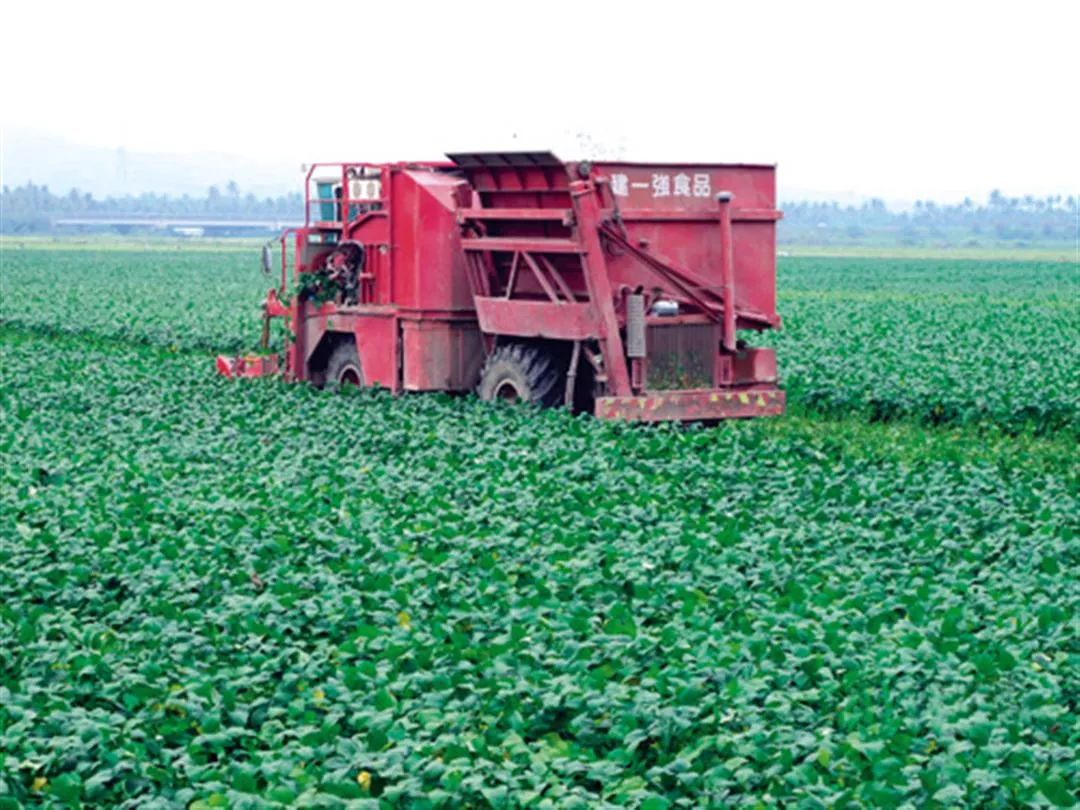
Harvesting soybeans by machine saves labor equivalent to 500 farm workers.
The key to Taiwan’s resurgence in the frozen edamame market in Japan is that frozen food factories in Taiwan upgraded their equipment and processing chain to lock in the freshness of the vegetables within the “golden four hours” window of opportunity. The resulting frozen edamame, with “Produced in Taiwan” and “Kaohsiung #9” printed prominently on the labels, offered Japanese consumers a freshness of taste that was unprecedented for imported frozen green soybeans. Indeed, one of Liu Kuei-ping’s clients, who has been doing business with him for over 30 years, has declared that frozen edamame from Taiwan “taste even fresher than just-picked edamame grown in Japan!”
No other imported vegetables have been as big a hit among Japanese consumers as Taiwan edamame. The model for success has been to link and coordinate R&D, production, processing, and marketing.
The success of edamame has not been a matter of luck. Japan is well known for the strict standards it has for managing imported agroproducts. The reason Taiwan edamame have been getting over the bar for 40 years is due to one thing: quality.
Of course “quality” is a rather abstract term. What has it meant in practice? Liu Kuei-ping’s answer is simple: “If the consumer market sets the standard at 100, we give them 101.”
Walking into Hou Zaobai’s office, you see a huge poster hanging on the whitewashed wall. On it are names of agrochemicals in Chinese, English, and Japanese. “The Japanese authorities use a ‘positive’ method of agrochemical management, which is to say they list the types and amounts that are allowed, rather than the types and amounts that are prohibited. If any chemicals at all other than those listed come up in a test, you’re done for,” says Liu. Taiwan edamame producers treat these standards as their “Ten Commandments.”
But that still isn’t enough. Liu says that after the incident involving mainland Chinese vegetables back in 2002, Young Sun coughed up big bucks to upgrade the agrochemical testing facilities in its factory, and anything they can’t handle themselves they commission out to the labs of the Council of Agriculture.
In other words, internal quality control is stricter than external standards—that’s what Liu means by a quality grade of “101 points.” And that commitment to quality remains steady no matter which market the exported edamame are headed to.
In fact, Taiwan edamame producers are now beginning to look beyond Japan and are eyeing the US as a possible second market. Since the US Food and Drug Administration issued a report in 1998 that edamame can help prevent cardiovascular disease, interest in this veggie has risen in the US. But right now Taiwan exports account for only about 2200 tons of the 40,000 tons of frozen edamame imported by the US each year, roughly 7% of total exports from Taiwan.
Liu Kuei-ping says the reason is that US consumers still have only a very elementary level of understanding about edamame quality, so cheaper edamame from mainland China and Thailand hold the upper hand in the marketplace. However, given that mainland Chinese growers are now facing problems of rising wages, price inflation, and difficulty recruiting labor, and their level of mechanization lags behind Taiwan, many Taiwanese firms have decided to come back home, and it is expected that many foreign buyers will shift their orders to Taiwan.
However that may be, the fact remains that for the present the edamame exporters have almost all their eggs in one basket: Japan. Isn’t that a little risky?
“I’m not really worried,” says Liu with confidence. “The condition of the economy only affects the food industry by about plus or minus 10%. No matter how bad things get, Japanese will still eat at least 50,000 tons of imported edamame per year.”
Moreover, edamame fetch a higher unit price in Japan than anywhere else. (They sell for about ¥398 for a 400-gram bag in supermarkets there; mainland edamame go for about ¥100 less.) Liu has even gone so far as to refuse orders from the US over the past couple of years to satisfy demand from the higher-profit Japanese market. “It’s too bad, but there just aren’t enough green soybeans to go around!”
But as soon as the reserve supplies of ammunition (soybeans) can be brought up to the troops, Taiwan’s edamame army will be ready to conquer new markets wherever they may be. Taiwan’s edamame exporters are still far from exhausting their ambitions!


@List.jpg?w=522&h=410&mode=crop&format=webp&quality=80)
