

Time magazine’s mid-April list of its 100 Most Influential People in the World included two Taiwanese stars: Jeremy Lin, the source of the NBA’s “Lin-sanity,” and Yani Tseng, the top name in women’s golf for 62 weeks running.
Lin and Tseng became sports legends by virtue of their dogged pursuit of aspirations formed at an early age.
Aspirations are valuable tools, helping us choose careers and establish lifelong goals and values. What can new graduates preparing to enter the working world in June do to discover the right path in life?
“If you tell me that what’s keeping you from your dreams is that you don’t have time, that you face obstacles, that you fear challenges, I’m not going to believe you. Statements like that tell me instead that you just don’t care enough about your dreams to invest an equal amount of passion in them.”
A Lucifer Chu lecture can be inspiring, confusing, and charming all at once, much like the music of the Pied Piper. Amazingly, each of the several hundred Tsz Shiou Senior High School students in the audience today appears to be hanging on his every word. Not one of the kids is napping, playing with a phone, or otherwise goofing off. The tenor of the speech oscillates from indignant to heartfelt, and the audience responds to Chu’s every change of tone with exclamations or laughter.
Chu’s lecture tour has been a hit on campuses all over Taiwan and acclaimed online as “the most passionate in history” for his ardent advocacy of his theme: “Listen to the voice inside you. Discover what it is you really want to do, and go do it.”
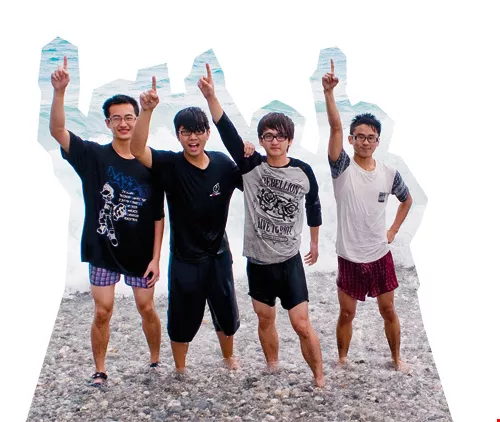
“Taiwan’s educational system derails kids’ dreams the minute they finish primary school,” says Chu, himself a graduate of the electrical engineering department at National Central University. Children are encouraged to write essays on their dreams and aspirations, but once they start making their way up the educational ladder, very few take the time to think about who they are and what they want to do with their lives.
Born in 1975, Chu has become almost legendary for dreaming big. His childhood ambition was to earn NT$10 million because, as he thought then, anyone with a “price tag” that high must be making a tremendous contribution to society. When the popularity of his translation of The Lord of the Rings trilogy enabled him to achieve his goal at the age of 27, he discovered that this wasn’t necessarily the case.
“I realized that the correspondence was a lot looser than I’d imagined. I ended up with NT$10 million through luck. Even though everyone thought I had earned it, I knew that I hadn’t grown that much.”
He decided to spend everything he’d earned on efforts to change society. He established a foundation, promoted a program creating Mandarin translations of “open university” courses from US universities such as MIT, and began giving lectures around Taiwan. Over the last 10 years, his core aspiration has become clearer: “Share knowledge and try to ignite the passions of others.”

Volunteering can help people discover their interests and develop their aspirations. Shown here, young people from Taiwan help Nepalese villagers clear a firebreak to protect their community.
Monica Chiu, former marketing director of 104 Job Bank, is known as an employment expert. After graduating from the Art Institute of Seattle and returning to Taiwan, Chiu went to work for a design studio. She then moved on to a position as an English-language secretary for an advertising agency, where coworkers joked that she was a “translation machine.” Looking for greater challenges, she changed tracks, taking a sales job with Just Gold, where she discovered a talent for marketing and public relations.
But it wasn’t until she went to work for 104 Job Bank that she discovered her true aspiration: helping others find their direction in life and realize their dreams.
At root, both “dreams” and “aspirations” involve personal development. But do the two words describe different things?
Kevin Zang, editor-in-chief of Career magazine, believes that “aspiration” connotes an orientation and is therefore more concrete. It relates to both your career choice and social expectations of the kind of person you should be. “Dreams” are more romantic and less tangible. They are an amplification of your interests, and more likely to be larger and less practical than aspirations. Nonetheless, Zang sees them driving us forward and giving us something to have faith in.
Tom Wang, a noted author and founder of the Dream School, says that both aspirations and dreams have a “futurity” about them, but aspirations indicate a direction, while dreams are the tangible end you hope to achieve by moving that way.
Jou Yi-cheng, a key figure in the Wild Lily Student Movement who went on to found the Third Society Party, views the issue from the standpoint of public interest. He sees aspirations as necessarily benefiting others, because if they didn’t they would be mere ambitions. Dreams, on the other hand, originate with the self and require the courage to face any obstacle. In his view, if your goals are only concerned with meeting the expectations of others, they aren’t dreams, they’re just vanity.

Taiwan’s “creativity market” is blossoming as today’s young people fashion more personal, more “small joy” oriented aspirations.
There will probably never be a single “correct” definition for the two terms because the question of how to live your life is itself open-ended and influenced by your interests, personality, economic circumstances, and educational attainments. In the case of the earlier generations, traditional values and the expectations of parents and teachers were important as well.
Zang, who is on the frontlines of career trends, says that Taiwanese society used to be almost universally conservative and strongly emphasize educational attainment. The aspirations of people born in the 1940s, 50s, and 60s tended to be determined by the entrance exam scores needed to get into different universities and departments, or by their parents’ expectations. Very few people had the opportunity to choose for themselves.
Author Hou Wenyong, a former attending anesthesiologist with National Taiwan University Hospital who was born in the 60s, says his teachers didn’t approve of his childhood passion for writing. “You’re so smart,” they told him, “why don’t you do something more useful?” Feeling pressured, he did as his parents and teachers expected, and tested into medical school.
Hou would go on to be a doctor, author, PhD student, and university educator before completing his doctorate in clinical medicine at the age of 36. After discussions with his dentist wife, he decided to give up medicine for a career in literature because “I felt empty inside in spite of everyone thinking I was successful. And the flip side of having done so many things is that I’d never really devoted myself to any of them.”
Over the last decade or so, the diversification of routes into university has loosened social strictures on career choices and “career education” has blossomed. The spread of alternative methods of university admissions exemplifies the trend: students who want to have a reasonable shot at getting into a university must really explore their interests and figure out what they want to study early on.
The change in social attitudes has greatly affected the current generation of young people’s choices. Professionals like the renowned Chef Ah-chi, master baker Wu Pao-chun, and clothing designer Jason Wu have become “job-market idols” for the kids of today.
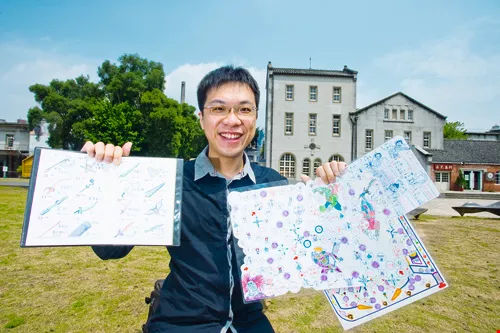
Toy and game designer Box Lin holds draft drawings for a Monopoly-type game and a toy he created as a child. His passion for toys and games remains undimmed.
Today’s youth may be drawing from diverse values to chart their courses through life, but larger environmental factors are in many cases resulting in identical aspirations.
A 2009 survey by the Directorate-General of Budget, Accounting and Statistics on the state of Taiwan’s young people found that those aged 25–29 had a labor-force participation rate of 86.42%. It found further that more than 60% of these new workers were employed in the service sector.
A report just published by 1111 Job Bank entitled “The Employment Situation of New Graduates in 2012” similarly found that new entrants to the workforce most desired to work in “commercial services” (56%, including fields such as investment and insurance), followed by “IT/technology” (47%, including fields such as semiconductors and optical communications) and “retailing/consumer services” (44%, including fields such as hospitality services and tourism). That is, two of the top three sectors were service-related.
Jou Yi-cheng, who once headed the Democratic Progressive Party’s youth division, says that his generation (those born in the 1960s) grew up in a relatively stable, prosperous society, and never experienced the travails of war or true poverty. He argues that people born in the 1970s, 80s, and 90s, are even further removed from the hardships of the war era.
There have been dramatic changes in both Taiwan and the world since the late 90s. Here in Taiwan, negative factors such as the offshoring of manufacturing, the bursting of the dot-com bubble, and the global financial crisis have slowed economic growth, driven unemployment higher (it’s around 10% for young people), and stalled wage growth.
Faced with such tough challenges, a naïvely optimistic younger generation that had never known material want now finds itself at a loss. Many of its members have responded by shrinking their worlds and pursuing so-called “small joys.”
This attitude is most often expressed via consumption in the pursuit of happiness. In the working world, it takes a somewhat different form: seeking “interesting, creative, and undemanding work” without regard to salary or future prospects.
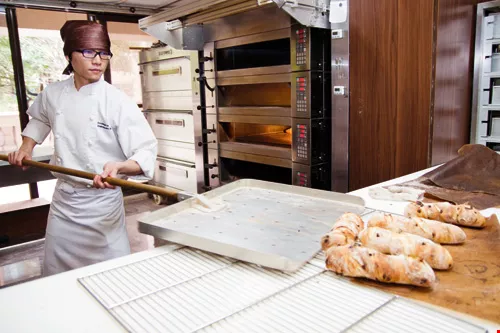
Young people have been inspired by the many Taiwanese bakers who have been bringing home titles from international competitions. The photo shows Justin Wu, a 26-year-old baker who won a prize for sweet pastries at France’s 2011 World of Bread competition.
The older and younger generations may have grown up in different eras, but are linked on an aspirational level by the shared desire of their members to go into business for themselves. However, the business model that today’s young people have in mind has little to do with dashing around the world or building an industrial empire in the manner of Taiwan’s tech titans. Instead, they want to establish businesses that let them “be themselves.”
A 2011 survey by 1111 Job Bank on the entrepreneurial desires of working persons found that 79% of working individuals were interested in going into business for themselves. The survey further revealed that the desire took root at an average age of 27.84 years, and focused primarily on restaurants, personalized products, online shops, and cafes.
Box Lin (born in 1984) enrolled in the master’s program in toy and game design at National Taipei University of Education following his graduation from the mechanical engineering department of National Central University. The decision made his mother, who had hoped he would find a steady job in technology, weep. Lin tried to console her by telling her that he’d been wanting to open a toy shop since kindergarten. “I’m not fooling around,” he said. “I’m pursuing a lifelong dream.”
He’s not just blowing smoke. Lin has actually founded three companies since turning 25, all of them related in some way to the training he received in his toy and game creation and design courses.
“My generation really needs ‘space to breathe,’” he says. “We’re not like our parents, content to grow old working for some organization, every day almost identical to the one before it. We see going into business as a way of expressing ourselves.”
This kind of thinking happens to be exactly in line with the observations of American psychologist Jean Twenge, author of Generation Me. Data from more than 1 million questionnaires and a decade-plus of research revealed that “Generation Me” (young people born since 1970) shared a number of characteristics, including self-centeredness, self-confidence, creativity, imagination, distrust of authority, and the courage to embrace their ideals, as well as a corresponding aversion to facing reality and an insufficient sense of responsibility.
Career’s Zang observes that today’s young people are particularly sensitive to their “return on investment.” Just as people on Facebook expect friends to immediately “like” their posts, young people today expect good performance in the working world to yield an immediate return.
“Unfortunately, there are fewer opportunities nowadays,” says Zang, “and many people can’t help but think, ‘If I’m only going to be a poorly paid assistant anyway, why not strike out on my own? Even if I don’t earn much of anything, I’ll at least be running my own business and won’t have to answer to a boss.’”

Hundreds of aspiring young dancers turned up to audition for parts in Dancing Diva, a Broadway-style spectacular planned by advertising professional Jerry Fan and others as a vehicle for young dance performers.
In the eyes of earlier generations, the younger generation lacks ambition and will, and its aspirations tend to be “soft.” Foxconn chairman Terry Guo is among the critics: “In Taiwan today, many young people are satisfied with nothing more than opening a coffee shop. What are they thinking?”
Guo’s criticism got under the skin of many of his targets, who retort by mentioning the “bomb generation” theory of Academia Sinica research fellow Lin Thung-hong, who is himself a child of the 1970s. Lin points out that in the early 1990s the business birth rate in Taiwan was 13%, versus a business death rate of 3%. By 1999, following the wave of offshoring in manufacturing, the rates were in balance. Meanwhile, by 2006 the cost of starting a business had risen to NT$1.6 million, nearly four times the old average of NT$450,000.
“The younger generation faces more difficult challenges,” says Lin. “The reason they are starting coffee shops and other micro-businesses is that, given their capital constraints, they have no choice.”
Lee Ming-tsung, a National Taiwan University professor of sociology who is also a child of the 1970s, analyzes the situation from the standpoint of “transforming values.” He says that since the 80s, the heart of the collective identities of European, American, and Japanese societies has transitioned from “work ethics” to “consumption aesthetics.” By “work ethics” Lee means basing your identity on your work, and using the act of settling down into a job as the basis for following the usual track through life: promotions, marriage, and bearing and raising children.
Consumption aesthetics, on the other hand, encourage self-awareness and emphasize marching to your own tune rather than reflexive value judgments and ethical standards. “Isn’t the yearning of young people to open cafes and boutiques, run online auctions, or become opinion-making bloggers an aesthetic choice?” asks Lee.
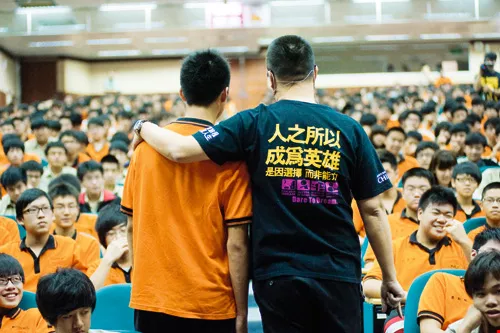
Lucifer Chu (right) has given lectures at more than 300 high schools around Taiwan in an effort to inspire young people to pursue their passions. The photo was taken at Taipei’s Da’an Vocational High School.
The “soft aspirations” trend is therefore arguably a natural consequence of social development. Long interested in social issues, Jou Yi-cheng is concerned: “I’m worried that today’s soft, inward-looking young people may not have the organizational and decision-making skills needed to address the food shortages, economic implosions, and political crises of the future.”
Jou currently runs Art Yard, a business in Taipei’s Dadaocheng area that offers him a means to act on his concern for culture. Recalling his experience founding the Third Society Party, he says: “It was the sort of thing you know you can’t do but do anyway. Changing society is a slow, accretive process. Failure is a step in that process, and I was looking for a kind of ‘noble failure.’ [I also felt that] young people needed to experience that kind of thing at first hand at least once in their lives.”
Tom Wang has a more positive take. He says that he’s seen many young people at the Dream School willing to commit themselves to public-spirited endeavors and international issues. Even given the current, less-than-ideal state of the world, young people today live in a technologically, economically, and intellectually liberal society, which gives them advantages that their elders did not have.
“We live in a time when someone can write an ‘app’ in their home, then sell it to the entire world,” says Wang. “It’s an era in which you can win recognition for everything from doing volunteer work, to writing a blog, to being an athlete. What’s key is your own abilities.”
Confusion as a starting pointJeremy Lin and Yani Tseng aspired to be athletes from an early age. Their brave pursuit of their dreams and their willingness to keep striving in the face of setbacks have inspired countless youngsters. Those who, like Lin and Tseng, have found their direction early in life should go for it. But those who haven’t needn’t worry: being confused now isn’t the end of the world.
“Confusion isn’t necessarily a bad thing,” says Wang. “It indicates that you’ve started thinking. The worst thing is to be resolute without having been confused, without ever having given the matter some thought. It’s sad when people simply follow a course that others have laid out for them, just tracking the herd.”
Take a tip from the T-shirt Lucifer Chu always wears for his lectures: “Heroism is a choice, not a skillset.” You’re young. Do you hear your inner voice calling?


@List.jpg?w=522&h=410&mode=crop&format=webp&quality=80)


