The Pioneer of Taiwanese Rock--Freddy
Chang Shih-lun / photos Yang Hung-hsi / tr. by Geof Aberhart
October 2005


Sometime after 10 one hot September night, in a crowded Taiwan Rock Alliance meeting room, a twenty-something host speaks to around a dozen of Taiwan's biggest concert promoters about his vision for music festivals. This meeting is an important step in his attempt to unite the industry and create a musical performance alliance.
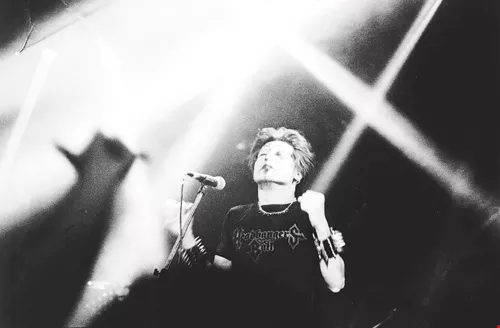
The next night, the same young man who 24 hours ago was chairing that meeting with his warmth and intelligence has undergone a transformation. On stage in a bar, made up like a corpse, Freddy snarls and sneers his way through a furious performance with the band ChthoniC.
Off stage, he is the man behind Taiwan's biggest music festival, the Formoz festival. On stage, he is the lead vocalist for heavy metal band ChthoniC and is known to his fans as the "King of Ghosts." He is Freddy--real name Lin Chang-tzuo--and he is acknowledged by young music fans as the most influential person in Taiwan's independent music.
Looking over Freddy's business card, one sees an array of titles--leader of ChthoniC, founder of The Wall, and organizer of the Formoz Festival. Not only is he the lyricist for his band, he's also the man responsible for one of Taiwan's grassroots live gig spots, and the brains behind a major music festival. In his three roles, Freddy is involved in all the different stages and levels of Taiwanese music, from the ground on up.
Already, ChthoniC has won a Golden Melody award for Best Rock Group; The Wall has become northern Taiwan's premiere place for live performances, and the Formoz Festival, which 10 years ago was a student event at a university, has become one of Asia's biggest music festivals, spanning three days and drawing crowds of over 50 thousand.
All of these have drawn attention to the island's independent music scene, and started from a festival of Freddy's at university.
As a child, Freddy studied classical piano, but when he started junior high school, he started getting into heavy metal. Where classical music stresses form and style, heavy metal is all about volume and tempo, and Freddy loved both, despite the apparent contradiction between the two. He found a strange kind of balance between the two when in university he started listening to black metal.
Freddy remembers that at first he just wanted to listen to a bit of music that was heavy and extreme, and he ended up coming across a lot of black metal. Within its musical structure, this particular genre not only employs standard rock instrumentation, it also puts to use a lot of classical methods. Through its use of strings and keyboards, it's able to bring out the symphonic elements of heavy metal. "It had the power of heavy metal with the structure of classical music. I fell in love with it on the spot," says Freddy.
As he listened to more and more, he gradually learned about black metal's origins in northern Europe, and the particular cultural background of the music. Before being influenced by and assimilated into Christian culture, northern Europe had already developed its own rich history, religions, mythologies, languages, and philosophical traditions. The black metal of northern Europe was an attempt to revive and return to that traditional culture, and so its lyrics were frequently written in the manner of classical literature, and were injected with liberal amounts of anti-Christian sentiment, historical and mythological references, and contradictions and death. Meanwhile the vocals were performed in high-pitched bellows and growls.
His love for black metal and the way it combined the ferocity of heavy metal with the complicated, symphonic elegance of classical music led to Freddy getting together with some friends in 1995 to form ChthoniC. But right from the start they found themselves facing the problem of importing the musical style without just copying their northern European counterparts. After all, Taiwan has its own historical and cultural background, and so Taiwanese black metal should focus on local themes and musical styles.
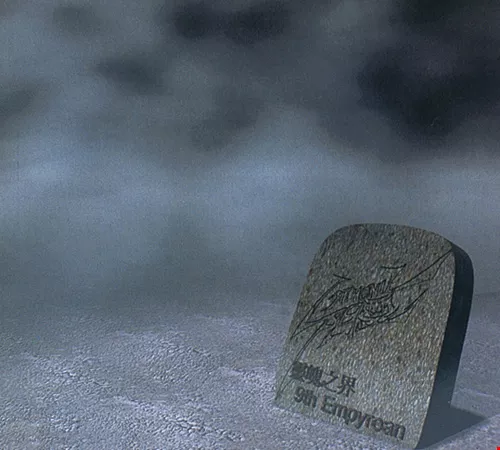
ChthoniC takes much of its inspiration from Taiwanese history. Thus far the band has released four albums (from left): Where the Ancestors' Souls Gathered (1999), 9th Empyrean (2000),Relentless Recurrence (2002),andSeediqBale (2005).
Freddy searched for the right instruments to use to inject an element of Taiwan's own plaintive musical forms into black metal, eventually settling on the melancholic, desolate sound of the erhu. "Not many people know this," he says, "but when I was in university, I wasn't in the Rock Club--I was actually in the Traditional Music Club."
To infuse their brand of black metal with appropriate historical overtones, ChthoniC's work has drawn liberally from Taiwanese history. In their 10-year history, they've released four concept albums. Where the Ancestors' Souls Gathered is the tragic tale of Chinese crossing the Taiwan Strait to flee the mainland. 9th Empyrean uses a mythological style to describe the battles between Chinese and Aborigines on the island. Relentless Recurrence builds on an ancient ghost legend passed down in Taiwan, and lyrically discusses faith in the cycle of life and death, and perceptions of good and evil. This finely crafted album was the one that earned the band the 2003 Golden Melody Award for Best Rock Band.
And just this year the band released their newest album, SeediqBale, which is based on the Wushe Incident and tells of the Aboriginal leader Mona Rudao and the resistance he led against the Japanese during their colonial rule of Taiwan. The album's title comes from a term meaning "real person" in the Aboriginal Sedeq language. A "real person" in Sedeq culture is one who fears neither the enemy nor death, and after their deaths, these people return to the Earth and the Ancestral Spirit.
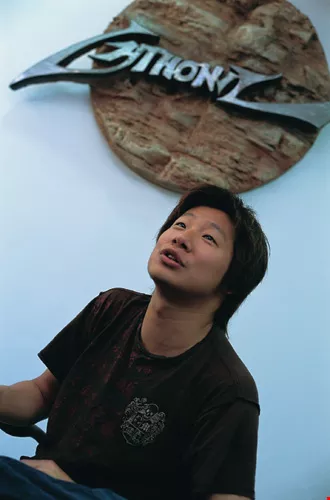
Off-stage, Freddy is a handsome, eloquent young man--a far cry from his fearsome on-stage persona. TRA Music, which he heads up, is one of Taiwan's most prominent promoters of the local music scene.
It's hard to imagine that handsome, eloquent Freddy and the ferocious, wild-eyed "King of Ghosts" are one and the same. When they're on stage, the members of ChthoniC are always made up with dark, gothic makeup. "That's because our music deals with issues of life and death, and this kind of look helps both the band and the audience get into the spirit quicker," he explains.
Most of Freddy's lyrics are written in a literary style, but the growling manner in which black metal lyrics are delivered frequently means that the audience can't clearly make out exactly what's being sung. But Freddy says that whether or not the vocalist is growling is less important than making sure the instrumentation is balanced, and that the feeling of speed and the majesty of the poetic structure can make themselves felt. As the vocalist, his singing and lyrics are only one part of the total package. And as such, with the vicious drumming, explosive guitar and bass, the elegant keyboard accompaniment, and the frequently sorrowful sound of the erhu, Freddy's howling tales of the fate of this little island seem kind of unimportant. The dark, moody music has already told us everything we need to know about life and death, existence and extinction.
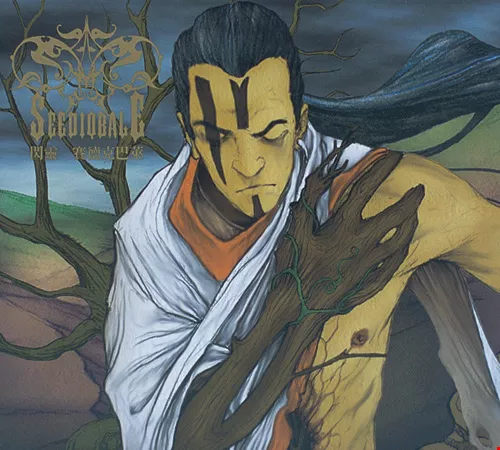
ChthoniC takes much of its inspiration from Taiwanese history. Thus far the band has released four albums (from left): Where the Ancestors' Souls Gathered (1999), 9th Empyrean (2000),Relentless Recurrence (2002),andSeediqBale (2005).
As a musician, Freddy's a success. But in recent years he's become more well-known to music fans as the head of the Taiwan Rock Alliance (TRA). The TRA is the organization behind the annual Formoz Festival, which was held for the 11th time this year. Every year it plays host to over 200 bands from Taiwan, Hong Kong, and Japan, and spans three days, with six stages going simultaneously and crowds as large as 50,000.
Formoz has become famous as an indie music event, but when it started 11 years ago, it was just an intercollegiate event held by the Northern Taiwan Rock Alliance. Open to the public each year, Formoz provided an annual opportunity for university student bands to take to the stage, as well as to learn from one another.
In 2000, ChthoniC was invited to play at the Fuji Rock Festival in Japan. After seeing the professional and structured way in which the festival was run, Freddy decided to kiss goodbye to the idea of staying amateur and establish a company dedicated to music. For naming this organization, they took their cue from the name of the previous organization, naming it the Taiwan Rock Alliance.
Under the auspices of the TRA, Formoz grew bigger and bigger, signing up more and more bands, and what started as a student gathering evolved into one of Asia's biggest annual rock festivals.
The 11th Formoz Festival was held at the Yuanshan Children's Recreation Center, and concertgoers were sitting or lying around the place, or wandering over to whatever stage took their fancy. Nearby, stalls sell self-published albums by the bands. When they'd had enough music for a while, attendees could go and watch some experimental cinema or wrestling, and if they got hungry, there were snacks a-plenty. "Formoz is built around the concept of letting people follow their own tastes," says Freddy, "so there are always a range of options going on around the venue. We always look at each year's festival as our own creation, and we pay attention to all the details."
Formoz also emphasizes a level of specialization in the event, meaning there are more dedicated rock fans in the crowds. They focus on fostering alternative music in Taiwan, and with the fertile field the Formoz provides, an independent rock culture is starting to gradually take root in the island.
.jpg?w=1080&mode=crop&format=webp&quality=80)
The members of ChthoniC have developed their own distinctive "undead" style and have provided inspiration to other artists. This picture is a piece depicting ChthoniC created by artist Evan.
If ChthoniC's own performances are at the grassroots of creative musical culture in Taiwan, then Formoz is the annual inspection of that very same culture. But most of the time, artists need a place to keep gigging and develop a depth and presence. To this end, Freddy established Zeitgeist in 2000. In 2003, he and some friends got together and renovated Zeitgeist, turning it into The Wall, in the hopes of providing a focal point for Taiwan's blossoming indie music culture.
The Wall covers an area of just under 1000 square meters and can accommodate a crowd of 650. As well as the permanent stage, The Wall is also home to a record shop, music classes, a restaurant, and an art gallery, bringing them together into an area of artistic fusion. In the time it's been running, it has gradually earned more and more of a name for itself, leading a massive number of acts, well-known and unknown, to take the stage in an almost endless flow.
Passion and spirit are something every young person has, but taking that and dedicating oneself to a goal heart and soul like Freddy has is something few people can do. In order to keep supporting the band and Formoz, Freddy's kept putting off his graduation, studying at university for a total of seven years so far. To make sure bands have a regular place to play, he mortgaged his own home without a second thought. People keep asking him what it is that drives him like this. Humbly, Freddy says, "I'm not interested in getting rich. I just want Taiwan's independent music scene to one day be as rich and vibrant as those in America and Europe. Our generation, the stuff we're doing, that's just planting the seeds for that."
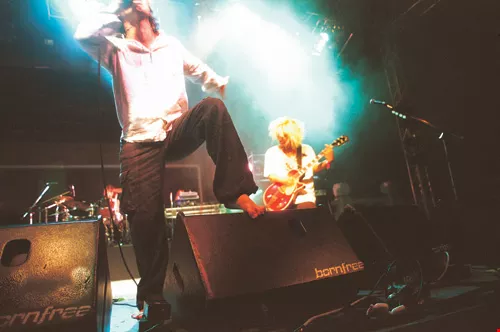
Every summer for the past 11 years TRA has held the Formoz Festival, which as well as being an excellent opportunity for Taiwanese rock bands to perform publicly, provides a platform for exchange between independent artists from around the world. This picture shows Japanese band The Back Horn, who performed at the 2005 Formoz Festival.
Every summer for the past 11 years TRA has held the Formoz Festival, which as well as being an excellent opportunity for Taiwanese rock bands to perform publicly, provides a platform for exchange between independent artists from around the world. This picture shows Japanese band The Back Horn, who performed at the 2005 Formoz Festival.
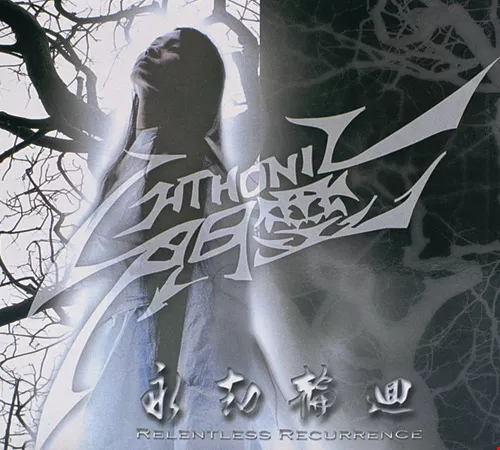
ChthoniC takes much of its inspiration from Taiwanese history. Thus far the band has released four albums (from left): Where the Ancestors' Souls Gathered (1999), 9th Empyrean (2000),Relentless Recurrence (2002),andSeediqBale (2005).
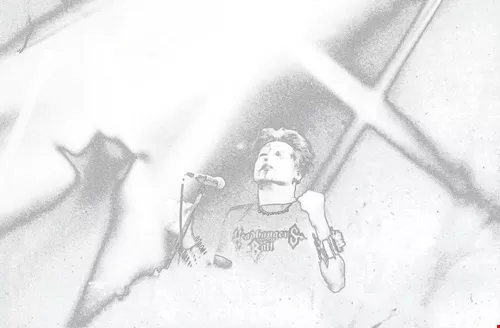
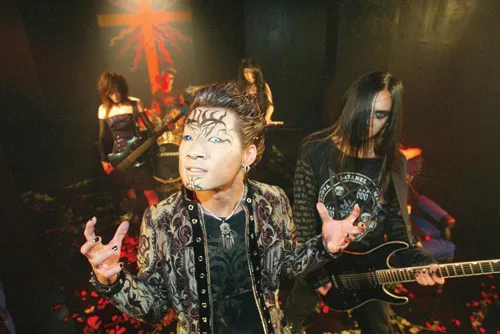
ChthoniC, formed 10 years ago, is Taiwan's premier heavy metal band. Lead vocalist Freddy (front) has been with the band throughout, but the remaining lineup has been through a number of changes. The current lineup consists of (from left) bassist Doris, drummer Dani, keyboardist Alexia, and guitarist Jesse.
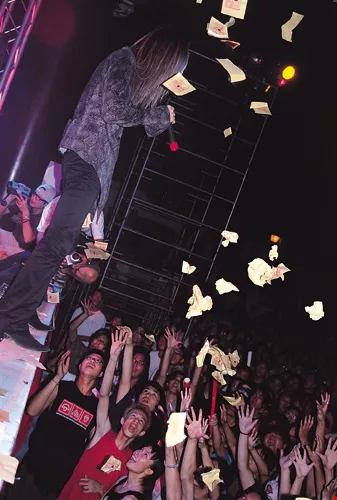
When ChthoniC performs, their passionate audiences prepare their own ghost money and cast it around while the band plays, giving the shows a unique atmosphere.
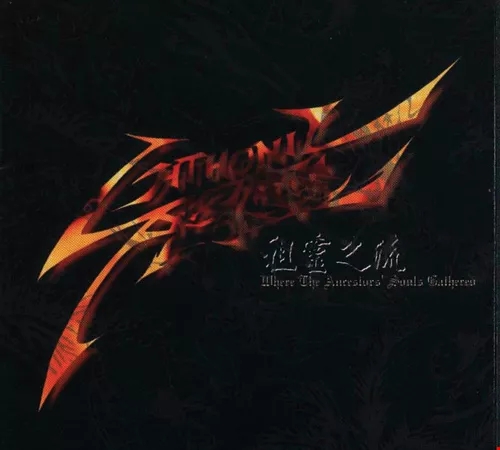
ChthoniC takes much of its inspiration from Taiwanese history. Thus far the band has released four albums (from left): Where the Ancestors' Souls Gathered (1999), 9th Empyrean (2000),Relentless Recurrence (2002),andSeediqBale (2005).

The Wall, situated in the Kungkuan district of Taipei, brings together live performances and the record, food and drink, and musical instrument industries in one place, and is currently Taipei's youth culture hub. The name "The Wall" was taken from the classic 1979 Pink Floyd album The Wall.

@List.jpg?w=522&h=410&mode=crop&format=webp&quality=80)


